
A new category is emerging

The rise of non-alcoholic and low-alcohol spirits on the global market isn’t a temporary phenomenon, and the trend is also strengthening in Hungary.
This article is available for reading in Trade magazin 2026/04

Attila Piri
marketing director
Heinemann Testvérek
“The trend toward low-alcohol beverages is also becoming more and more important on the domestic market”,
points out Attila Piri, marketing director at Heinemann Testvérek.
RTD products are the flagship of the low-alcohol category.
Products with a HoReCa focus

György Madalina
head of dry food
purchasing
METRO
In addition to their basic products, most spirit brands are already present on the domestic market with at least one or more reduced-alcohol, flavoured variants in order to reach as wide a consumer base as possible.
“METRO offers a selection of non-alcoholic products that can be used as ingredients in alcohol-free cocktails”,
explains György Madalina, head of dry food purchasing at METRO.
These products are mostly used as cocktail ingredients and growth is typically achieved through continuous innovation. Non-alcoholic spirits are primarily enjoyed on the HoReCa market at the moment.
Functional role

Beáta Harcsa
marketing director
Zwack
“The reason for the success of the no/low trend in the West may be the more developed aperitivo culture, conscious consumption, and stronger brand building. Low-alcohol products are more closely linked to the culinary experience, while no-alcohol drinks play a more functional role, for example when driving, doing sports, or aiding concentration”,
informs Beáta Harcsa, marketing director at Zwack.
Zwack’s portfolio includes the Tanqueray 0.0% alcohol-free drink, which is based on the same four quality herbs as the classic Tanqueray gin version.
Attila Piri adds it is unfortunate for the development of the domestic market that we are still at the basics of the category: we are in the education and awareness-raising phase. The objective of the category is clearly to provide the same social and cocktail experience as the alcoholic version, but without the effects of alcohol. The product range of the Sober Spirits brand is perfectly suited to this..
Moderation
Moderation is one of the drivers of declining consumption and spending on alcohol worldwide – for both health and economic reasons. Motivations and consumer behaviours vary significantly across markets and age groups.

According to data from the No/Low Alcohol Strategic Study, per capita pure alcohol consumption on the 10 markets surveyed has dropped 20% since 2000. Moderation affects all age groups, but is particularly strong among young people of legal drinking age: three-quarters of Generation Z who consume no/low products have moderated their alcohol consumption in the past six months. However, it is important to note that moderation among young people isn’t necessarily permanent.
Market, product offering and taste
The non-alcoholic segment is building an increasingly strong position in developed markets: retailers and bars are making more room for non-alcoholic alternatives. According to IWSR data, the non-alcoholic spirits category grew by 13% globally in 2024 (albeit from a low base) and by a further 10% in 2025. Experts forecast a 9% growth by 2026 and a total volume increase of 36% by 2029. The momentum of the category is also reflected in significant investments (Diageo, Rémy Cointreau, AG Barr), while the phenomenon of “zebra striping” is spreading: consumers alternate between alcoholic and alcohol-free beverages within a single occasion. The category can now be divided into two directions: one offers “0% equivalents” of well-known drinks (gin, vodka, and other spirit alternatives), while the other creates a new, independent style – the latter is inspired by aperitivo culture. One of the challenges for the sector is that the absence of alcohol makes it more difficult to give drinks body and aromatic complexity. The no/low offering in bars is also growing spectacularly.
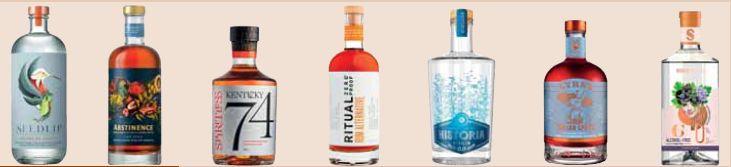
While most beverage alternatives can still be marketed as alcohol‑free ‘whisky’, ‘rum’, ‘tequila’ or similar, using descriptors such as ‘style’ or ‘type’, gin can no longer be referred to in this way. Whether to use a well‑known brand name or create an entirely new one is perhaps no longer even a question
Alcohol adjacent
According to the IWSR the No/Low-alcohol Strategic Study 2025, the no/low category continues to grow dynamically, with so-called alcohol adjacent drinks playing an increasingly prominent role, especially among young LDA (legal drinking age) consumers. Alcohol adjacent is a collective term for non-alcoholic, non-psychoactive beverages that are associated with alcohol consumption in terms of sensation, ritual, or function. In other words, they are products that evoke the experience of alcohol.
Alcohol adjacent products include CBD-containing, nootropic, and adaptogenic functional beverages, as well as non-alcoholic products that evoke alcoholic beverages in terms of taste and experience (botanical, bitter, fermented, or sparkling tea alternatives). The market for alcohol adjacent products grew by 11% in 2025.Among no-alcohol consumers the consumption rate of alcohol adjacent products was already 19% on the 10 leading markets in 2025, while in the US it was 33%. It is also prominent among Gen Z (30%). Market expansion is primarily limited by availability.
Related news
(HU) FruttaMax Gold szörpök
🎧 Hallgasd a cikket: Lejátszás Szünet Folytatás Leállítás Nyelv: Auto…
Read more >
Nappy market: forced to adapt
🎧 Hallgasd a cikket: Lejátszás Szünet Folytatás Leállítás Nyelv: Auto…
Read more >
Green light for SPAR’s new acquisition in Austria
🎧 Hallgasd a cikket: Lejátszás Szünet Folytatás Leállítás Nyelv: Auto…
Read more >Related news

Brake on Shein’s growth in Europe
🎧 Hallgasd a cikket: Lejátszás Szünet Folytatás Leállítás Nyelv: Auto…
Read more >
GKI: High base rate, low inflation?
🎧 Hallgasd a cikket: Lejátszás Szünet Folytatás Leállítás Nyelv: Auto…
Read more >
Lidl sold nearly 100 million liters of Hungarian milk
🎧 Hallgasd a cikket: Lejátszás Szünet Folytatás Leállítás Nyelv: Auto…
Read more >
