
Manpower: More than a third of domestic companies plan to increase staff in the next quarter

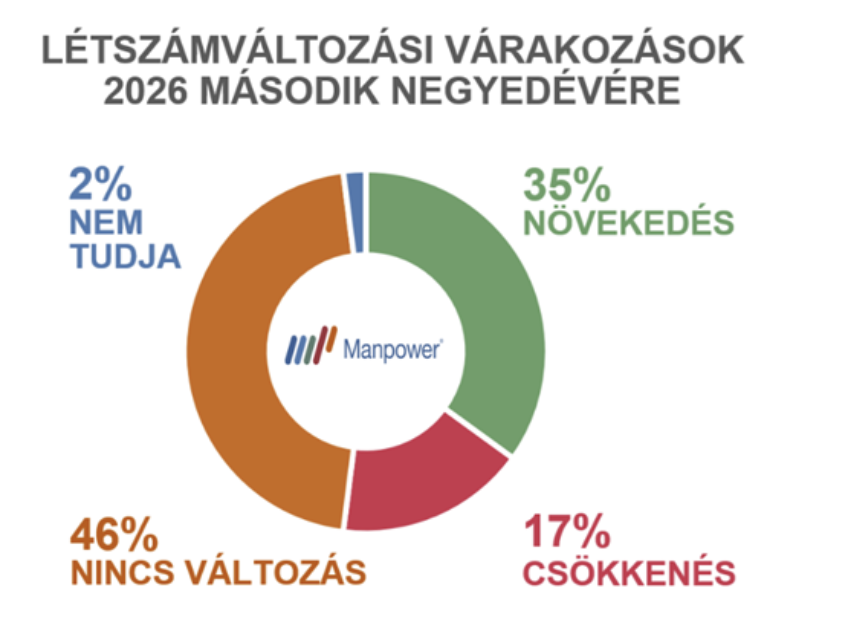
The employment plans of domestic companies show improving prospects: in the second quarter of 2026, 35 percent of Hungarian employers plan to expand their current workforce, while only 17 percent predict a reduction – according to the Labor Market Forecast published by Manpower Hungary today.
ManpowerGroup conducted its quarterly survey among nearly 42 thousand employers in 42 countries around the world, in which a representative sample of 540 employers in Hungary were asked about their hiring intentions for the second quarter of 2026.
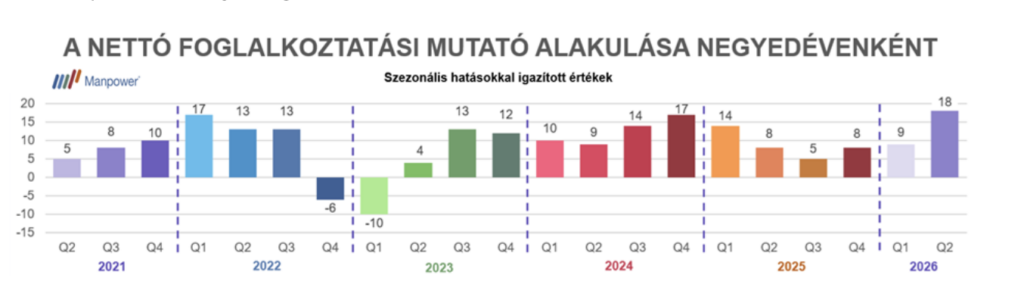
The Net Employment Indicator (NEI), derived from the difference between the number of companies forecasting an increase or decrease in headcount and then adjusted for seasonal effects, reached an average value of +18 percent, which is 9 percentage points higher than the previous quarter’s value and 10 percentage points higher than a year earlier.
“Such a large shift clearly indicates the growing optimism of domestic companies regarding the revival of their markets and the expansion of their economic scope – points out Péter Varga, Managing Director of Manpower Hungary. – In particular, companies operating in the construction and real estate, trade and logistics, and financial sectors may start recruiting more actively in the near future. The fact that a large proportion of key sectors are planning to increase their staff numbers also indicates a positive change, “The number of companies planning to hire increased to an average level in sectors such as the automotive industry and IT, as well as in manufacturing, which employs a significant workforce.”
A closer look at the individual sectors reveals that there are significant differences between the different industries. The growth in headcount may be well above average in the construction and real estate (NFM: +30%), trade and logistics (+27%), and finance and insurance (+27%) sectors, but companies operating in technology companies (+26%) and automotive (+25%) also plan to increase their number of employees in large numbers. The increase in staff numbers may be around average in the areas of utilities and natural resources (+20%), manufacturing (+18%), and catering (+15%). A smaller than average shift can be expected among organizations in public services, health and social services (+9%), and a net decrease in staff numbers is even possible in the area of professional, scientific and technical services (-2%).
The differences may also be significant between individual regions of the country. Employers’ expectations are above the national average in Southern Transdanubia (NFM: +42%) and Budapest (+21%), while companies in Southern Great Plain (+5%) expect only a minimal increase in staff numbers. In the other regions, slightly below the average, 11-17 percentage points, more people are planning to increase their workforce than layoffs.
Overall, there is an intention to increase staff in all categories based on company size, with the highest proportion of companies with 1,000-5,000 employees planning to expand. (NFM: +42%).
Compared to the previous quarter, the outlook for labor market movements has also improved internationally. The indicator is currently very high, at 31 percent, which is 6 percentage points higher than the previous quarter. A significant decline is not expected in any of the 42 countries examined, but among the neighboring countries, companies in Romania (-5%) and Slovakia (+3%) cannot expect a significant increase in staff overall. In Europe (+21%), the expectation is somewhat lower than the world average, with Sweden (+39%), the Netherlands (+37%) and Ireland (+36%) planning to expand their workforce the most on the old continent. Outside Europe, employers expect the largest increase in staff numbers primarily in India (+68%), the United Arab Emirates (+60%), Brazil (+55%), India (52%), Panama (+44%) and Costa Rica (+43%). The corresponding indicator for the United States also increased significantly, from 27 to 38 percentage points.

Related news

Recent research examined young people’s career choices
🎧 Hallgasd a cikket: Lejátszás Szünet Folytatás Leállítás Nyelv: Auto…
Read more >
It’s time to redefine work – AI can help
🎧 Hallgasd a cikket: Lejátszás Szünet Folytatás Leállítás Nyelv: Auto…
Read more >
Profession.hu: It takes less time to find a job today than a year ago
🎧 Hallgasd a cikket: Lejátszás Szünet Folytatás Leállítás Nyelv: Auto…
Read more >Related news

KSH: in February the foreign trade surplus for goods was 665 million euros, the volume of exports was 2.3 percent lower, and that of imports was 6.7 percent higher than in the same period of the previous year
🎧 Hallgasd a cikket: Lejátszás Szünet Folytatás Leállítás Nyelv: Auto…
Read more >
REGIO Játék: Families spend a maximum of ten thousand forints on Easter gifts
🎧 Hallgasd a cikket: Lejátszás Szünet Folytatás Leállítás Nyelv: Auto…
Read more >
Péter Szijjártó: the domestic food industry is further strengthened with the investment of SUGO FOOD Kft. in Baja
🎧 Hallgasd a cikket: Lejátszás Szünet Folytatás Leállítás Nyelv: Auto…
Read more >
