
Precision farming makes the world more livable and better

Precision farming makes the world more livable, better and safer, said Greyhound Minister István Nagy on Tuesday in Kecskemét.
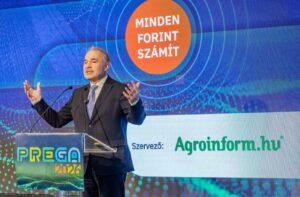
(Photo: AM/Tibor Vermes)
At the professional forum dealing with precision farming and agricultural informatics, at the PREGA conference and exhibition held for the eleventh time this year, István Nagy spoke about how agriculture is often mentioned as the cause of climate change, even though the players in the sector are part of the solution. Those who live in nature, near nature and from nature have a fundamental interest in preserving the quality of the created world. That’s why improvements are of the utmost importance, which is clearly shown by the fact that in 2025 Hungarian farmers bought HUF 163.5 billion worth of machinery and equipment, 21 percent more than in 2024, the minister said, adding that this represents a huge change in quality.
István Nagy explained: the fact that the competitiveness of the Hungarian agriculture and food industry is at a disadvantage compared to EU competitors has historical reasons
After the regime change, the food processing plants, which were becoming outdated, were privatized due to lack of funds. The government at the time hoped that the investors would renovate it and “the food industry would soar again”. On the other hand, in addition to closures and liquidations, Hungarian agricultural products were taken as raw materials to foreign parent companies, processed there, and the finished, expensive food was brought back to Hungary, he said. Later, in 2004, when distributing the first European Union funds, the government prioritized support for the social sector instead of economic revitalization. As a result, Hungarian agriculture continued to produce mainly raw materials and basic materials, which have the lowest income-generating capacity, he added. “During my ministry, the government made a historic decision to raise the level of national co-financing to the maximum level, 80 percent, in addition to the new European Union fund,” he said, pointing out that thanks to this, three times more funds can be provided to the entire agricultural and food industry in order to make up for the previous backlog of the processing industry, the food industry, and cold storage capacities. In practice, this means that 80 euros out of 100 euros are provided by the national source, so the government provides it, and 20 euros by the European Union, which triples the available resources, he said. This system supports farmers’ investments, renews the Hungarian agricultural and food industry, and supports the development of precision farming, he underlined. He emphasized: 2026 is the “year of construction”, since 90 percent of the available funds have already been tied up with supporting documents, which clearly shows the outstanding application activity of the farmers. The oversubscription for the modernization of livestock farms and the development of food industry farms clearly proves that farmers want to develop and “move forward”. As a result, by 2030, the Hungarian agricultural and food industry can be at the forefront of Europe – said István Nagy.
The minister emphasized: “working hands and educated people” are essential for the agricultural and food industry.
He also talked about how one of the most important tasks of the 21st century agricultural engineer is to process and organize data, draw conclusions and make the right decisions based on them. It is no coincidence that the government transformed agricultural university education, since the expectations of agricultural engineers have changed significantly since the nineties, he explained. Today, the profession and the sector both need well-prepared specialists who are able to move the sector forward in accordance with the challenges of the times and to find the most appropriate solution in the given situation, he added. István Jakab, the vice-president of the Parliament and the president of the National Association of Hungarian Farmers’ Associations and Farmers’ Cooperatives (MAGOSZ), spoke about how, by fulfilling the duties of the president of the National Agricultural Advisory Board, they strive to make modern knowledge a part of everyday life, and to ensure that every farmer gets the information and skills that are the basis of competitiveness. According to him, Hungarian farmers are facing serious challenges. In addition, a generational change is also necessary, which enables young people to take over the management of the farms, continuing the work with a new approach and dynamism. The government therefore made the necessary decision, and farm transfer support is underway, which allows older farmers to leave, giving space to young people, while they can continue working in the framework of family farming, he explained. He recalled that more than 1,700 applications have already been received within the framework of the program, while in Brussels they are still thinking about how to transform the support system to “put the young people in a position”, István Jakab said. Bence Bolyki, the managing director of Agroinform.hu, which organized the conference, recalled in his welcome that the first conference was organized in 2015, the mission of which was to help players in agriculture make better decisions and make better deals. He pointed out that last year a total of 34,000 registrations were received for their various conferences, which indicates that there is still a demand for serious professional presentations. The two-day PREGA conference and exhibition will take place in Kecskemét on February 10 and 11 with around 700 participants and more than 110 speakers.
AM/MTI

Related news

AM: agricultural support to reach tens of thousands of producers in the coming days; Ministry of Agriculture helps farmers with accelerated payments
🎧 Hallgasd a cikket: Lejátszás Szünet Folytatás Leállítás Nyelv: Auto…
Read more >
Imre Hubai: Hungarian agriculture is capable of renewal
🎧 Hallgasd a cikket: Lejátszás Szünet Folytatás Leállítás Nyelv: Auto…
Read more >
Ministry of Agriculture has started the preparation of a new state origin certification mark
🎧 Hallgasd a cikket: Lejátszás Szünet Folytatás Leállítás Nyelv: Auto…
Read more >Related news
Asda And Podback Recycle 20 Million Coffee Pods In First Year Of Partnership
🎧 Hallgasd a cikket: Lejátszás Szünet Folytatás Leállítás Nyelv: Auto…
Read more >
Danone buys meal-replacement firm Huel
🎧 Hallgasd a cikket: Lejátszás Szünet Folytatás Leállítás Nyelv: Auto…
Read more >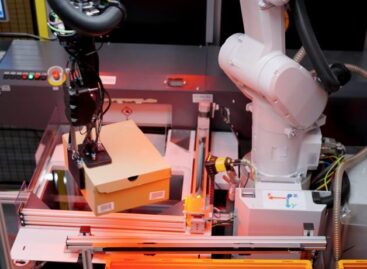
Zalando is scaling up its use of AI-powered warehouse robots
🎧 Hallgasd a cikket: Lejátszás Szünet Folytatás Leállítás Nyelv: Auto…
Read more >
