
Teleworking has proven successful for more than a quarter of Hungarian companies, and they do not intend to change their practices in the next year or two

According to the GKI survey, 27% of companies provide the opportunity for at least some of their employees to work from home. The home office has therefore become a stable but highly segmented form of employment in Hungary. The prevalence of working from home is outstanding in the service sector and is almost not at all typical of the construction industry. Large companies are most willing to use this form of employment, 83 percent of them use teleworking. Three-quarters of companies do not intend to change their practices in this regard in the next one or two years.
 Regular working from home was previously only available to those practicing a few professions. These included, for example, those working in IT and technology jobs, those engaged in creative and intellectual freelance work, those performing consulting and analytical work, private tutors, and those engaged in administrative background work (data recording, accounting, etc.).
The Covid-19 epidemic has thoroughly redrawn the map of domestic teleworking
The spread of broadband internet has broadened the range of tasks that can be performed in teleworking, and the coronavirus epidemic has also made it necessary for employers to use teleworking. In essence, wherever possible, employees were sent to telework. The epidemic did not invent it, but rather massified and normalized what had previously only existed in a narrow circle. As the pandemic passed, the role of working from home decreased, but hybrid models have remained present ever since: the number of people working partly from home and partly in the office is currently much higher in Hungary than before the epidemic. According to the data from the KSH labor force survey, 8-10 percent of employees worked partly or entirely from home after the pandemic, compared to 3-4 percent before 2020. According to the latest statistical data, between August and October 2025, approximately 392 thousand domestic employees occasionally or regularly worked from home (also). This accounted for approximately 9 percent of the total number of employees.
A good quarter of domestic companies provide the option of a home office
In order to map the domestic prevalence of teleworking and the future of this form of employment, the GKI conducted a survey in the Hungarian business sector in December 2025. Those involved in agriculture and public services were also left out of the survey. Almost 1,500 business organizations provided evaluable answers during the survey. 27 percent of the responding companies provide at least some of their employees with the option to work from home. On average, this option covers roughly half of the employees in these companies. If we consider the total number of employees employed by all respondents as 100 percent, then 13 percent of employees, i.e. essentially every eighth employee, occasionally or regularly performs certain tasks from home. Since the incidence of home office is presumably much lower in the sectors not included in the survey, the sample analyzed by GKI can be considered representative in this respect.
Would you (also) work from home? Your place is in a large company
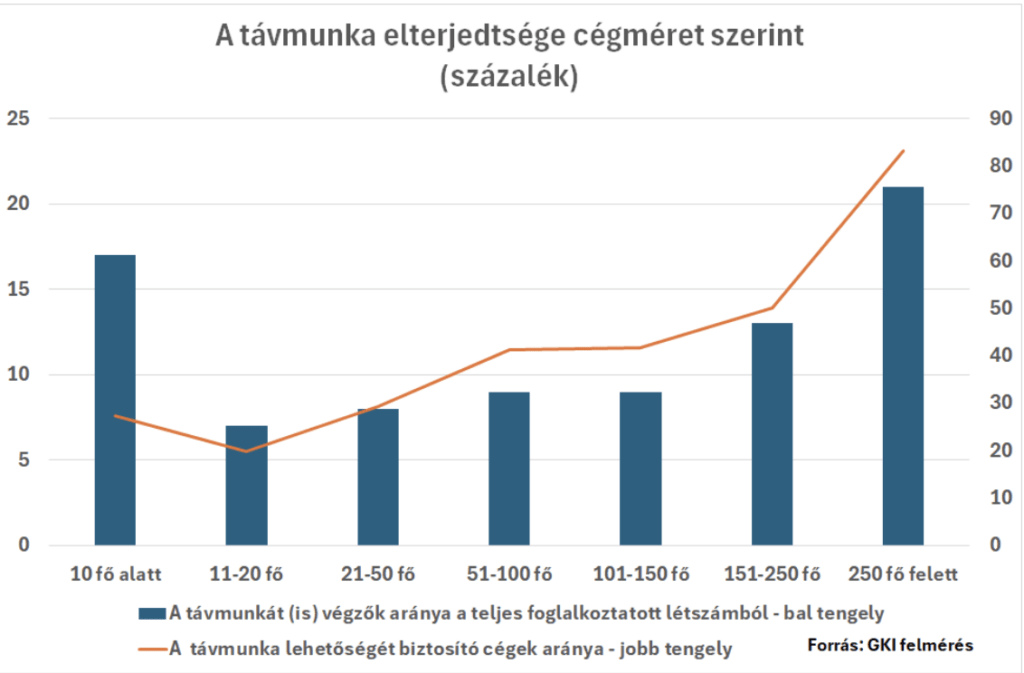
The proportion of companies that offer at least some of their employees the option of working from home is average among micro-enterprises with less than 10 employees (27 percent). However, in the case of larger companies, a correlation between size and the frequency of teleworking can be observed: as the number of employees increases, working from home becomes more and more common. The overwhelming majority, 83 percent, of companies employing over 250 people also employ teleworkers. At the same time, it is also true that micro-enterprises are the only group where, if a company employs teleworking, the majority of employees (two-thirds) can take advantage of this option. In the case of small, medium-sized and large companies, this option only extends to every third to fifth employee. If we consider the entire corporate sector as a base, it can be stated that 17 percent of employees in micro-companies, 13 percent of employees in companies employing between 150-250 people, and 21 percent of employees in large companies with over 250 people work from home at least occasionally. In companies belonging to other staff groups, this rate is below 10 percent.
The service sector is the big gun for home office
Related news

Although the business benefits of using AI are clearly visible, half of companies are still lagging behind
🎧 Hallgasd a cikket: Lejátszás Szünet Folytatás Leállítás Nyelv: Auto…
Read more >
Recent research examined young people’s career choices
🎧 Hallgasd a cikket: Lejátszás Szünet Folytatás Leállítás Nyelv: Auto…
Read more >
It’s time to redefine work – AI can help
🎧 Hallgasd a cikket: Lejátszás Szünet Folytatás Leállítás Nyelv: Auto…
Read more >Related news

Oat-based “feta” wins the cheese innovation competition of Lidl Germany and ProVeg
🎧 Hallgasd a cikket: Lejátszás Szünet Folytatás Leállítás Nyelv: Auto…
Read more >
The horticulture of the future is being built in Szentes
🎧 Hallgasd a cikket: Lejátszás Szünet Folytatás Leállítás Nyelv: Auto…
Read more >
Finger Food Experience
🎧 Hallgasd a cikket: Lejátszás Szünet Folytatás Leállítás Nyelv: Auto…
Read more >
