
Richárd Szabados: the Széchenyi Card multifunctional product package provides businesses with a solution for their specific life situations

The Széchenyi Card multifunctional product package enables businesses to find solutions to their specific life situations within the program – emphasized Richárd Szabados, State Secretary for the Development of Small and Medium-Sized Enterprises, Technology and the Defense Industry of the Ministry of National Economy (NGM) on Thursday at the event “Behind the Numbers: The Economic Impacts of the Széchenyi Card Program” in Budapest.
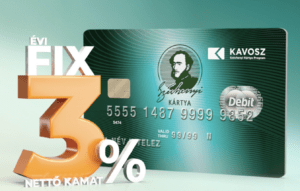 The State Secretary mentioned as an example that the Széchenyi Card products provide solutions They are useful if the business has liquidity problems, needs to finance investment ideas, needs leasing, or is unable to take out a larger loan due to the size of a start-up business.
He explained that due to the multifunctional nature of the Széchenyi Card, it can react quickly, for example to force majeure situations, damage events, and also provides room for maneuver in the case of a stagnant corporate credit demand market.
The Secretary of State explained that corporate credit demand is necessary for economic growth. The corporate credit market could be helped within the supported credit structure in the past year and a half.
Richard Szabados highlighted:
Széchenyi Card interest rates have been reduced in several areas, most recently on October 6th to 3 percent for all seven products, and there has been significant interest in the loans.
Last year, the total applications in the Széchenyi Card program were 2,200 billion forints, of which the contracted amount was 1,550 billion forints. The planned contracted amount this year is 2,000 billion forints, and the interest subsidy has been planned for this. This was 260 billion forints in 2025, and 320 billion forints are expected in 2026.
Richard Szabados also said that the Széchenyi Card Program is a unique product that we can “be proud of“. Foreign countries are also interested in its introduction, and he recalled that within Europe, there is a similar scheme in Germany and Poland, in which guarantor institutions offer subsidized loans to businesses in various forms.
The research of the Egyensúly Institute was presented at the professional event, according to which the Széchenyi Card Program operated by KAVOSZ Zrt. had a significant positive impact on the domestic SME sector and the Hungarian economy. State-supported schemes have effectively stimulated the competitiveness and financial stability of companies, having a positive impact of approximately 1.5 percent on the domestic GDP in 2025.
The research found that the Széchenyi Card Program is not only a support tool, but also a defining, stable pillar of business financing for the Hungarian economy.
The analysis shows that thanks to the program, the GDP level of the Hungarian economy increased by a total of approximately 4,500 billion forints between 2015 and 2025. The state-supported financing instrument encouraged an additional 1.5 percent GDP contribution in 2025. The schemes announced under the program have permanently strengthened internal demand, employment stabilization, and the income-generating capacity of the entrepreneurial sector. The program generated a total of approximately HUF 700 billion in tax revenue surplus between 2015 and 2025.
Related news

KSH: in February the foreign trade surplus for goods was 665 million euros, the volume of exports was 2.3 percent lower, and that of imports was 6.7 percent higher than in the same period of the previous year
🎧 Hallgasd a cikket: Lejátszás Szünet Folytatás Leállítás Nyelv: Auto…
Read more >
Confidence in the SZÉP card remains unbroken, with 18 percent more payments made with it in February
🎧 Hallgasd a cikket: Lejátszás Szünet Folytatás Leállítás Nyelv: Auto…
Read more >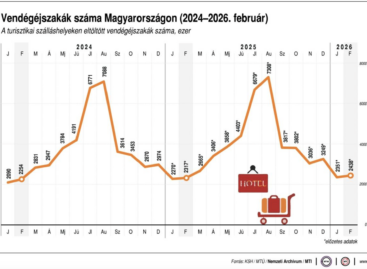
NGM: domestic tourism did not slow down in February either
🎧 Hallgasd a cikket: Lejátszás Szünet Folytatás Leállítás Nyelv: Auto…
Read more >Related news

BioTechUSA: a plant-based diet is an opportunity, not a risk
🎧 Hallgasd a cikket: Lejátszás Szünet Folytatás Leállítás Nyelv: Auto…
Read more >
They’re coming, crunching and munching
🎧 Hallgasd a cikket: Lejátszás Szünet Folytatás Leállítás Nyelv: Auto…
Read more >
Big shopping begins, trade is prepared
🎧 Hallgasd a cikket: Lejátszás Szünet Folytatás Leállítás Nyelv: Auto…
Read more >
