
PwC Hungary CEO Survey: Hungarian leaders focus on the imperative of technological transformation

Domestic business leaders are simultaneously faced with increasing short-term threats and the ongoing pressure of technological transformation, which requires a long-term, strategic focus. While they remain optimistic about the prospects for the global economy, growing uncertainty in the domestic environment dominates managerial thinking. According to the 15th CEO survey conducted by PwC Hungary in the fall of 2025, Hungarian CEOs spend 60% of their time on issues shorter than one year – much more than their peers worldwide – and thus have less focus on the longer-term, strategic issues of corporate viability, innovation and AI adaptation, which are increasingly on the agenda.
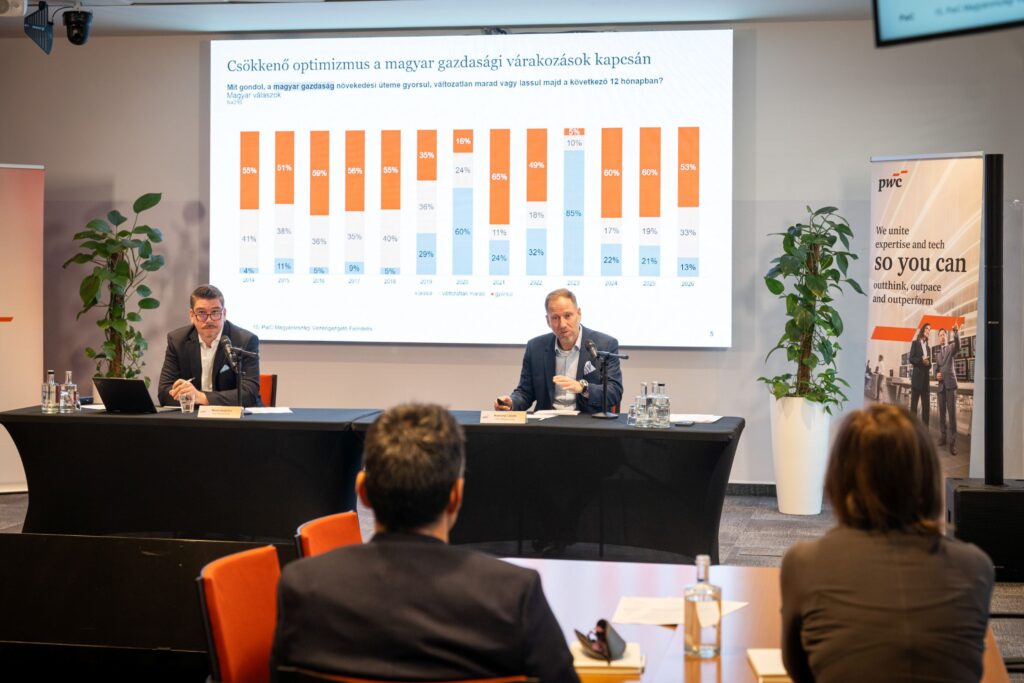
The 15th PwC Hungary CEO Survey main findings and results:
- The confidence of company leaders in the growth of their own company’s revenues has reached a 15-year low: only 31% expect growth in a one-year period.
- Managers are more optimistic about the acceleration of the global economy than about the increase in the growth rate of the domestic economy.
- In terms of economic indicators, they predict a EUR of 397 forints, 4.6% inflation and 1.5% GDP growth by 2026.
- The proportion of those who felt exposed to the various threats examined has continuously decreased in recent years. This has now reversed, with the proportion of those who perceive various external threats as a threat to their company increasing again. The list is topped by changes in the regulatory environment, inflation and macroeconomic volatility.
- “Am I transforming my business quickly enough to keep up with changes in technology, including AI?” – this is the question that most CEOs are asking; Meanwhile, 77% of them have not yet experienced the impact of AI on their company’s performance.
- Corporate transformation efforts are hampered by caution and risk aversion stemming from the economic outlook.
- A characteristic of CEOs’ everyday lives is that they can devote an average of 10% of their working time to long-term strategic decisions.
- Trust issues regarding companies have intensified: 81% of domestic leaders have noticed a need for greater transparency from their stakeholders regarding their company.
The duality of growth expectations: optimism regarding the global economy, domestic caution
Hungarian leaders are much more optimistic than their global counterparts when it comes to global economic growth: 71% are confident in its recovery, compared to international 61%, and only 5% expect a slowdown compared to the previous year’s pace. At the same time, the outlook for the domestic economy is already showing a more nuanced picture. Compared to the previous 60%, only 53% expect an acceleration this year, which clearly indicates a deterioration in confidence.
Companies’ revenue expectations are also more pessimistic than in previous years: only 31% in Hungary expect revenue growth for the next 12 months, which is the lowest value in the survey’s decade and a half history. The three-year horizon, however, is more optimistic, with around half of the managers being optimistic, both according to domestic (48%) and global results (49%).
The macroeconomic forecasts of company managers for the average exchange rate of the forint, inflation and GDP growth also reflect moderate confidence: this year’s predictions indicate an average exchange rate of 397 forints, 4.6% inflation and 1.5% GDP growth.
The domestic regulatory environment is the new number one risk
A turnaround has occurred in the assessment of threats: for the first time since 2023, the risk perception level of CEOs has increased noticeably. This year, the domestic regulatory environment topped the list of fears with 51%, ahead of inflation and macroeconomic volatility (both at 43%), and the proportion of those who fear geopolitical conflicts has slightly increased (from 36% last year to 37% this year), while cyber risk remains among the most significant threats at 37% (globally 31%). The proportion of those who fear the availability of essential skills has decreased significantly (44% → 32%) and the fear of technological disruption (35% → 24%).

Related news

CBAM finally has its effect felt in retail trade too
🎧 Hallgasd a cikket: Lejátszás Szünet Folytatás Leállítás Nyelv: Auto…
Read more >
AI is now a health advisor
🎧 Hallgasd a cikket: Lejátszás Szünet Folytatás Leállítás Nyelv: Auto…
Read more >
Dr. AI – Artificial intelligence instead of a healthcare professional?
🎧 Hallgasd a cikket: Lejátszás Szünet Folytatás Leállítás Nyelv: Auto…
Read more >Related news
TUTTI turns 40 – a defining Hungarian family company with development spanning generation
🎧 Hallgasd a cikket: Lejátszás Szünet Folytatás Leállítás Nyelv: Auto…
Read more >
The message of Hungarian business leaders for 2026: Consolidation instead of revolution
🎧 Hallgasd a cikket: Lejátszás Szünet Folytatás Leállítás Nyelv: Auto…
Read more >
ALDI will be on Sziget again this year
🎧 Hallgasd a cikket: Lejátszás Szünet Folytatás Leállítás Nyelv: Auto…
Read more >
