
PwC Global CEO Survey: CEO confidence at a five-year low

One of the strongest indicators in this year’s PwC Global CEO Survey is that the revenue expectations of CEOs have dropped to a five-year low: only 30% of respondents say they are very or extremely confident about their company’s revenue growth over the next 12 months (2025: 38%, 2022: 56%).
This article is available for reading in Trade magazin 2026/02-03
PwC’s 29th Global CEO Survey was conducted between 30 September and 10 November 2025, with 4,454 CEOs in 95 countries.

Spotlight is on the speed of implementation: CEOs say the pace of technological adaptation has become one of the key determinants of competitiveness – even as most AI investments have yet to show clear, tangible returns
AI: where is the return on investment?
According to the survey, CEOs are currently most concerned about whether they can transform their operations quickly enough to keep up with technological changes, including AI. While AI experiments are widespread, 56% of respondents reported neither revenue growth nor cost cutting in the past 12 months as a result of AI applications. The Hungarian summary adds an important layer: company executives who believe their organisation has a strong AI foundation are three times more likely to report meaningful financial returns. Businesses that widely use AI in their products, services and customer experiences achieve profit margins nearly 4 percentage points higher than those that haven’t yet done so.
Tariffs and cyber risks
This year’s survey narrative has seen a dramatic surge in the importance of external factors that not only put pressure on costs, but also reduce predictability. There is a mixed picture when it comes to tariffs: 20% of CEOs say their company is highly or very highly exposed to significant financial losses due to tariffs over the next 12 months, with exposure varying by region (e.g., 6% in the Middle East, 35% in Mexico and 22% in the US). Cyber risk has become even more prominent among the threats: according to the Hungarian summary, 31% of CEOs cite it as the main threat (up from 24% last year and 21% two years ago). It is no coincidence that 84% indicated that they would improve their company-level cybersecurity practices in response to geopolitical risks. 42% of executives said their companies had started competing in new sectors in the past five years – meaning that in many cases renewal has already translated into actual market steps.
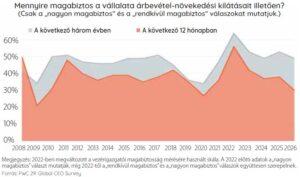
Five‑year trough: in 2026, only 30 per cent of CEOs say they are “very” or “extremely” confident about revenue growth over the next 12 months; their three‑year outlook has also become more restrained
Consumer markets: double exposure
The CEO Survey also shows that for firms closely linked to consumer goods and retail, geopolitical uncertainty quickly translates into margin, procurement and supply security issues. On the consumer markets sector 23% of CEOs said their companies would be highly exposed to tariffs over the next 12 months. Alongside tariffs, the preparedness of supply chains is also uneven: 33% of consumer markets executives indicated that they have defined processes in place to manage climate-related risks and opportunities in their supply chains. Taken together, these two figures show why dual adaptation will become a key issue in 2026: it will be necessary to respond to trade policy shocks in the short term and make procurement and logistics systems more stable in the medium term. PwC claims that in today’s environment, one of the keys to leadership agility is how quickly a CEO can switch between issues, opportunities and time frames.
Related news

Hungarians order with one sentence: this is how we shop with the help of AI
🎧 Hallgasd a cikket: Lejátszás Szünet Folytatás Leállítás Nyelv: Auto…
Read more >
Rozi: Rossmann has launched an AI assistant on shop.rossmann.hu
🎧 Hallgasd a cikket: Lejátszás Szünet Folytatás Leállítás Nyelv: Auto…
Read more >
Metro modernises fresh logistics with artificial intelligence
🎧 Hallgasd a cikket: Lejátszás Szünet Folytatás Leállítás Nyelv: Auto…
Read more >Related news
THE LATEST ISSUE OF TRADE MAGAZINE HAS BEEN PUBLISHED!
🎧 Hallgasd a cikket: Lejátszás Szünet Folytatás Leállítás Nyelv: Auto…
Read more >
Spring renewal: interest in surprising products increased in spring
🎧 Hallgasd a cikket: Lejátszás Szünet Folytatás Leállítás Nyelv: Auto…
Read more >
A new director will lead Nestlé’s factories in Szerencs and Diósgyőr from April
🎧 Hallgasd a cikket: Lejátszás Szünet Folytatás Leállítás Nyelv: Auto…
Read more >
