Mere in Lithuania: Rapid growth and a hard discount niche left open by Lidl

As Lidl continues its evolution toward a more supermarket-like proposition, Mere is advancing with a very different hard discount logic. Rapid growth in Lithuania suggests that an ultra-lean, branded, and low-investment model can still find demand alongside much larger competitors.

Sebastian Rennack
international retail analyst
Aletos Retail
Mere hard discounters in the Baltics are gaining momentum. In Lithuania, the Mere hard discount format has moved from market entry into a phase of rapid scale-up. Combined net revenue of Mere’s two operating entities, Valientė, UAB and Litproduktai, UAB, doubled to 82.2 million euros in 2024 from 41.9 million euros in 2021, according to the companies’ financial statements. This corresponds to an average annual growth rate of 24.8 percent in this period, underlining the sustained expansion of the format over multiple years. Growth has even accelerated further most recently, with combined revenues increasing by 32.7 percent year on year in 2024, pointing to rising commercial momentum rather than one-off external inflation effects.
The hard-discount newcomer, which launched operations in Lithuania in 2019, is growing noticeably faster than the country’s established market leaders. Maxima LT, Lithuania’s largest domestic retailer, increased revenue to 2.2 billion euros in 2024, representing year-on-year growth of 3.1 percent. Lidl Lietuva reached 889 million euros in revenue, with sales up by 2.1 percent year on year, underlining the markedly stronger growth dynamics of Mere, even considering its much smaller base.
Mere Lithuania reached break-even in 2023, marking the transition into a profitable operating phase. In 2024, Mere posted a net profit margin of 1.7 percent, compared with 5.6 percent at Maxima LT and 1.7 percent at Lidl Lietuva. While Lidl’s margin declined by 0.22 percentage points year on year, Mere improved profitability by 0.63 percentage points, raising the question of whether Mere, as the second discounter in the country, has identified a market niche that Lidl has left unoccupied.
To assess what Mere is doing differently on the shopfloor from established discounter Lidl, we visited Mere stores in Lithuania to analyze organizational and commercial concept differences directly in-store:
Mere focuses on structural simplicity and capital discipline over refinement or experience-led optimization.
Locations are without exception second-tier, typically reusing former retail units with existing parking infrastructure, enabling expansion without competing for prime retail space.
Store investments are kept to an absolute minimum. The shopfloor is organized around high racks and mono-pallet placements, with goods often moving directly from the goods receiving ramp onto the sales area. Price communication relies on simple A4 paper signage, while chilled containers, reused freezers, and checkouts taken over from previous tenants complete the functional setup. Local market experts estimate investment per store at only 20,000 to 30,000 euros, highlighting how sharply Mere reduces capital exposure at unit level.
The operating model is equally lean from a commercial perspective. Products are delivered directly by suppliers to stores, marking a fundamental difference from the centralized, private-label-driven distribution systems of international discounters. Mere’s assortment consists almost entirely of branded goods, predominantly B and C brands, while internationally known brands appear sporadically as temporary spot purchases rather than permanent listings.
Compared with store visits in 2022, the supplier landscape has shifted visibly. Russian suppliers have disappeared entirely, replaced by a broader mix of domestic Lithuanian producers and regional partners from Poland and Romania, alongside new entrants from Turkey and China. Roughly half of the assortment is allocated to ambient assortment, the other to detergents, cosmetics and household goods.
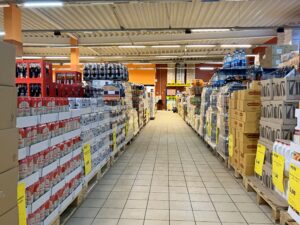
The store environment is minimalist, with no major investments in fitting or design elements
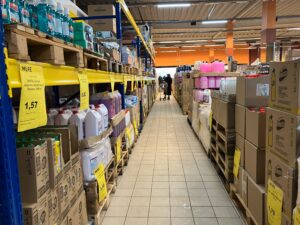
The first half of the store is dominated by detergents, cosmetics, and selected household non-food items
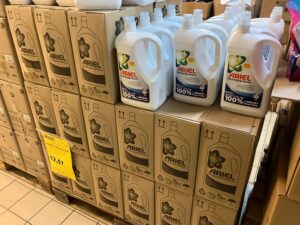
Right at the entrance, Mere signals affordability by featuring internationally known A-brands, such as Ariel Professional, visibly below market prices
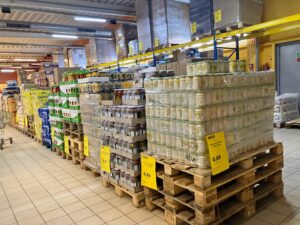
In ambient categories, the dominant merchandising principle is mono-pallet presentation with a single SKU per pallet
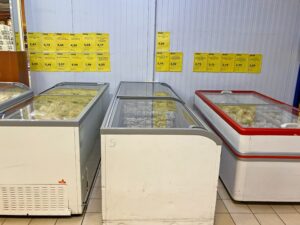
Frozen products are displayed in reused chest freezers, reinforcing the low-investment approach
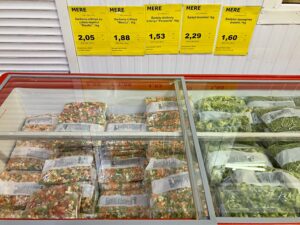
Standard pack sizes in this category are large, with one-kilogram formats prevailing
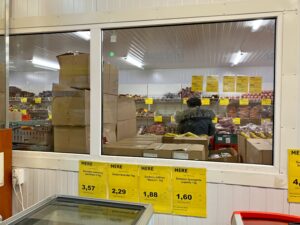
Chilled products are presented in a walk-in refrigerated container placed on the shop floor
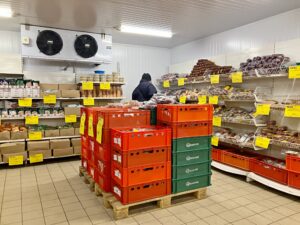
In the chilled categories, products are displayed directly in cardboard transport packaging, supplier crates or in dump bins
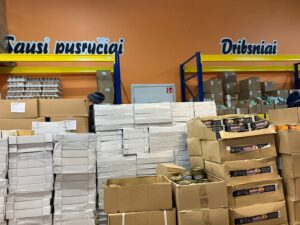
Wall elements still reference the building’s previous use as a grocery store
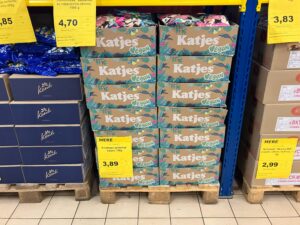
The confectionery section features a notable presence of internationally recognizable brands
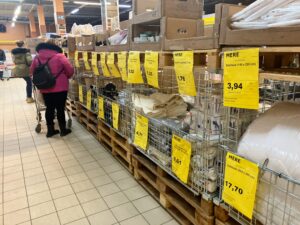
As a newly introduced impulse category, home textiles are placed centrally in the store and displayed in metal grid boxes
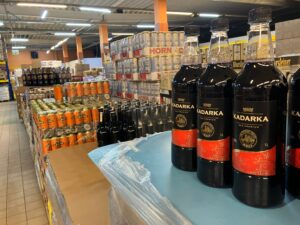
A substantial share of the selling space is allocated to beer and spirits, predominantly sourced from domestic producers
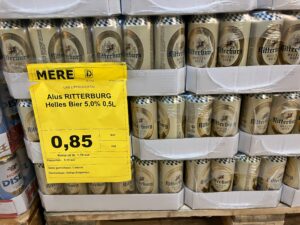
The beer brand “Ritterburg” (“Knight’s Castle”) draws on positive German beer associations, despite being absent from German grocery retail, and is produced by Lithuanian brewer Volfas Engelman
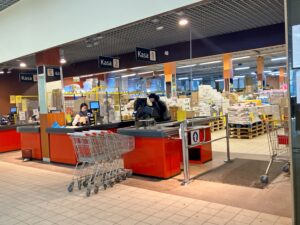
Checkout counters are inherited from the former retailer, further limiting capital expenditure at store level
Related news
Lidl Hungary achieved outstanding successes in supporting the domestic wine sector in 2025 as well
🎧 Hallgasd a cikket: Lejátszás Szünet Folytatás Leállítás Nyelv: Auto…
Read more >
Lidl’s kitchen and household brand has a new look
🎧 Hallgasd a cikket: Lejátszás Szünet Folytatás Leállítás Nyelv: Auto…
Read more >
Aldi tests “Compact 2.0” urban store concept at Warsaw transport hub
🎧 Hallgasd a cikket: Lejátszás Szünet Folytatás Leállítás Nyelv: Auto…
Read more >Related news
KSH: in February the foreign trade surplus for goods was 665 million euros, the volume of exports was 2.3 percent lower, and that of imports was 6.7 percent higher than in the same period of the previous year
🎧 Hallgasd a cikket: Lejátszás Szünet Folytatás Leállítás Nyelv: Auto…
Read more >
REGIO Játék: Families spend a maximum of ten thousand forints on Easter gifts
🎧 Hallgasd a cikket: Lejátszás Szünet Folytatás Leállítás Nyelv: Auto…
Read more >
Péter Szijjártó: the domestic food industry is further strengthened with the investment of SUGO FOOD Kft. in Baja
🎧 Hallgasd a cikket: Lejátszás Szünet Folytatás Leállítás Nyelv: Auto…
Read more >
