
Zsolt Pálinkás: “The inflation-induced strudel dough effect has become permanent”

Our magazine sat down for a conversation with Zsolt Pálinkás, the CEO of Tesco Magyarország.
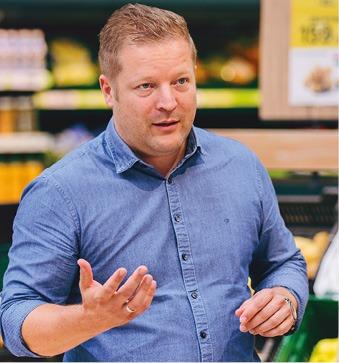
Where we placed a focus on growth, performance also began to improve — but there’s still plenty of untapped potential in investment opportunities.
This article is available for reading in Trade magazin 2025/11.
 How did the first half of 2025 go for Tesco?
– In terms of results, there are no miracles anymore. There are too many external influences and uncertainties, so households prefer to build up safety reserves. Growth is therefore not volume-based but value-powered, driven by inflation. We published our results for last year at the beginning of August: we achieved a roughly 4% turnover growth. This indicates that real wages have started to rise somewhat, stores have performed better and we have halved our losses on a year-on-year basis. Yet we are still talking about losses, closing the year with minus HUF 10bn. Nevertheless, we have opened two new stores and achieved nearly 30% growth in our online channel.
Recently several regulations have had an influence on pricing and promotions. How do you perceive their impact on day-to-day operations and how can Tesco’s loyalty programme adapt to this situation?
– I see three significant effects. The first is that interventions prolong inflation and mask its real causes. The second is that in the past our problem was that we were driving prices down, but now in certain categories – such as products with fixed margins – market competition has disappeared, taking promotions with it. There is also a third, less discussed effect: supplier pricing. Quite simply, with a margin of 10-15% a drastic drop has occurred in the incentives of the system that would contribute to keeping purchase prices low. We are really fond of the Clubcard: we need to remain competitive in our base prices and the Clubcard gives an added bonus. Last year our 2.7 million Clubcard holders saved a total of HUF 12bn on top of the normal promotions – this is a stable, strong base.
The time has come to highlight our value-for-money even more: we make steak, chicken breast, and vegetables consistently available in durable, reliably high quality
– The more transparent market environment created by price caps has brought supplier disputes to the surface at several retailers. Has this phenomenon affected Tesco’s cooperation with its partners in any way?
– Negotiations with suppliers about prices and procurement are part of normal operations. We have made great effort to maintain long-term cooperation: we try to succeed with the same partners and on the same market.
How has the weight of domestic and international suppliers changed in the portfolio recently? In what direction has the role of private label products shifted?
– Looking at Tesco as a whole, domestic and foreign sourcing is divided in a ratio of 70-30%, but in the case of food the domestic ratio is closer to 75-80%. Domestic sourcing has a clear advantage – logistics alone justify this. In times of crisis (Covid, war, the energy crisis and now customs duties) it is primarily the wallet that decides. Shoppers “cheat” at times like these: the role of promotions and private labels has strengthened, with the share of private labels increasing by 3-4 percentage points. With the improvement in real wages, this may stabilise in a healthier fashion and the old habit of identifying private labels with poorer quality has now disappeared. The same domestic suppliers and the same quality assurance are behind these products.

Over the past year, we opened two new stores, launched our new logistics center in Szigetszentmiklós, and continued refurbishing our existing outlets. All this shows that we’re not thinking short-term
The various store formats – hypermarkets, express stores, franchise partners and the online channel – are all important pillars of Tesco’s operations. What kind of future do you see for them?
– I believe we need to stand on more legs. The hypermarket format can’t be “buried” because it is a living and functioning model – but it had to be transformed. Together with our partners we are creating mini shopping centres. The online channel typically starts off from larger stores and also boosts their sales; we were able to expand our market share with a double-digit annual growth. Next year we are going to transform the Budaörs hypermarket into Tesco’s flagship store, where we will showcase the group’s latest innovations. We are opening express stores where convenience is paramount and there is a need for a “quick stop” solution in addition to online shopping – small baskets are best suited to small stores.
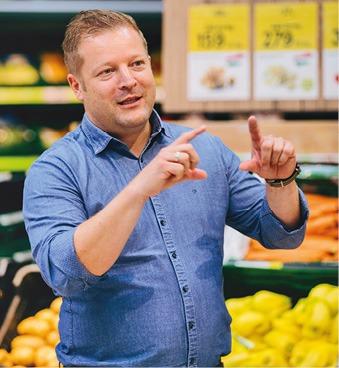
The hypermarket format cannot be ‘written off’ — it’s a living, functioning model. The goal is for every location to remain competitive. Across all formats, customer satisfaction is the key
The franchise concept opens up new opportunities for Tesco. Where are you currently in the planning process and what are the results so far?
– We have opened our first Premier store in Csepel, which is a successful format in the UK. We converted an Express store into a Premier store and we are monitoring the initial customer reactions. Compared to Express, the assortment has been expanded and the store interior has been redesigned.
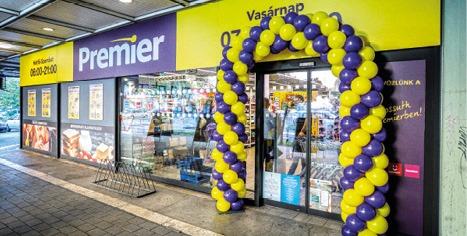
With our first Premier store, we have been looking for a concept that would resonate with a younger audience
Operating different store formats is a logistics challenge. How can you work efficiently and what developments are you planning to make operations more sustainable?
– We started planning the new warehouse five or six years ago and it took five years to build it. Thanks to this consolidated warehouse, we can transport fresh and dry goods together, which has resulted in nearly 20% savings in point-to-point logistics. This means up to a million kilometres less on the roads per year, while also gaining 14-16 hours in terms of product freshness.
The conquest of robotics and AI is also bringing new challenges to the labour market. How can Tesco adapt to this?
– We are currently testing cleaning robots and AI is already advanced enough that they don’t disturb customers. There is no large-scale robot use in the warehouse yet and this was a conscious decision. We are cautious with cutting-edge technologies: first we observe how they work abroad and then we adapt them to domestic operations.
Upon planning for next year, structural progress in the food industry will be the top priority. The task now is to identify where we can ‘inject’ growth into volume
If you “looked into your crystal ball” now, what would you see: what are the expectations at group level and on the domestic market?
– The group’s first-half figures were better than we had expected based on our initial “crystal ball” prediction, so profit expectations have been revised upwards. This was primarily driven by the performance of the UK and Ireland. The Czech-Slovak-Hungarian unit saw an increase in turnover in the first half of the year, but we are still in negative territory in terms of volume sales.
From an owner’s point of view, the question may arise: is there a point at which the group would consider letting go of the Hungarian market or do the owners continue to see our country as a long-term opportunity?
– They don’t say so, nor do they give any indication of it. If we look at the reports, we can see that the last two years have been difficult, yet the Tesco group has consistently generated money. For a shareholder the most important thing is how much value has already been accumulated in the company and what its long-term performance is like. Hungarian consumers spend more than 25% of their income on food, while in Western Europe this figure is less than 10%. This means that there is enormous growth potential ahead of us. (x)
Related news

Hungarian retailers were in a teasing mood on April 1
🎧 Hallgasd a cikket: Lejátszás Szünet Folytatás Leállítás Nyelv: Auto…
Read more >
GKI: High base rate, low inflation?
🎧 Hallgasd a cikket: Lejátszás Szünet Folytatás Leállítás Nyelv: Auto…
Read more >
Using the system has a boost effect
🎧 Hallgasd a cikket: Lejátszás Szünet Folytatás Leállítás Nyelv: Auto…
Read more >Related news

An exciting journey into the world of beauty
🎧 Hallgasd a cikket: Lejátszás Szünet Folytatás Leállítás Nyelv: Auto…
Read more >
Szerencsejáték Zrt. strengthens with modern lottery kiosk islands in 2026
🎧 Hallgasd a cikket: Lejátszás Szünet Folytatás Leállítás Nyelv: Auto…
Read more >
What everyone is talking about: focus on creatine
🎧 Hallgasd a cikket: Lejátszás Szünet Folytatás Leállítás Nyelv: Auto…
Read more >
