Green marketing requires accuracy

At the end of January the Green Chapter of the Hungarian Marketing Association (MMSZ) focused on a little-known EU directive (EU 2024/825) with very practical implications: Empowering Consumers for Green Transition (EmpCo/ECGT).
This article is available for reading in Trade magazin 2026/04

Hajnalka Kovács-Czövek
country manager
GREEN BRANDS Hungary
Hajnalka Kovács-Czövek, country manager of GREEN BRANDS Hungary gave a presentation on the EmpCo. She explained the logic behind EmpCo’s approach to green communication.
EmpCo = basis, Green Claims = tightening
She made it clear right from the start: EmpCo and the Green Claims Directive currently being drafted aren’t the same package and don’t intervene in the same areas. EmpCo works through consumer protection logic: it typically relies on ex post facto verification and uses prohibitions and minimum standards to designate what should no longer be routinely claimed. In practice EmpCo doesn’t measure green intent, but rather the accuracy of communication. Green Claims, on the other hand, may later introduce a preliminary certification/validation system, a more detailed methodology, and even an accredited expert role.
From “recommendation” to sanctionable case?
EmpCo was adopted on 28 February 2024 and entered into force in the EU on 27 March 2024. Member states must transpose the rules into national law by 27 March 2026 and from 27 September 2026 the requirements under EmpCo will become applicable and enforceable. It was stated at the meeting that EmpCo won’t just introduce a “blacklist”, but that from 27 September 2026 there will also be serious consumer protection legal consequences. Four typical pitfalls in green claims: the first prohibition concerns general environmental claims, the second is for non-credible, non-audited sustainability labels, the third affects partial truths presented as complete statements, and the fourth prohibition draws a hard line on climate claims.
The system behind the green claim
One of the big turning points of the EmpCo era is that the green message is no longer a creative abbreviation, but an auditable claim: what we say to consumers must be traceable and verifiable. This has led to an increase in the value of certification systems that are designed to operate under external control and with a public set of criteria – instead of simply appearing on packaging as an own logo. The GREEN BRAND label is an EU-registered certification trademark with a public set of criteria and an independent audit basis. The system isn’t a one-off snapshot: it is confirmed in two-year cycles and can be revoked if necessary. From 2026 every successful certification receives a unique identifier (GB-ID), which will also appear on the trademarks. The compliance criterion is a minimum GB index of 51%.
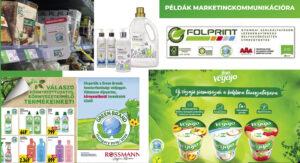
Environmental claims in practice: green messages, eco-labels and certifications appear simultaneously on packaging, in-store communication and advertising materials – and in the era of the Empowered Consumer, precise wording and credible, auditable substantiation have become more important than ever.
What should be done between now and the summer of 2026?
Companies will have roughly half a year to ensure that the handling of green claims isn’t a campaign intuition but a functioning internal system. The quickest yet most effective step is to take inventory of claims: we say the same thing in many places today, just using different words – this is where compliance tends to slip. The next step isn’t a legal text, but a decision-making path: each claim should have a responsible person, a where-to-find-it reference, and a clear rule for when the issue is transferred from marketing to the professional/management table. Hajnalka Kovács-Czövek underlined: the risk isn’t in saying something green, but in the company not being able to quickly show what its claims are based on.

Related news

Generation Z vs. senior executives: young people are ready, companies need to act now
🎧 Hallgasd a cikket: Lejátszás Szünet Folytatás Leállítás Nyelv: Auto…
Read more >
Asda And Podback Recycle 20 Million Coffee Pods In First Year Of Partnership
🎧 Hallgasd a cikket: Lejátszás Szünet Folytatás Leállítás Nyelv: Auto…
Read more >
(HU) FruttaMax Gold szörpök
🎧 Hallgasd a cikket: Lejátszás Szünet Folytatás Leállítás Nyelv: Auto…
Read more >Related news

Brake on Shein’s growth in Europe
🎧 Hallgasd a cikket: Lejátszás Szünet Folytatás Leállítás Nyelv: Auto…
Read more >
GKI: High base rate, low inflation?
🎧 Hallgasd a cikket: Lejátszás Szünet Folytatás Leállítás Nyelv: Auto…
Read more >
Lidl sold nearly 100 million liters of Hungarian milk
🎧 Hallgasd a cikket: Lejátszás Szünet Folytatás Leállítás Nyelv: Auto…
Read more >
