
Planet Budapest Sustainability Expo opens

One of the most significant sustainability events in Central Europe, the Planet Budapest Sustainability Expo, has opened, organized for the third time by the Blue Planet Climate Protection Foundation; The event, which can be viewed in the Railway History Park in Budapest, awaits visitors for more than a month.
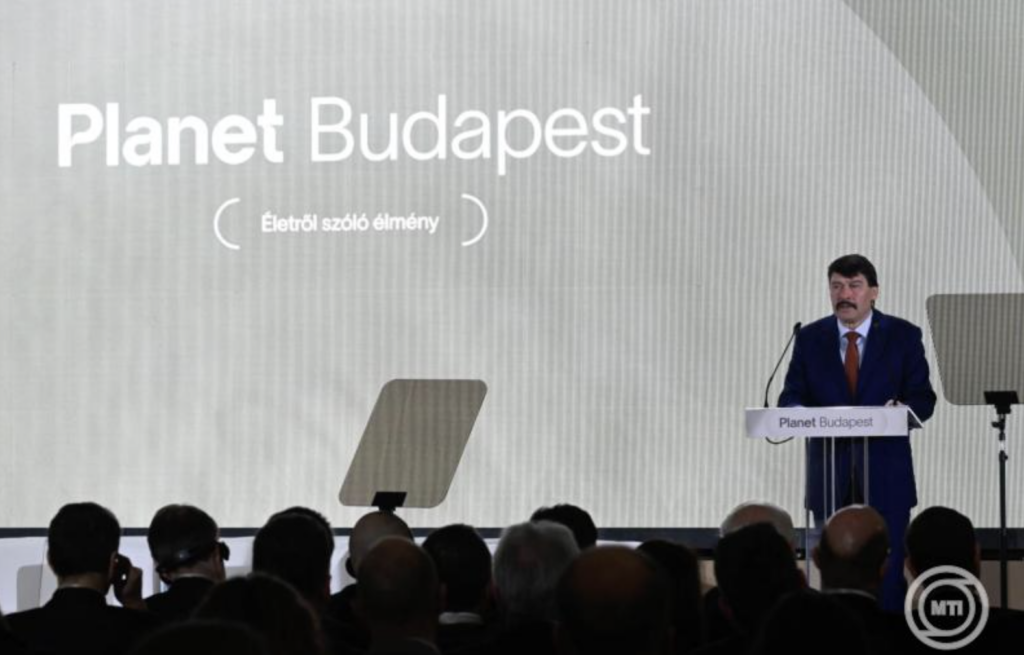
MTI/Bruzák Noémi
János Áder, chairman of the board of trustees of the Blue Planet Climate Protection Foundation and the event’s main patron, emphasized in his opening speech that sustainability has many factorial concept, a complex science, the essence of which is that the Earth’s resources are finite.
“No matter how much we believe in human ingenuity, no matter how much we trust in the omnipotence of technology, no matter how much we delude ourselves that we will figure out how to expand the Earth and make it grow, sustainability is the realization that this will not succeed“
– said the former head of state.
Therefore, human knowledge and creativity must be focused on creating a balance between human well-being and nature’s finite resources. “Nature itself teaches us this, which does not produce waste, does not let anything go to waste and is capable of continuous renewal” – said János Áder.
In his presentation, János Áder also touched on the problems, including the fact that today man is endangering his own future, overusing his resources: polluting the air, soil, water, and destroying the wilderness.
He emphasized that man acts as if he does not receive every molecule of oxygen he breathes, every sip of water he drinks, every bite of food he eats from nature, as if he had forgotten that he cannot grow infinitely because he cannot outgrow the Earth.
He said that the desire to involve more and more resources and maximize profits drives continuous growth in the current sense, but the way people are pursuing it today is unsustainable.
As an example, he mentioned that according to the Hungarian customs authority’s report, the number of low-value commercial packages arriving from abroad in Hungary increased by 50 percent last year, amounting to 204 million pieces. Most of these originated from overseas and arrived in the country over long distances. All of this has a positive impact on GDP in the areas of manufacturing, packaging, transportation, industry, trade, and logistics. However, the negative externalities resulting from manufacturing, packaging, and transportation are also important: the harmful health, social, and environmental effects. The former head of state believed that the numbers show that “we pollute the air and water for convenience reasons, and use our resources unnecessarily“.
Referring to the increase in the volume of low-value commercial packages arriving from abroad, János Áder asked questions: is “this better for us, is this what we need for happiness, is the value proportional to the price? In short: is it worth it?“
The same questions were asked by economist Sir Partha Dasgupta, professor emeritus at the University of Cambridge, in the language of science, and the expert pointed out that nature had been left out of economic models – the former president explained.
Therefore, János Áder drew attention to whether it can be called growth when the quality and quantity of natural capital, the most important tool of the economy, is continuously decreasing, losing its diversity and ability to renew itself. Based on the professor’s findings, he noted that sustainability, in addition to being a nature conservation and moral program, is also a question of money.
János Áder also touched on the measurement of changes in natural capital and the economy, which is being dealt with by excellent experts worldwide. He drew attention to the measurement model presented in 2024, which was jointly created by 3 cooperating Hungarian research groups under the auspices of the Hungarian Academy of Sciences and the Blue Planet Climate Protection Foundation. Its great virtue is that its methodology makes visible the use of ecological resources that have been mostly invisible until now.
Related news
The goal is to improve the quality of life for generations: Nestlé’s summary of shared value creation has been published
🎧 Hallgasd a cikket: Lejátszás Szünet Folytatás Leállítás Nyelv: Auto…
Read more >
Just Eat Takeaway.com brings sustainable packaging range to European markets
🎧 Hallgasd a cikket: Lejátszás Szünet Folytatás Leállítás Nyelv: Auto…
Read more >
Action Results 2025: Strong Growth and Progress Sustainability Programme
🎧 Hallgasd a cikket: Lejátszás Szünet Folytatás Leállítás Nyelv: Auto…
Read more >Related news
István Nagy: the pig sector has received further assistance
🎧 Hallgasd a cikket: Lejátszás Szünet Folytatás Leállítás Nyelv: Auto…
Read more >
Weight loss injections: a breakthrough in the treatment of obesity, but access and price are still bottlenecks
🎧 Hallgasd a cikket: Lejátszás Szünet Folytatás Leállítás Nyelv: Auto…
Read more >
Ministry of Agriculture: At the initiative of Hungary, another EU source will help farmers affected by last year’s drought
🎧 Hallgasd a cikket: Lejátszás Szünet Folytatás Leállítás Nyelv: Auto…
Read more >
