
Despite partial price easing for several basic ingredients, the total cost of baking a traditional Hungarian bejgli at home remained stubbornly high at the end of 2025. Over the past five years, the production cost of the iconic Christmas pastry has increased by nearly 40%, while consumer demand has shown little sign of weakening – according to calculations by Economx and market insights from the Hungarian Bakers’ Association.
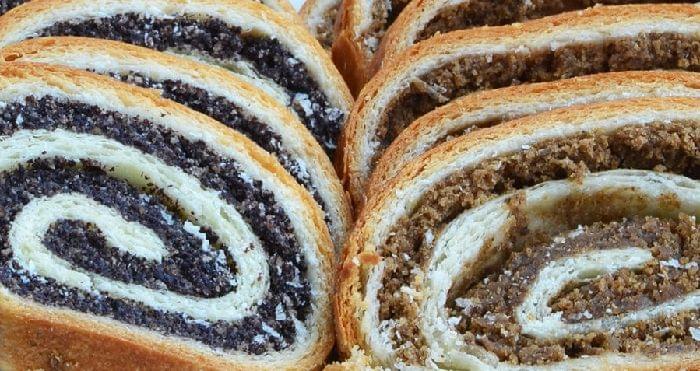 Bejgli continues to be one of the most defining seasonal products in Hungary. Based on data from the Hungarian Central Statistical Office (KSH), around 80% of households included bejgli on their Christmas tables in 2024. At the same time, the pastry has increasingly become not just a cultural symbol, but also a cost-sensitive product, even when prepared at home.
Ingredient Prices Ease, Final Cost Stagnates
KSH data show that prices of several core ingredients declined year-on-year: flour, sugar, margarine and milk became cheaper, while eggs and walnuts continued to rise in price. Walnuts remain the single largest cost driver, accounting for more than 70% of total production costs.
At the end of 2025, the cost of baking a traditional walnut-filled bejgli at home amounted to just over HUF 4,040, assuming margarine is used instead of butter – essentially unchanged from the previous year. Using butter instead pushes the cost close to HUF 4,700, highlighting how sensitive the final price is to ingredient choices.
A longer-term comparison underscores the structural shift:
-
In 2020, a similar bejgli could be baked for under HUF 2,900
-
In 2021, costs rose to around HUF 3,200
-
Since 2022, costs have remained consistently above HUF 4,000
The Filling Sets the Price
The breakdown clearly shows that bejgli pricing is driven not by the dough, but by the filling. In the analysed recipe, the dough itself costs just over HUF 1,000, while the walnut filling alone exceeds HUF 3,000.
This aligns with the Hungarian Food Codex, which requires that fillings account for at least 50% of the total weight of bejgli products – a regulatory standard that further limits cost-cutting options for producers.
Bakery Market: Wide Price Range, Expanding Trends
According to the Hungarian Bakers’ Association, pricing of finished bejgli products is fundamentally shaped by raw material costs, particularly walnuts and poppy seeds. Large-scale, automated manufacturers can offer lower prices, while artisanal bakeries position themselves at higher price points reflecting manual production and premium quality.
From a trend perspective, the market is clearly diversifying. Alongside classic walnut and poppy-seed varieties, flavours such as chestnut, chocolate, pistachio, fruit-based and zserbó-style fillings are gaining ground. At the same time, demand for special-diet products is rising sharply, with gluten-free bejgli showing particularly strong growth.
Stable Demand, Shrinking Room for Maneuver
Although many bakeries and confectioneries refrained from raising bejgli prices in 2025, industry bodies warn that raw material costs, packaging fees and labour expenses continue to exert significant pressure on margins.
As a result, bejgli has become a clear indicator of how food inflation filters into even the most traditional festive products. The conclusion is unavoidable: the era of “cheap bejgli” is long over – regardless of whether the pastry is baked at home or purchased in-store.