
Sitting outside
In the hospitality industry terrace furniture has become a strategic issue: besides price and durability, branding has also become an important factor in customer decisions.
This article is available for reading in Trade magazin 2026/04

Melinda Szaniszlai
head of B2B
JYSK
“Consciousness has clearly emerged as a trend. In 2026 the focus will be on function and proportion rather than quantity. Fewer, but well-chosen pieces of furniture and accessories create a calmer overall picture, especially when furnishing terraces”,
says Melinda Szaniszlai, the head of JYSK’s B2B department.
Terrace furniture is now part of the brand experience. In the HoReCa sector the boundaries between functions are becoming increasingly blurred, for instance the hotel lobby becomes a living room, etc. Premium terrace furniture is typically made of weather-resistant, heavy-duty materials, which ensure a longer lifespan and stable structure. Comfort is also emphasised in these models, with thicker cushions, water-repellent or quick-drying covers, and ergonomic designs.
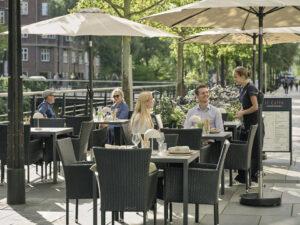
Furniture selection is no longer about getting guests to leave quickly, but about ensuring they can stay comfortably for a long time
Naturalness and modularity

Gabriella Bakos Tóth
head of furniture division
Coninvest
“In the past few years there has been a strong demand for naturalness on restaurant terraces. Wood, woven textures, rope, and natural colours dominate, and this isn’t only an aesthetic issue but also part of the guest experience”,
explains Gabriella Bakos Tóth, head of the furniture division at Coninvest.
Comfort has taken on a new dimension and modularity has become important: terraces are designed so that restaurants and bars can use easily rearrangeable elements.

Anita Manisz-Ősi
non food purchasing
specialist
METRO
“We have seen it recently that the market has become more open to new ideas. Neutral, natural shades continue to dominate, but bolder colours and distinctive patterns are also becoming more common”,
informs Anita Manisz-Ősi, METRO’s non-food purchasing specialist.
Demand for high-quality plastic furniture is also on the rise. At METRO both those who prefer classic solutions and those who are open to new ideas and inspiration will find the right furniture for them.

Péter Boncz
seasonal and marketing
specialist
Praktiker Áruházak
“Functional, weather-resistant materials have become popular, such as polyester, aluminium, and synthetic rattan, as well as minimal maintenance requirements”,
points out Péter Boncz, seasonal and marketing specialist of Praktiker Áruházak.

Balázs Karasz
head of category
management
OBI
“The outdoor living room concept is gaining ground, with cosy comfort replacing mere functionality. Instead of plastic, upholstered-effect polyrattan and airy aluminum furniture dominate”,
reports Balázs Karasz, OBI’s head of category management.
Product offering and solutions
JYSK offers a wide range of furniture and accessories for furnishing outdoor spaces. In addition to functionality, customer decisions are more and more influenced by guest comfort and the conscious combination of colours and shapes. The JYSK selection combines different style elements with durable quality, allowing bar and restaurant owners to make a conscious decision to furnish outdoor spaces in a way that it can be used for a long time. JYSK’s outdoor furniture consists of matching elements, making it easy to create a uniform look on a terrace.
Coninvest sells outdoor furniture designed specifically for the hospitality sector that can withstand daily, intensive use. They have some exciting new products for this season: seating combined with smart heating and cooling elements, which offer integrated charging points; they have also launched a line of bio-composite furniture, where the design enhances the appearance of natural fibers; plus the company offers new colourful textile collections too.
METRO is preparing for its catering partners with predominantly own brand products: chairs, tables, and parasols. The company is getting ready for the season with their rattan (Mohim, Barbados) and wood (Lynx) pieces of furniture, and it has also introduced some new products: a black wooden beer bench set and a redesigned version of the new product, Laveria armchair. They also sell seasonal and artificial plants as decorative accessories.
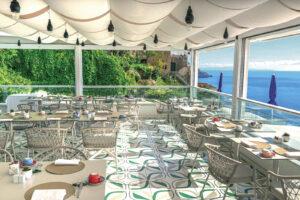
Comfort is also influenced by thermal sensation, shading, airflow, and lighting
Categories and comfort
Praktiker’s selection of outdoor furniture is divided into four main categories: lounge and exclusive combination sets (typically made of eucalyptus wood), metal furniture, and innovative synthetic rattan and plastic solutions. In addition to design and comfort, multifunctionality is also emphasised in the sets: the selection includes variable, modular sofas and dining sets. The metal-wood and metal-textile combinations are characterised by clean colours. The company’s outdoor accessories include solar lamps and string lights for atmospheric lighting.
OBI’s durable products are also suitable for hospitality use. Their featured offers are the Sacramento (modern, stackable chairs, durable steel mesh table) and Bonlee product lines (sustainable, FSC eucalyptus and aluminium combination, with an extendable table). In 2026 they will focus on balcony furniture: new models – made of synthetic rattan, wood, steel-textile, and FSC acacia wood – will arrive. OBI offers everything in one place, for instance large Mediterranean plants (oleander, palm) in pots add intimacy by separating spaces.
Design, dynamics and revenue
A restaurant terrace isn’t just a seasonal capacity expansion, but a conscious revenue optimisation tool. A well-designed outdoor dining area not only means more seating, but also consciously designed space utilisation solutions with different functions. Smaller, practical tables are ideal for a quick lunch, while more comfortable lounge-style seating is better for evening cocktails. The key isn’t necessarily furniture that can be constantly rearranged, but rather that the given space can adapt to different guest situations. All this can be achieved on 20-30m² and the choice of furniture isn’t only an aesthetic decision, but also a logistical issue. Stackable chairs, easily movable yet stable tables or quickly rearranged modular elements significantly reduce the time and labour needed for rearranging. The focus is on extending the time guests spend on site, so outdoor hospitality will be a strategic issue in 2026.

Related news
(HU) FruttaMax Gold szörpök
🎧 Hallgasd a cikket: Lejátszás Szünet Folytatás Leállítás Nyelv: Auto…
Read more >
Nappy market: forced to adapt
🎧 Hallgasd a cikket: Lejátszás Szünet Folytatás Leállítás Nyelv: Auto…
Read more >
Green light for SPAR’s new acquisition in Austria
🎧 Hallgasd a cikket: Lejátszás Szünet Folytatás Leállítás Nyelv: Auto…
Read more >Related news
This is how Hungarians will travel at Easter this year
🎧 Hallgasd a cikket: Lejátszás Szünet Folytatás Leállítás Nyelv: Auto…
Read more >

(HU) Tengergyümölcsöskert – A nap videója
🎧 Hallgasd a cikket: Lejátszás Szünet Folytatás Leállítás Nyelv: Auto…
Read more >
