
Yoghurts riding on the back of prices

Introduced in March 2025, the margin freeze measure brought great changes on the yoghurt market. It shifted demand towards volume, while the growth in value sales took a back seat.
This article is available for reading in Trade magazin 2026/04

Ádám Nagy
CEO
Nádudvari Élelmiszer
“Looking ahead to 2026, we expect milk prices to reach their lowest level at the beginning of the year and then hopefully start to rise slowly. Still, Nádudvari doesn’t intend to modify its long-term supply contracts”,
says Ádám Nagy, the CEO of Nádudvari Élelmiszer Kft.
This isn’t the region for small manufacturers

István Dobrovoczky
sales and marketing
director
Ökotej
Although the change in purchasing habits has had a positive effect on yoghurt and dairy product sales in general, it has also posed serious problems for the sector, points out István Dobrovoczky, sales and marketing director of Ökotej ZRt.
“The goal – namely to cut consumer prices and stop inflation – has been successfully achieved and has even resulted in significant deflation in certain product categories to a certain extent. Yet, we mustn’t forget that this has come at a heavy price, both then and now”,
says the director.
He adds that even increases in volume sales don’t bring in enough extra revenue to cover the increased expenses. Hungarian producers remain under pressure, since it is very difficult – and in many cases impossible – for them to compete with the large European “multinationals”.
It is quite difficult to get new products and new listings on the shelves at the moment, as the minimal 10% profit margin doesn’t encourage anyone to launch more and more loss-making products.
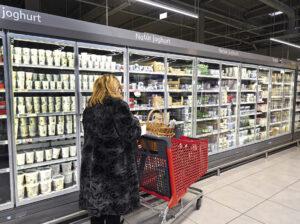
For products subject to the price margin cap, exceptional volumes appeared, while for others achieving growth — or merely maintaining previous market positions — it proved to be a significant challenge
Price contraction and fewer promotions
Discounters continue to play a dominant role in sales, which also strengthens the weight of private labels. At the same time, there is strengthening innovation work in this segment too.
“The consumer price of branded yoghurts has dropped, which led to an increase in sales in the short term. At the same time, the lower starting price has reduced the scope for promotions”,
explains Ádám Nagy.

Miklós Vörös
CEO
Cserpes – Sajtműhely
Miklós Vörös, the CEO of Cserpes – Sajtműhely Kft:
“The margin freeze regulation had a traffic-siphoning effect on Hungarian chains with more fragmented sales and independent stores, which were unable to match the prices required by the margin freeze – thus increasing the share of multinational chains in sales. Manufacturer brands are now closer in price to private labels, so consumer demand for them keeps growing”.
Nádudvari’s innovation work focuses primarily on the premium segment. As part of this, Nádudvari Greek yoghurt will come out around Easter, which is made with traditional Greek yoghurt culture and has been developed to meet high quality standards.
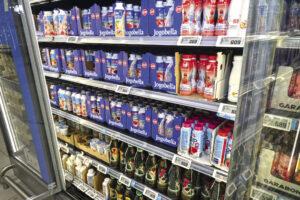
The consumer price of branded yogurts decreased, which led to a short‑term increase in sales volumes; however, the lower starting price level narrowed the scope for promotional activity
Dynamic plant-based alternatives
Yoghurt is one of the top categories at Cserpes, with nine flavoured, layered, and one plain yoghurt making up the assortment. The products are made using homemade jam. Their three best-selling flavours are raspberry, blueberry, and apricot, but sea buckthorn is also enjoying a renaissance. Besides the permanent yoghurt selection, they are considering the launch of seasonal flavours for the summer and winter periods, and the company is also planning to introduce yoghurt drinks.

Gábor Szommer
commercial and
purchasing director
Fino-Food
At FINO-FOOD Kft. they see dynamic growth in plant-based yoghurt alternatives in both the flavoured and natural segments. The company has entered this category with its Fino Vegajó Vegagurt ACIDO+BIFIDO probiotic products.
“Our Fino Vegajó Vegagurt products contain ACIDO+BIFIDO bacterial cultures that support intestinal flora and have a probiotic effect. They are available in three flavours and all products are rich in calcium, soy-free, and free-from allergenic ingredients”,
says commercial and purchasing director Gábor Szommer.
The yoghurt market grew in 2025
After a decline in volume in 2022-2023, the yoghurt market continued to grow in 2025: despite a drop in prices, sales were up 6.5% and purchased volume grew by 11% compared to 2024.


Guest writer:
Fruzsina Nábelek
data analyst team lead
YouGov CP Hungary
The category’s penetration level reached 96% in 2025. Consumers prefer flavoured yoghurts, the volume of which augmented by nearly 20% compared to the previous year. More than 80% of households took home at least one flavoured product and on average we purchased 8.6kg of fruit yoghurt per household in 2025.
Plain yoghurts also grew, but at a more modest rate – there was an 11% volume growth. While consumers prefer private label products in the case of natural yoghurts, they tend to choose branded products when buying flavoured yoghurts. Value sales of lactose-free yoghurts increased by 15% and volume sales of these products grew by more than 30% in 2025.

Related news
Shoppers loved chocolate bars
🎧 Hallgasd a cikket: Lejátszás Szünet Folytatás Leállítás Nyelv: Auto…
Read more >
(HU) FruttaMax Gold szörpök
🎧 Hallgasd a cikket: Lejátszás Szünet Folytatás Leállítás Nyelv: Auto…
Read more >
Nappy market: forced to adapt
🎧 Hallgasd a cikket: Lejátszás Szünet Folytatás Leállítás Nyelv: Auto…
Read more >Related news

Brake on Shein’s growth in Europe
🎧 Hallgasd a cikket: Lejátszás Szünet Folytatás Leállítás Nyelv: Auto…
Read more >
GKI: High base rate, low inflation?
🎧 Hallgasd a cikket: Lejátszás Szünet Folytatás Leállítás Nyelv: Auto…
Read more >
Lidl sold nearly 100 million liters of Hungarian milk
🎧 Hallgasd a cikket: Lejátszás Szünet Folytatás Leállítás Nyelv: Auto…
Read more >
