
This is how European marketing decision-makers see the industry’s most important challenges this year

According to Europe’s largest CMO survey to date, customer centricity remains the number one strategic priority, but implementation is significantly lagging behind the goals. As AI spreads, the focus shift towards sales and performance marketing is becoming stronger, while a serious lack of knowledge and preparedness in many companies is slowing down progress. The main message of the research is clear: AI is not a miracle weapon, real results require a conscious strategy and business-level integration. The Hungarian professional community contributed the second highest number of completions to the creation of valuable international knowledge.
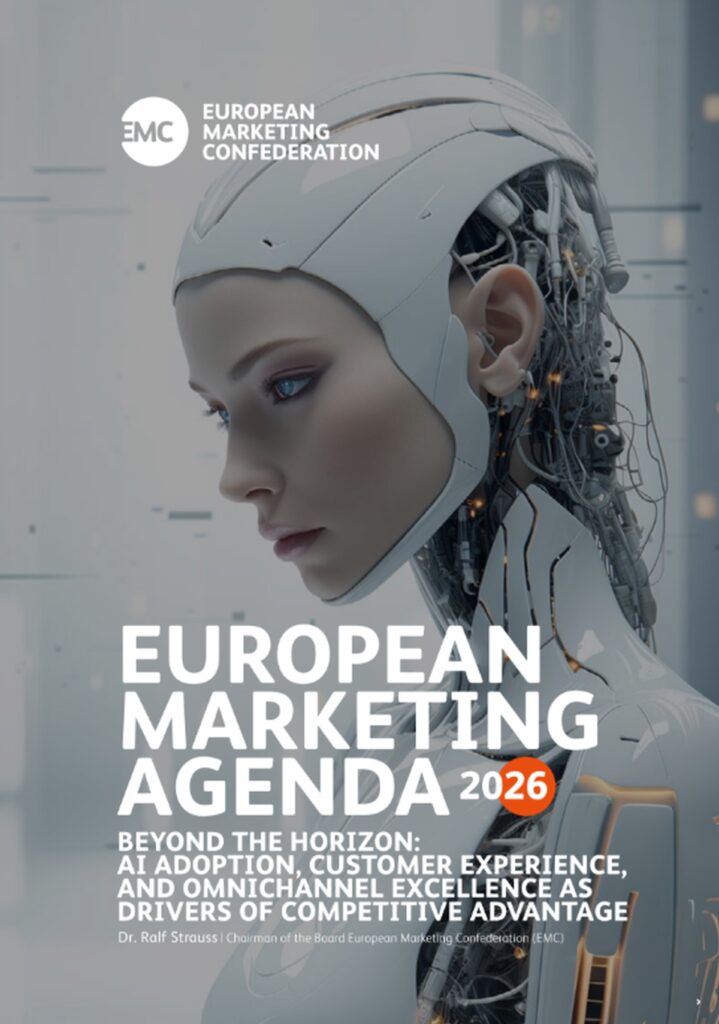 The European Marketing Agenda is compiled every year by the European Marketing Confederation (EMC), which now represents fourteen European national marketing associations and more than 100,000 marketing professionals, of which the Hungarian Marketing Association (MMSZ) is also a member. The global version of the survey – the Worldwide Marketing Agenda – reflects the opinions of professionals from two other continents, in addition to European experts, thanks to the cooperation of the African Marketing Confederation (AMC) and the Asian Marketing Federation (AMF).
The results of the research provide an accurate picture of where CMOs are across Europe and which areas pose challenges for the profession in the coming period. The results of this year’s survey draw attention to the following challenges:
Partial successes and partial results regarding the most important strategic priority – Customer centricity remains the leading strategic focus in Europe, as 43% of respondents identified it as the number one priority. However, implementation is lagging behind, with a third of marketing decision-makers “only partly satisfied” with progress – indicating a persistent gap between strategy and operations.
Increasing spending, insufficient AI knowledge and a growing focus on the bottom of the sales funnel – As AI spreads, the focus is increasingly shifting towards sales and performance marketing, especially at the bottom of the funnel. However, companies’ AI maturity is mixed: 22% consider themselves “AI pioneers”, while 53% are more of a balanced “considered movers”. The good news is that despite the uncertain economic environment, marketing budgets appear stable: nearly 75% of companies report unchanged or increasing spending.
Companies are actively looking for opportunities to use AI appropriately – The biggest challenge in 2026 is understanding the business impact of AI and the lack of knowledge (30%). Although many pilots have been launched, only 12% have reached live, fully integrated operations. Currently, respondents mainly expect efficiency improvements from AI agents – for example, in the areas of automated content creation, A/B testing, email automation or customer service support – rather than complex, strategic-level optimization. The lesson is clear: AI alone is not a solution, the real value lies in good use cases and deep integration.
The tension between knowledge and the pace of technology is growing – GenAI-based search (AIO/GEO) will fundamentally transform content evaluation in 2026: depth, relevance and user intent will come to the fore, often in a “zero-click” environment. Meanwhile, the development of Retail Media continues to be hampered by a lack of internal expertise, unclear value contribution and limited access to critical data.
“While technology is changing at an exponential pace, organizations are typically evolving much more slowly and often with almost unchanged structures. For most companies, the bottleneck is the lack of the right knowledge and preparedness. The revolution and transformation journey towards data and AI-driven customer interaction is really just beginning – and it requires real cross-functional collaboration”
– highlights Hinora Ferenc, President of the Hungarian Marketing Association (MMSZ), which participated in the survey.
Related news

Shein opens office in Barcelona for Spanish marketing
🎧 Hallgasd a cikket: Lejátszás Szünet Folytatás Leállítás Nyelv: Auto…
Read more >
Why won’t AI replace marketers?
🎧 Hallgasd a cikket: Lejátszás Szünet Folytatás Leállítás Nyelv: Auto…
Read more >
The 2026 Marketing Diamond Awards have been presented
🎧 Hallgasd a cikket: Lejátszás Szünet Folytatás Leállítás Nyelv: Auto…
Read more >Related news

When organic becomes mainstream: A glimpse of what awaits food retail in Central & Southeast Europe
🎧 Hallgasd a cikket: Lejátszás Szünet Folytatás Leállítás Nyelv: Auto…
Read more >
Food Retailer Biedronka Eyes Carrefour Assets In Poland
🎧 Hallgasd a cikket: Lejátszás Szünet Folytatás Leállítás Nyelv: Auto…
Read more >
AM: agricultural support to reach tens of thousands of producers in the coming days; Ministry of Agriculture helps farmers with accelerated payments
🎧 Hallgasd a cikket: Lejátszás Szünet Folytatás Leállítás Nyelv: Auto…
Read more >
