
Csaba Gyuricza: Farmers cannot afford to wait

The future of agriculture is not about patching up the problems of the past, but about exploiting the new opportunities offered by artificial intelligence – emphasized Csaba Gyuricza, rector of the Hungarian University of Agricultural and Life Sciences, at the Portfolio Agricultural Sector 2025 Conference in Siófok on December 3. According to the expert, AI is already an unavoidable factor today, offering security, competitive advantage and joint action opportunities for agriculture, and will become the most decisive force in the sector in the coming years.
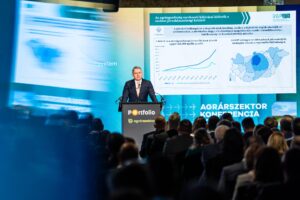
(Photos: MATE/Berecz Valter)
Artificial intelligence is not a threat, but a new stage in the natural development of agriculture – emphasized Csaba Gyuricza, rector of the Hungarian University of Agricultural and Life Sciences, at the Portfolio Agricultural Sector 2025 Conference in Siófok. As he said, AI is already unavoidable today and will become the most decisive factor in agriculture in the coming years. Artificial intelligence means three things for agriculture in the future: security, competitive advantage and joint action – the expert said. It provides security because it can predict drought, epidemics, market risks, so that it can react in time. It provides a competitive advantage, since AI gives Hungary the opportunity to be among the first to respond to challenges. And finally: it forces the players in the sector to join forces, since the problems of soil, plant health, the situation of livestock and the changing climate are a set of problems that can only be effectively addressed together. The rector reminded that the most visible of the internal structural problems of Hungarian agriculture is the continuous decline in profitability. Agricultural wages are increasing, but purchase prices are not keeping pace, which is why the scissors are constantly opening, and the pressure on the players in the sector is increasing – he said. This is accompanied by regional differences: in Budapest, the investment per capita is several times higher than in rural areas, while more than a thousand retail stores closed nationwide in 2023-24. External factors such as drought, tariff wars and the rapid spread of diseases show that previously frightening scenarios have now become everyday reality. Today, agricultural actors cannot afford to wait, and artificial intelligence offers them a lot of roles and opportunities in this, he emphasized.
Three strategic pillars
The rector of the Hungarian University of Agricultural and Life Sciences named three strategic pillars that could define the future of agriculture: green competitiveness, digital and AI-based developments, and the knowledge-based economy. The applications of AI are organized around four key areas. The first is the preservation of soil quality, where precision input management, data-based nutrient optimization and soil fertility modeling can help. The second is the management of plant diseases and pests, where predictive models, early warning systems and precision spraying can reduce losses. The third is animal health: avian influenza and other epidemics have caused billions in damage, but these can even be prevented through real-time monitoring and behavioral analysis. The fourth is mitigating the effects of drought and climate change, where predictive models can help farmers adapt. We can therefore see that the application of artificial intelligence is no longer a distant vision, but a set of real working practices that are capable of preventing significant economic damage. The question today is no longer why it is worth taking action, but when and how – said Csaba Gyuricza. The rector emphasized: no one gets far in agriculture alone. Data-based solutions can only work effectively along coordinated national databases and integrated networks. The Hungarian University of Agricultural and Life Sciences has therefore developed a vision for the National Resilience Center, which would include the country’s strategic agricultural data in a unified system and build it into a network of expert advice. Without digital competence, farmers will become uncompetitive within five years – warned the rector.
MATE/agrarszektor.hu
Related news
The horticulture of the future is being built in Szentes
🎧 Hallgasd a cikket: Lejátszás Szünet Folytatás Leállítás Nyelv: Auto…
Read more >
The cereals commodity group accounted for the majority of Hungary’s agricultural balance in 2025
🎧 Hallgasd a cikket: Lejátszás Szünet Folytatás Leállítás Nyelv: Auto…
Read more >
The engine of rural Hungary lies in strong family businesses
🎧 Hallgasd a cikket: Lejátszás Szünet Folytatás Leállítás Nyelv: Auto…
Read more >Related news

Oat-based “feta” wins the cheese innovation competition of Lidl Germany and ProVeg
🎧 Hallgasd a cikket: Lejátszás Szünet Folytatás Leállítás Nyelv: Auto…
Read more >
The horticulture of the future is being built in Szentes
🎧 Hallgasd a cikket: Lejátszás Szünet Folytatás Leállítás Nyelv: Auto…
Read more >
Finger Food Experience
🎧 Hallgasd a cikket: Lejátszás Szünet Folytatás Leállítás Nyelv: Auto…
Read more >
