
Urban discount: How Lidl discounters advance into inner Berlin

Lidl is advancing into the heart of Berlin. Struggling department stores are opening unexpected entry points for the discounter. What does it take for discount retail to work in inner-city locations?

Sebastian Rennack
international retail analyst
Aletos Retail
For decades, inner-city catchment areas were largely avoided by food discounters. The classic discount model was built around peripheral locations, where large plots enabled standardized stores of 1,000 square meters or more, uncomplicated logistics, and ample customer parking. Dense urban locations, by contrast, implied high rents, constrained delivery windows, limited floor space, and shopper flows dominated by pedestrians rather than car-based stock-up missions.
This structural mismatch was reinforced by the central role of parking within the discount value proposition. Assortments optimized for weekly or bulk shopping align poorly with purely foot-based demand, making inner-city sites long appear incompatible with the efficiency logic underpinning the discount model.
The post-Covid phase has fundamentally altered this equation. Many inner-city specialist retailers, particularly in non-food, have exited the market, leaving behind prominent vacancies in prime locations. At the same time, German city centers are structurally shaped by multi-story department stores, a format that had already been under pressure well before the pandemic. Declining non-food footfall, rising personnel costs, and the accelerating shift of discretionary spending to online channels have further undermined the economic viability of these large-format stores.
Against this backdrop, Lidl has begun to capitalize on the restructuring of inner-city retail. In particular, the ongoing difficulties of department store operator Galeria, have opened access to large, centrally located ground-floor spaces that were previously out of reach for food retail. Around a year ago, the discounter leased ground-floor space in former department stores in inner Berlin, including prominent locations at Hermannplatz and along the Kurfürstendamm.
At Hermannplatz, Lidl operates a 1,100-square-meter store with separate entrances and independent opening hours. The location sits at one of Berlin’s busiest subway interchanges, with direct access from the station into the former Karstadt department store. The building itself, dating back to the 1920s, is a well-known architectural landmark in the city and amplifies the site’s visibility and footfall.
Kurfürstendamm represents a different but equally strategic context. Often described as Berlin’s most prestigious shopping boulevard, it combines high pedestrian frequency with an upscale retail environment and strong tourist appeal, positioning Lidl in one of the city’s most symbolically charged shopping locations.
These sites combine exceptional footfall with sales areas that remain sufficient to implement Lidl’s standard discount concept. A further strategic advantage is the availability of on-site parking infrastructure inherited from the former department store use, partially offsetting one of the classic limitations of inner-city locations for discounters. This enables Lidl to serve multiple shopping missions simultaneously, ranging from stock-up purchases for households in the wider catchment to top-up shopping for nearby residents and convenience-driven missions for passersby. Embedded within department store buildings, the stores also enable a complementary shopping logic, allowing consumers to combine browsing non-food assortments or services with a food purchase in a single trip.
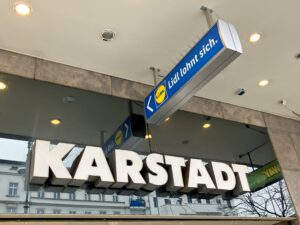
Against this background, we visited Lidl’s most recently opened inner-city stores in Berlin to observe how the discount concept translates into high-footfall department store locations.
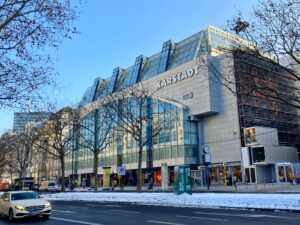
Lidl’s latest expansion focus are department store locations in the German capital Berlin
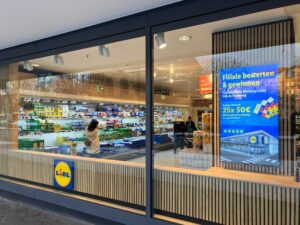
Lidl stores are located on the ground floor of Galeria buildings with direct street visibility and access. Dual-sided digital signage highlights promotions and the Lidl Plus loyalty program.
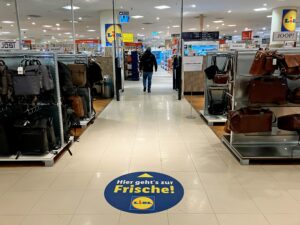
Clear floor signage guides shoppers through the department store toward Lidl. ‘Hier geht’s zur Frische!’ (‘This way to fresh food’) directs foot traffic into the food area.
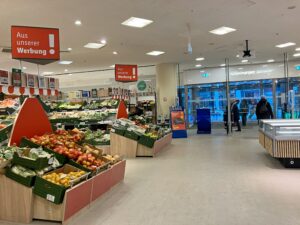
As in Lidl’s standard concept, the fruit and vegetable section is positioned at the store entrance
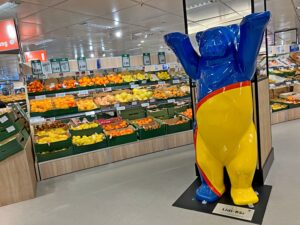
Lidl anchors the store locally by combining its brand colours with a bear statue – the hallmark of Berlin
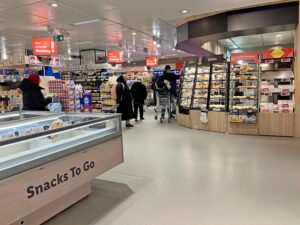
The urban store’s assortment largely mirrors Lidl’s standard concept. One key difference is the prominence of convenience ranges at the entrance, merchandised in ‘Snacks To Go’ low chillers.
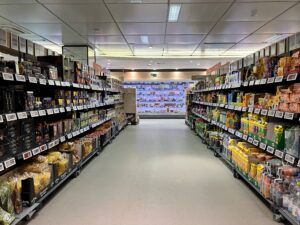
The department store layout allows Lidl to maintain full store size. Lower ceiling heights are offset by wider aisles, preserving openness and shopper comfort within the standard format.
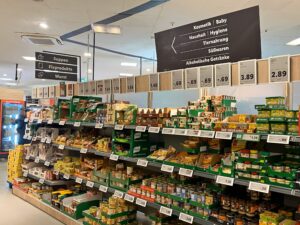
Structural constraints make category adjacencies less intuitive than in standard stores. Lidl compensates with clearer overhead signage and stronger in-store navigation to guide shoppers efficiently.
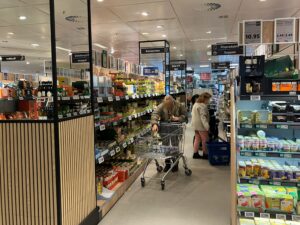
Mirrored pillars visually expand the space, reducing perceived barriers and reinforcing a more open, spacious store impression despite structural constraints
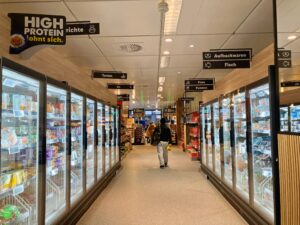
Vertical merchandising and tall freezer equipment support full-range presentation, with high-protein frozen products highlighted as a new thematic focus
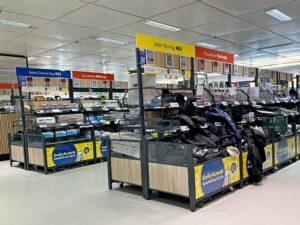
Despite its location in a non-food department store, Lidl integrates its rotating non-food in-out assortment, transferring a core footfall driver into the inner-city store format
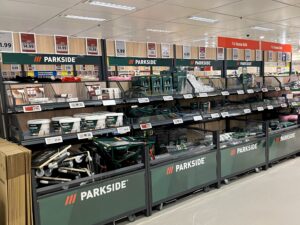
This also includes Lidl’s third non-food axis, the seasonal Parkside assortment
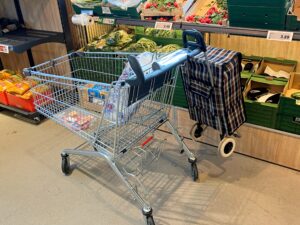
Beyond car and foot traffic, shopper logistics include two-wheeled trolleys, reflecting Berlin’s transport-hub locations and supporting grocery shopping without car dependency
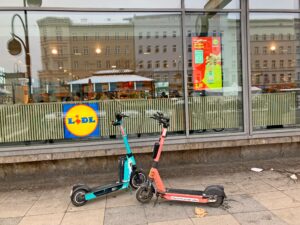
Lidl draws a younger, more mobile audience than the department store earlier, highlighting new shopper logistics challenges, visible in parked e-scooters outside the shared location
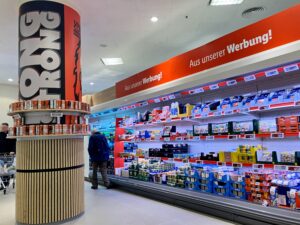
The younger shopper cohort is also reflected in-store, with a dedicated Kong Strong private-label energy drink fixture highlighting urban consumption habits.
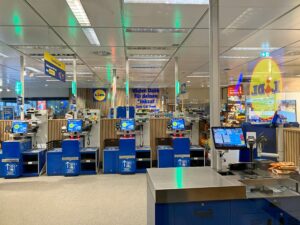
The checkout zone combines staffed tills and self-checkouts, including Lidl’s newer setup with a dedicated cash-payment station, while card and Lidl Pay remain standard at self-checkouts.
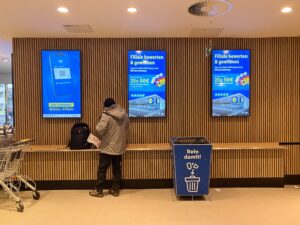
The newest inner-city stores feature expanded digital infrastructure, with large-format screens placed at the storefront and directly after the checkout zone

Related news
Lidl Expands UEFA Collaboration With Multi-Year Partnership
🎧 Hallgasd a cikket: Lejátszás Szünet Folytatás Leállítás Nyelv: Auto…
Read more >
A new LIDL store is being built in Csepel–Királyerdő – a time capsule was placed at the beginning of the investment
🎧 Hallgasd a cikket: Lejátszás Szünet Folytatás Leállítás Nyelv: Auto…
Read more >
dm Tests QR-Code Checkout Technology in Selected German Stores
🎧 Hallgasd a cikket: Lejátszás Szünet Folytatás Leállítás Nyelv: Auto…
Read more >Related news
Food Retailer Biedronka Eyes Carrefour Assets In Poland
🎧 Hallgasd a cikket: Lejátszás Szünet Folytatás Leállítás Nyelv: Auto…
Read more >
AM: agricultural support to reach tens of thousands of producers in the coming days; Ministry of Agriculture helps farmers with accelerated payments
🎧 Hallgasd a cikket: Lejátszás Szünet Folytatás Leállítás Nyelv: Auto…
Read more >
Ikea owner Ingka to cut 800 roles as CEO says it has “grown too complex”
🎧 Hallgasd a cikket: Lejátszás Szünet Folytatás Leállítás Nyelv: Auto…
Read more >
