
Sándor Czomba: net earnings are rising faster than gross earnings

For months now, it has been clear that net earnings have been growing at a higher rate than gross earnings, the State Secretary for Employment Policy at the Ministry of National Economy (NGM) stated on Thursday on the M1 current affairs channel.
 Sándor Czomba emphasized that this is clearly due to the family policy instruments that the government introduced last year. He added that the median salary is also rising more than the gross average salary, so “those in the lower region are the ones who are catching up more“.
The Secretary of State said that according to the latest data, the gross average salary in Hungary was almost 800 thousand forints in December last year, but he believes that this will be even more in January this year. He also highlighted that it is also visible that there is no gross average salary below 500 thousand forints anywhere in the country.
At the top of the list is Budapest with 850 thousand forints, while at the bottom is Szabolcs-Szatmár-Bereg County, where this amount is 530-540 thousand forints. He noted that there are fewer and fewer counties in the country where the gross average salary does not reach 600 thousand forints.
Sándor Czomba said that thanks to the decline in inflation, real wages also showed a significant increase of more than 6 percent. According to him, this fits into the trend that wages have been continuously and dynamically increasing for more than a year.
The Secretary of State also said that one of the top priorities in Hungary is to prevent the country’s population from decreasing. This demographic situation, however, is “not a Hungarian specialty“, but rather typical of the whole of Europe, and each person can decide what means to use to combat it.
As he said, there are those who have decided in favor of migration, but it is clear that its result is “more of a catastrophic story than a useful one from a labor market perspective“. He emphasized that the Hungarian government intends to encourage childbearing through the family support system and would like the country’s population to remain around 10 million in the coming years.
Sándor Czomba also mentioned that employers indicated during wage negotiations that this year’s 11 percent minimum wage increase represents a very serious challenge with such GDP growth. Companies must therefore invest significant resources in improving productivity and increasing efficiency.
He highlighted that the Hungarian government is supporting this effort – especially in the SME sector – through various support systems. He said that the result of a complex process is that despite the difficulties, “we see good data both in wages and in other segments of the labor market.”
According to him, the wage differences between individual sectors are also continuously narrowing and in three areas the gross average earnings have long been above 1 million forints. He added that wages increased most dynamically last year in the teaching profession and the gross average wage in the education sector exceeds the gross average wage in the national economy.
As he said, one of the important elements of the three-year wage agreement is to provide assistance to those businesses that employed workers at the minimum wage in September-October 2024. The essence of the support is that employers only have to pay the previous year’s contribution for these workers annually
– he said.
He announced that a tender will be available on the website of the Hungarian State Treasury from March 1st, for which micro, small and medium-sized enterprises can apply primarily if they employ workers at the minimum wage. The amount of the support is expected to be around 50 thousand forints per employee – he said.
Related news

Confidence in the SZÉP card remains unbroken, with 18 percent more payments made with it in February
🎧 Hallgasd a cikket: Lejátszás Szünet Folytatás Leállítás Nyelv: Auto…
Read more >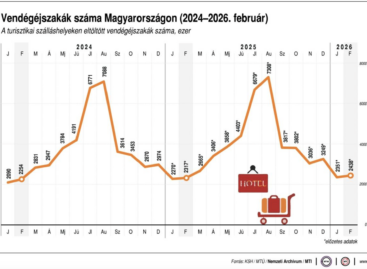
NGM: domestic tourism did not slow down in February either
🎧 Hallgasd a cikket: Lejátszás Szünet Folytatás Leállítás Nyelv: Auto…
Read more >
Hundreds of thousands would work more outside of traditional frameworks
🎧 Hallgasd a cikket: Lejátszás Szünet Folytatás Leállítás Nyelv: Auto…
Read more >Related news

Aldi, Auchan, Lidl, PENNY, SPAR, Tesco: in 2024 they paid more than 710 billion into the budget, while closing with a loss
🎧 Hallgasd a cikket: Lejátszás Szünet Folytatás Leállítás Nyelv: Auto…
Read more >
OKSZ: Household consumption cannot keep up with the growth rate of real wages
🎧 Hallgasd a cikket: Lejátszás Szünet Folytatás Leállítás Nyelv: Auto…
Read more >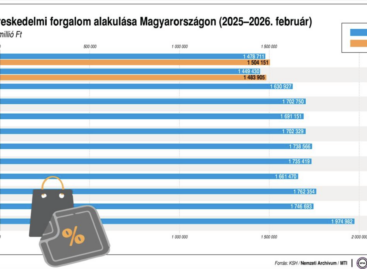
KSH: retail turnover in February exceeded the same period of the previous year by 3.8 percent and the previous month by 0.4 percent
🎧 Hallgasd a cikket: Lejátszás Szünet Folytatás Leállítás Nyelv: Auto…
Read more >
