
Aldi tests “Compact 2.0” urban store concept at Warsaw transport hub

Aldi has opened its first store located in a railway station in Poland at Warszawa Zachodnia, the country’s largest transport hub. The compact store with a sales area of around 600-square-meter could become a European blueprint for urban Aldi Nord locations, compressing the full discounter assortment into a format designed for high-traffic environments.
Aldi in Poland has opened its first store located in a railway station at

Sebastian Rennack
international retail analyst
Aletos Retail
Warszawa Zachodnia, Poland’s largest transport hub. The location operates in the Compact 2.0 format, designed for dense urban environments with limited space while maintaining Aldi’s full core assortment. With a sales area of approximately 600 square meters, the store is significantly smaller than typical Aldi stores and illustrates how the discounter adapts its model to highly urbanized locations. The store is integrated into the food service gallery beneath the platforms and targets commuters, travelers, and residents of nearby residential developments.
The concept is one of the few small-area stores of Aldi Nord across Europe and might serve as a blueprint for similar urban formats across the retailer’s international markets. The store addresses two different shopping missions without fundamentally changing the Aldi assortment.
On one hand the location inside Poland’s largest transport hub positions the store within a convenience-driven environment. After the full reconstruction and reopening of Warszawa Zachodnia in late 2025, the station now handles up to 100,000 passengers per day. The reduced sales area and the presence of six self service checkouts support quick purchases for commuters and travelers.
However, unlike typical convenience retailers, the store does not feature a dedicated, limited convenience assortment but instead compresses the full Aldi offer into a smaller footprint. Customers can therefore complete a full grocery shop aimed at the surrounding catchment area, estimated to include 30,000 to 40,000 residents. The location also creates a competitive advantage. While most stores in Poland must remain closed on Sundays, retail units located within railway stations are exempt when serving travelers. As a result the store operates seven days a week from 6:00 to 22:00.
To host the full assortment within a compact footprint Aldi adapts several merchandising elements. Shelving is significantly higher than in standard stores. Instead of a podium with two or three shelves on top, the structure consists of the podium level plus four or five shelf levels. Staples and bulky items such as flour, sugar, oil, UHT milk, washing liquid, and household paper are still merchandised on half pallets integrated into the shelving to maintain efficient in-store operations.
Promotional areas are minimized to save space. Food and non-food promotions occupy less than one third of the usual space and are additionally merchandised on multi level mesh wire shelving instead of the typical promotional tables with smaller add on fixtures used in standard stores.
With approximately 1.7 meters the aisle width is at the lower end of the Aldi standard. This is in line with the fact that the store does not offer standard shopping carts but instead provides rolling shopping baskets.
The fruit and vegetable department is more compact and positioned directly at the entrance, with a focus on ready to eat fruit suited for immediate consumption. Adjacent to this section the wall chillers begin with a dedicated range of chilled convenience products. The bakery section consists of one shelf unit for bread, two units for bread rolls, and three units for sweet and savory bakery snacks such as donuts, croissants, and pizza rolls, again favoring immediate consumption.
Despite the compact layout of the rest of the store, the beverages department, particularly relevant for the convenience mission, still consists of pallet streets and a full shelf axis for energy drinks and juices comparable to standard stores. In this location the beverage section is positioned directly next to the checkout zone.
Checkout space is optimized through six self service checkouts supported by an exit gate system. In addition the store includes two tandem checkouts that further reduce the space required for traditional cashier lanes. Together these elements support fast transactions and efficient shopper flow in a high traffic transport environment.
We visited the store to examine Aldi’s latest urban store concept.
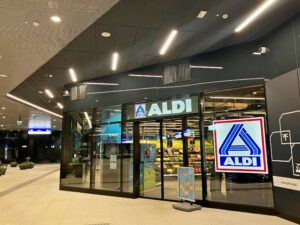
Aldi’s 600 sqm Compact 2.0 store at Warszawa Zachodnia station is located one level below the train platforms. The store sits directly within the passenger flow of Poland’s largest transport hub.
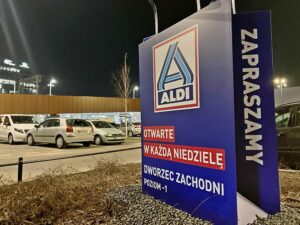
An oversized Aldi shopping bag installation in front of Warszawa Zachodnia station promotes Sunday opening of the new store on level −1. Stores located inside railway stations are exempt from Poland’s Sunday trading ban, allowing Aldi to operate the location seven days a week
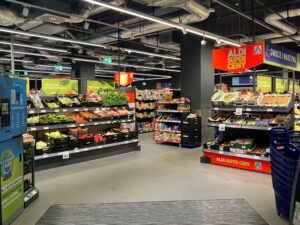
The fruit and vegetable department is located at the front of the store, following Aldi’s standard store layout, but highlighting items for immediate consumption
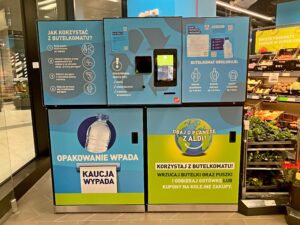
A bottle deposit return machine is positioned directly at the store entrance. Since January 1, 2026, retailers in Poland are required to accept beverage container returns under the national deposit system.
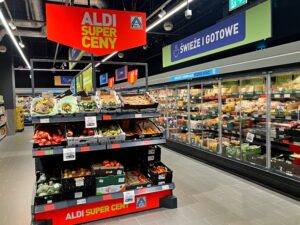
The first section of the wall chillers contains Aldi’s chilled convenience range, including mainly ready-to-heat meals and a smaller selection of fresh salads
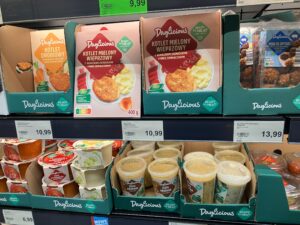
Under the Daylicious convenience private label jointly developed by Aldi Nord and Aldi Süd, the retailer offers Polish favorites such as Kotlet wiepryowz (pork cutlet) and Krupnik (barley soup).
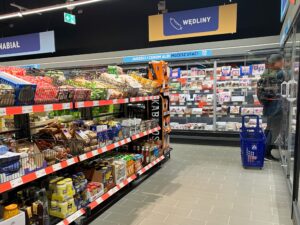
Food promotions use three-level mesh basket shelving instead of standard promotional tables. This fixture increases space productivity in the compact store layout
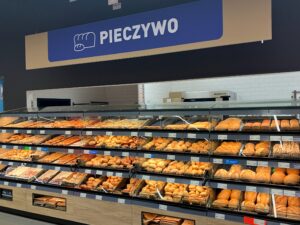
The bake-off station is merchandised from the back to support replenishment right from the oven. The assortment focuses mainly on bread rolls and sweet or savory bakery snacks.
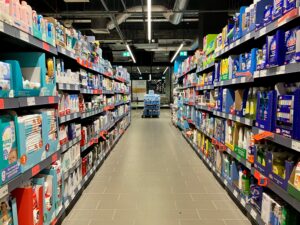
Aisle width measures around 1.7 meters, at the lower end of Aldi standards.
Narrower aisles reflect the compact layout used in this urban format
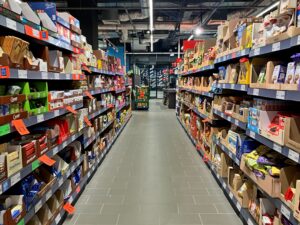
Shelving uses up to six shelf levels. Standard Aldi stores typically operate with three or four levels
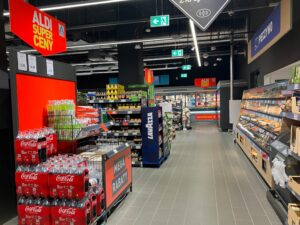
Promotions follow the same mechanics and pricing as in standard Aldi stores.
Aldi applies the same national pricing as across the rest of its store network
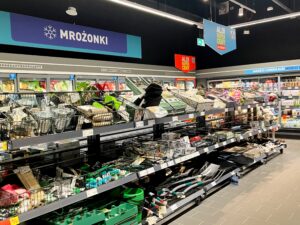
Non-food promotions use three shelf levels within compact mesh basket fixtures.
The space allocated equals roughly one third of that at standard Aldi stores
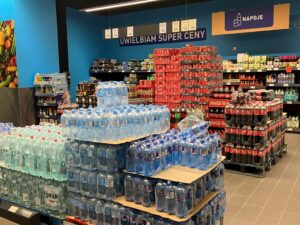
Water and carbonated drinks as core convenience assortment take up a large part of the store near the checkout zone and are displayed efficiently as pallet streets. In this railway station location the store carries no alcoholic beverages
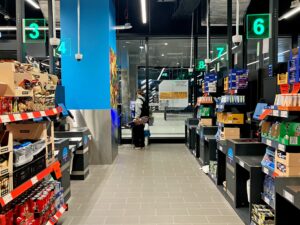
Six self-checkout terminals offer quick transactions for commuters and travelers.
Two traditional cash desks operate in a space-saving tandem installation
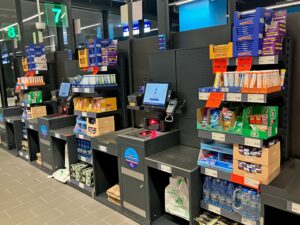
Impulse assortment at the self-checkouts includes OTC products, chewing gum, snack bars and water
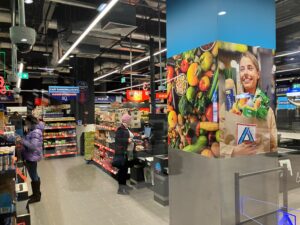
Full glass frontage makes the store interior visible from outside. Large image panels target younger shoppers and create strong visual merchandising
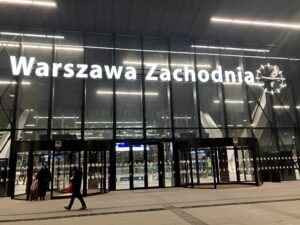
Warszawa Zachodnia station reopened in November 2025 after a five-year reconstruction. The modernized transport hub is designed for up to 100,000 travelers per day
Related news

Amazon to invest over 5 billion euros in Poland
🎧 Hallgasd a cikket: Lejátszás Szünet Folytatás Leállítás Nyelv: Auto…
Read more >
When organic becomes mainstream: A glimpse of what awaits food retail in Central & Southeast Europe
🎧 Hallgasd a cikket: Lejátszás Szünet Folytatás Leállítás Nyelv: Auto…
Read more >
Food Retailer Biedronka Eyes Carrefour Assets In Poland
🎧 Hallgasd a cikket: Lejátszás Szünet Folytatás Leállítás Nyelv: Auto…
Read more >Related news
István Nagy: the government’s goal is to further strengthen the competitiveness of Hungarian agriculture and place the future of domestic agriculture on a solid foundation
🎧 Hallgasd a cikket: Lejátszás Szünet Folytatás Leállítás Nyelv: Auto…
Read more >
Bulk shopping has become significantly cheaper: more than 900 products are available at much lower prices than a year ago
🎧 Hallgasd a cikket: Lejátszás Szünet Folytatás Leállítás Nyelv: Auto…
Read more >
EY: Activity increased, yet the value of the Hungarian M&A market decreased significantly
🎧 Hallgasd a cikket: Lejátszás Szünet Folytatás Leállítás Nyelv: Auto…
Read more >
