
When organic becomes mainstream: A glimpse of what awaits food retail in Central & Southeast Europe

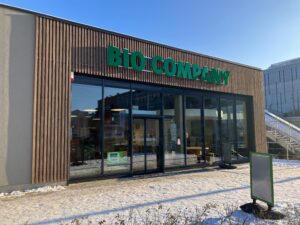
In Germany, discounters already dominate the organic category, forcing specialist retailers to redefine their differentiation logic. A visit to Bio Company in Berlin illustrates how organic retail evolves once price and certification are no longer sufficient competitive levers.

Sebastian Rennack
international retail analyst
Aletos Retail
Discounters have been gaining market share across Central and Southeast Europe for years. At the same time, they are expanding beyond pure price positioning and increasingly entering health-oriented and niche segments such as organic. What was once a clear differentiation field for supermarkets and hypermarkets is gradually becoming part of standardized private label assortments. Operators such as Carrefour and Auchan respond with dedicated shop-in-shop organic concepts, attempting to defend positioning and margin in a category that once offered natural differentiation from discount competitors.
In Germany, this structural shift has already reached a more advanced stage. Discounters have become the largest sales channel for organic products, holding a 28.9 percent share in 2025, up 2.1 percentage points compared to 2022. In doing so, they overtook full-range supermarkets, which remained broadly stable at 27.6 percent over the same period. Specialist organic retailers declined from 30.8 percent to 25.6 percent, losing 5.2 percentage points within three years. Organic is no longer a protected niche channel, but a competitive factor integrated into mainstream retail formats.
Against this backdrop, the German market provides a relevant benchmark for CSEE operators. Berlin-based Bio Company, the number three specialist organic supermarket chain in Germany, operates around 60 stores, almost entirely concentrated in the Berlin–Brandenburg metropolitan region. After slipping into losses in 2022 under inflationary cost pressure and shifting consumer spending patterns, the company returned to positive earnings in 2024. Rather than pursuing aggressive geographic expansion, Bio Company refocused on its urban core market, strengthened its private label strategy and consolidated its wholesale and logistics structures in northeastern Germany. The retailer opened its range of more than 450 private label products to independent organic stores, partnered with national wholesalers and transferred its online business to the delivery platform Wolt.
A visit to one of its Berlin stores illustrates how a regional operator seeks to differentiate in an environment increasingly shaped by discounter expansion. Assortment depth, regional sourcing and urban positioning form the backbone of a concept that aims to create distinction beyond standardized organic ranges and price competition..
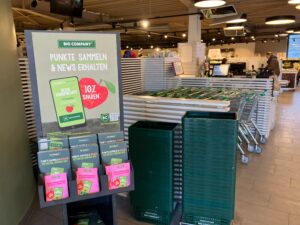
In a price-driven market and growing competition with discounters, Bio Company strengthens customer loyalty through a points program in which 50 collected points, earned at one point per €5 spent, unlock a one-time 10 percent discount on the subsequent purchase.
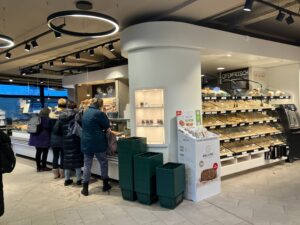
At the entrance, Bio Company presents its bakery as one integrated concept with self service shelves facing the supermarket entrance and a staffed counter connected to a dedicated café zone in front of the cash line. At the time of the visit, parts of Berlin had been without electricity for several days, which was reflected in a reduced bakery assortment across retailers
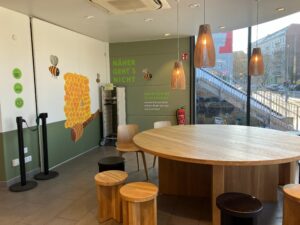
The café seating area furnished in natural wood furniture reinforces Bio Company’s local sourcing message, linking in-store consumption with rooftop beekeeping and transparent origin communication
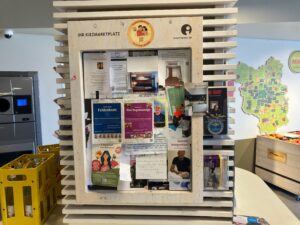
With its ‘Ihr Kiezmarktplatz’ (Kiez marketplace, with Kiez referring to a small, locally rooted urban community area in Berlin) notice board, Bio Company positions the store as a neighborhood hub that connects retail with local community life
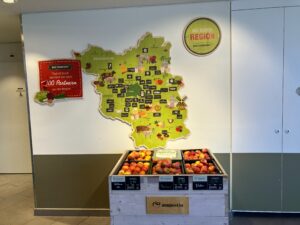
Bio Company visualizes its regional sourcing strategy with a supplier map of Berlin and Brandenburg, underlining daily deliveries from over 100 regional partners
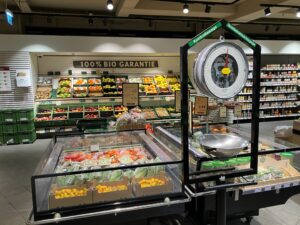
With a prominently placed analog control scale reminiscent of traditional market stalls, Bio Company visually connects its produce department to the atmosphere of open-air markets while reinforcing its 100 percent organic guarantee
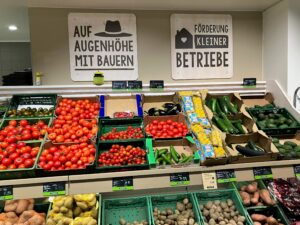
With messages such as “At eye level with farmers” and “Support of small businesses,” Bio Company emphasizes direct producer relationships as a structural counterweight to scale-driven sourcing
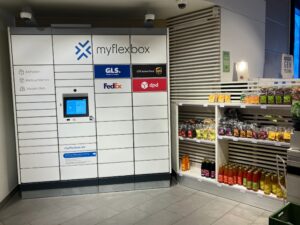
By integrating a third-party parcel locker inside the sales area, Bio Company turns the store into a multifunctional pickup point, driving additional footfall beyond pure grocery missions
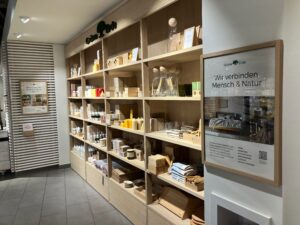
Bio Company’s shop-in-shop showcases a curated selection of Austrian organic brand Grüne Erde’s sustainably made home and lifestyle products, extending the organic shopping experience into non-food categories
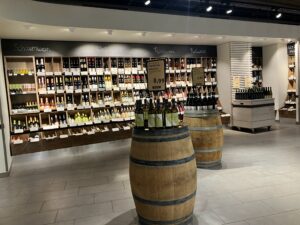
In a separate and atmospherically staged wine section, Bio Company presents a fully organic assortment in a premium setting that mirrors specialist retail rather than classic supermarket shelving
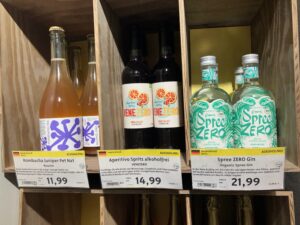
Bio Company expands its wine and spirits section with premium alcohol-free alternatives, including locally produced options from Berlin, reflecting zero-alcohol consumption within the organic segment
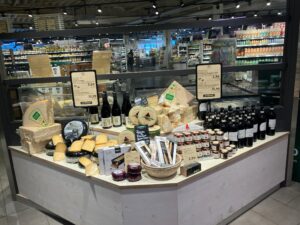
Bio Company elevates its dairy department with a climate-controlled cheese room, positioning organic specialty cheeses in a setting more typical of delicatessen retail than conventional supermarket presentation
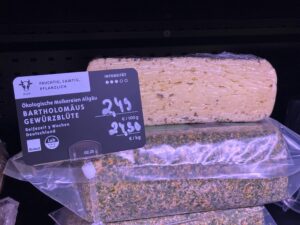
By specifying cow milk origin, maturation intensity, and Bioland standards, Bio Company moves quality signaling beyond the generic organic label
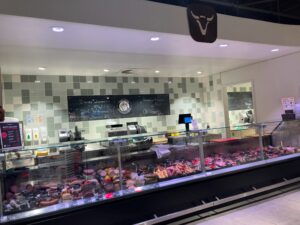
The staffed meat counter combines handwritten product boards and visible in-store preparation, reinforcing Bio Company’s positioning around craftsmanship and controlled organic sourcing
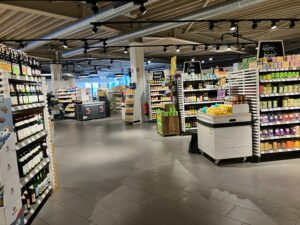
The open layout and warm wooden fixtures support a slower, more engaged shopping experience that invites product exploration rather than routine replenishment
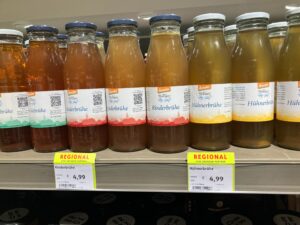
Regionally produced broths from partner BroDowin, certified under the biodynamic Demeter standard, highlight Bio Company’s emphasis on local sourcing combined with organic quality beyond EU baseline certification
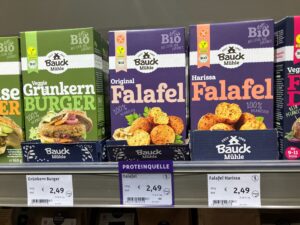
The clear protein cueing illustrates how the retailer incorporates mainstream health trends into standardized shelf communication
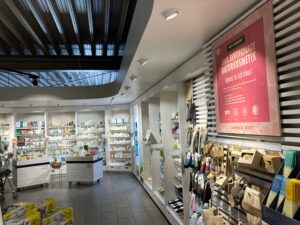
A dedicated natural cosmetics department highlights 100 percent certified products, positioning Bio Company as a specialist destination for organic beauty beyond food retail
Related news
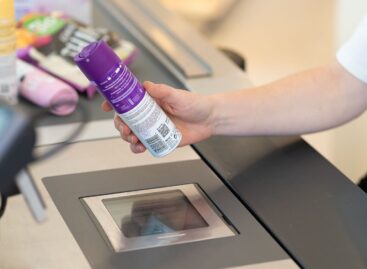
dm Tests QR-Code Checkout Technology in Selected German Stores
🎧 Hallgasd a cikket: Lejátszás Szünet Folytatás Leállítás Nyelv: Auto…
Read more >
Sustainable, innovative and longer-lasting: REWE Group sets a new standard in hydroponic cultivation with its loose-leaf lettuce
🎧 Hallgasd a cikket: Lejátszás Szünet Folytatás Leállítás Nyelv: Auto…
Read more >
Skyr Shortages Hit German Supermarkets Amid Social Media Hype
🎧 Hallgasd a cikket: Lejátszás Szünet Folytatás Leállítás Nyelv: Auto…
Read more >Related news

How will we pay for coffee in 2030, and will Europe finally get its own financial infrastructure?
🎧 Hallgasd a cikket: Lejátszás Szünet Folytatás Leállítás Nyelv: Auto…
Read more >
The government supported food industry developments with more than one thousand billion forints
🎧 Hallgasd a cikket: Lejátszás Szünet Folytatás Leállítás Nyelv: Auto…
Read more >
Starting today, restaurants, and from April, pastry shops, can also apply for the 5+5 million forint loan and support scheme
🎧 Hallgasd a cikket: Lejátszás Szünet Folytatás Leállítás Nyelv: Auto…
Read more >
