
The most expensive mistake in logistics is the “it’s the way we used to do it” mentality

The Hungarian and Central European logistics sector has now established operating patterns that reproduce cost increases, capacity shortages and unnecessary environmental burdens every day. According to a recent analysis by the Hungarian Logistics Service Centers Association (MLSZKSZ), the “business as usual” logic affects all actors: carriers, forwarders, shippers, receivers and ultimately consumers, while the efficiency of the system is barely improving and waste is constantly increasing. The problem does not start with a lack of technology, but with entrenched, faulty practices.
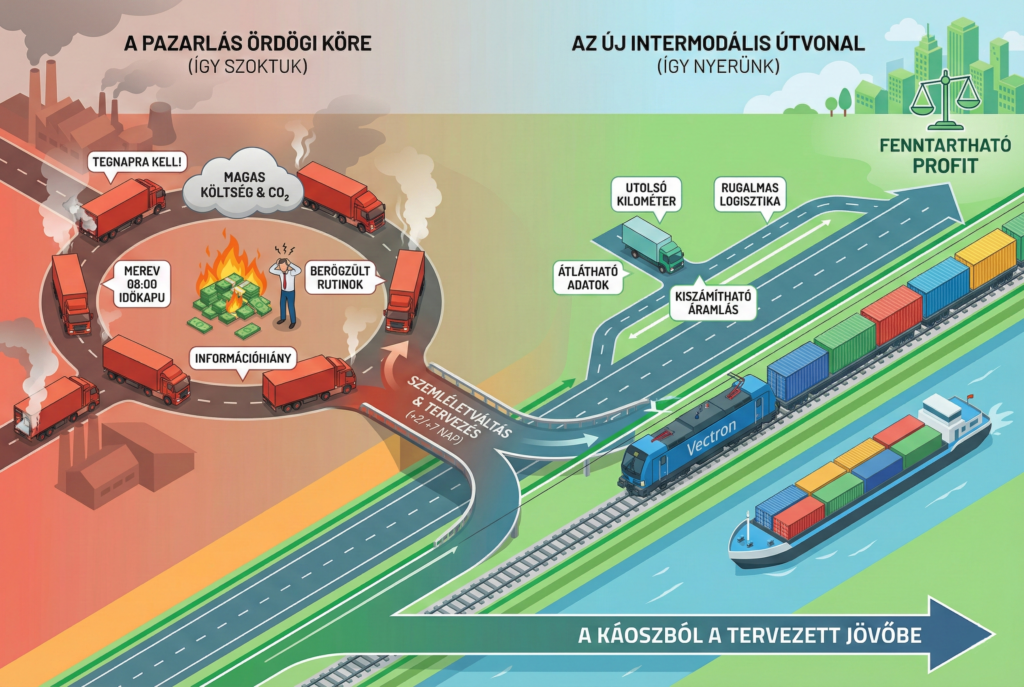
In supply chains today, it is still a widespread phenomenon that several trucks are ordered at once for eight in the morning, while only one can be served per hour. An average driver spends only a third of his working time actually driving, the rest is waiting, paperwork and organizational losses. The price of all this is oversized fleets, unnecessary idle times, increased emissions and hundreds of billions of forints of wasted resources annually. According to the analysis of the MLSZKSZ, the system operates as if it were struggling with a capacity shortage every day, even though the real capacity is mostly available, but it is not professionally coordinated.
The majority of deliveries labeled as urgent are not a real market demand, but the result of faulty internal performance indicators, distorted incentives and poorly functioning corporate cultures. The absurdity of the practice is clearly demonstrated by the fact that goods considered to be of paramount importance often sit in warehouses for days, while they have previously traveled up to a thousand kilometers by express. The analysis of the MLSZKSZ highlights that behind all unnecessary urgency there is an invisible environmental tax, as the CO₂ footprint of an express shipment can be equivalent to the annual binding of up to a hundred trees.
We are still heading North, even though the Adriatic is faster and greener
The majority of goods from the Far East continue to arrive in the ports of Northern Europe, even though the Adriatic route offers up to 6 days shorter sea time, half as long rail connections and free capacity for the region. However, habit is stronger than rationality. This is one of the most illustrative examples of how operating “the way we are used to” actually wastes days, serious money and a lot of fuel unnecessarily.
According to the analysis, rail is 20-30 percent cheaper, while inland waterway shipping can operate with a 30-50 percent cost advantage. In both cases, carbon dioxide emissions are 60-85 percent lower per tonne-kilometre. The role of roads will remain, but primarily in the last kilometres. If the supply chain is well organised, rail and water provide a stable basis for transport, and roads effectively complement it.
Sustainability does not start with electric trucks
According to the Association’s position, real greening does not start with replacing the vehicle fleet, but with rethinking the entire supply system and increasing its efficiency. The greatest environmental gains occur where waiting times are eliminated, planning becomes transparent, goods receipt and time slot management become more flexible, distorted incentives disappear, and companies examine their own processes with an end-to-end approach (i.e. treating the entire supply chain as a unit from the starting point to the end point). In the current operation, everyone loses.
“Carriers pay costs, forwarders pay capacity, customers pay time, and society pays a much greater environmental burden than necessary. However, if a change of attitude occurs, logistics can become more efficient, greener and more predictable. Railways, waterways and intermodal solutions can become the new backbone of the entire supply chain”
– said Ajtony Bíró Koppány, Secretary General of the MLSZKSZ.

Related news
Asda And Podback Recycle 20 Million Coffee Pods In First Year Of Partnership
🎧 Hallgasd a cikket: Lejátszás Szünet Folytatás Leállítás Nyelv: Auto…
Read more >
Customs authorities handle half a million packages a day, e-commerce is booming
🎧 Hallgasd a cikket: Lejátszás Szünet Folytatás Leállítás Nyelv: Auto…
Read more >
Put a limit on plastic! – plastic waste reduction campaign for Green – Green for Pécs
🎧 Hallgasd a cikket: Lejátszás Szünet Folytatás Leállítás Nyelv: Auto…
Read more >Related news
Asda And Podback Recycle 20 Million Coffee Pods In First Year Of Partnership
🎧 Hallgasd a cikket: Lejátszás Szünet Folytatás Leállítás Nyelv: Auto…
Read more >
Danone buys meal-replacement firm Huel
🎧 Hallgasd a cikket: Lejátszás Szünet Folytatás Leállítás Nyelv: Auto…
Read more >
Zalando is scaling up its use of AI-powered warehouse robots
🎧 Hallgasd a cikket: Lejátszás Szünet Folytatás Leállítás Nyelv: Auto…
Read more >
