
The domestic press market maintained its stability in 2025, although the expansion in real terms was minimal

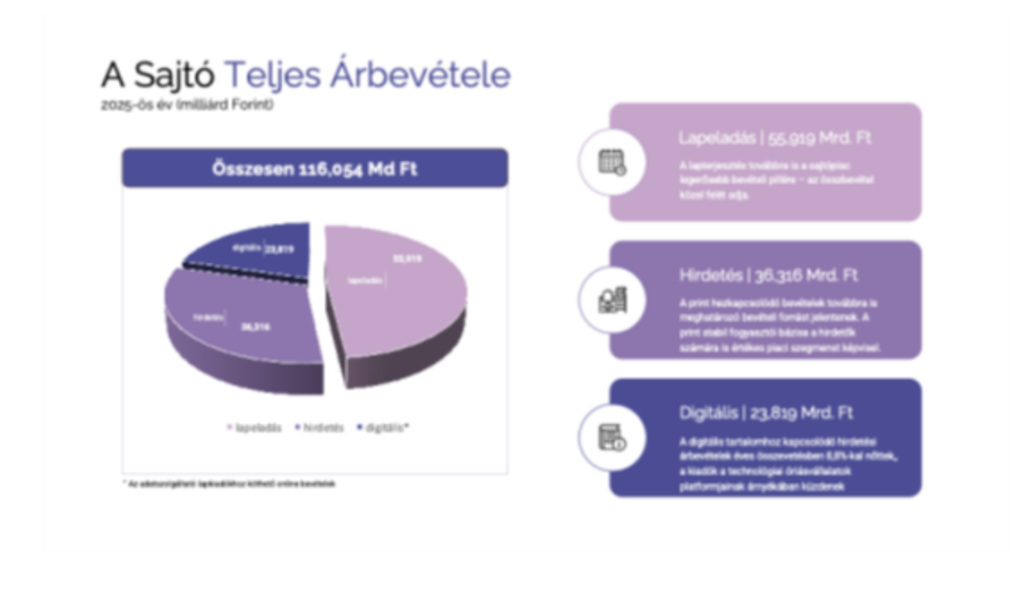
According to the MLE, in 2025 the “net-net” (reduced by agency and other discounts) print advertising market revenue was 36.316 billion forints.The total press revenue from newspaper distribution was 55.919 billion forints. data-contrast=”auto”> forint and theonline revenue included in the tax returntogether in 2025 116.054 billion forints.
The revenue from newspaper sales accounts for 48%, while the revenue from advertising is 31%. There are nearly 500 press publishers operating in the Hungarian market, publishing almost 7,200 publications, and their business model continues to be largely based on strong and stable newspaper sales. Revenues related to printed publications continue to be a significant source of income for many publishers. Printed advertising revenues showed a nominal increase of 4.6% compared to the previous year, however, in an inflationary environment of around 4.4%, this represents only a minimal increase in real terms. The print segment continues to have a prominent weight, accounting for 79% of total revenue.
In addition to print spending, the reporting publishing companies also realized online advertising revenue of HUF 23.819 billion. Digital content advertising revenue grew 8.8% year-over-year as advertisers continue to value the credibility of established brands. It now accounts for 21% of total revenue. While online advertising revenue has increased compared to the previous year, publishers are struggling to make significant gains, overshadowed by the platforms of tech giants.
Print ads (31%) still generate more revenue than digital (21%), but the The gap is narrowing. This stable source of income allows editorial offices to finance digital developments and new technologies. The market environment remains difficult, but international experience confirms that consciously diversifying, data- and brand-based publishers are the ones that perform particularly well. Overall, revenues from printed products – including advertising and circulation – account for 79% of publishers’ total revenue. This figure clearly shows that the print business remains one of the most stable pillars of the media industry, even in the face of digital transformation. In addition to the stability of print, the sector is intensively preparing for the future. For publishers, artificial intelligence and automation are one of the most prominent investment areas in 2026.
The domestic development of print advertising spending reflects that the print press remains an unavoidable factor in the advertising mix, thanks to consumer trustand the value of the content.
Publishers are looking to offset increased costs They also tried to stabilize the market with price increases in 2025.This is also supported by data from Lapker Zrt.: the prices of more than 900 publications they distribute increased by an average of 14.9%. However, due to the inflationary environment, we still cannot speak of a significant increase in real terms.
The strength of the printed press is its stable and significant readership, which also represents a valuable market segment for advertisers
A nationally representative survey conducted among the 16-75 age group published in December 2025research highlights thatthe printed press remains an important and stable part of Hungarian media consumption habits, despite the increasing penetration of digital content. According to the NOK’s national survey, approximately 36% of the entire age group regularly reads printed press products on a weekly basis, which means approximately 2.7million people. This number clearly shows that print has not lost its significance, but remains a decisive source of information. The consumption of printed newspapers and local press products is stronger among readers over 50 and those with higher education. Four out of ten people still read print media regularly, and the high satisfaction of subscribers shows that the experience of reading, the charm of a printed press product in their hands, continues to be a lasting value. An important result is that the research refuted the myth that young people (under 30) do not read print publications (also). 12% of those who read both digital and printed publications are in the 16-29 age group, and 32% of young people aged 16-29 buy newspapers.
According to the opinions of those who read both digital and printed media, the advantages of paper-based media include more in-depth, longer content consumption and the experience of relaxation, which is why they do not necessarily associate the printed form with certain topics or life situations, and both formats have their place and role in consumers’ lives, so it is important information for advertisers to consider both segments equally when planning budgets. While digital content consumption is growing, the stable consumer base of the print press also represents a valuable market segment for advertisers.
The professional and economic risks of the rise of artificial intelligence (AI) systems
The rise of generative artificial intelligence poses an increasingly significant existential risk to quality journalism and professional content production, as the technology’s training process involves the reproduction of works protected by copyright and related rights, often without the permission and knowledge of the rights holders who produced the content. In this way, AI development and data use undermine the economic return on publishers’ investments, further increasing the vulnerability of the press to online platforms, on which publishers both depend and with which they are in direct competition for users. Without adequate legal guarantees and cost recovery, the economic foundations of content production are shaken: without credible sources of information, neither online information nor quality content can be maintained.
Related news

Hungarian Advertising Association: solid growth in 2025, but still lagging behind 2019
🎧 Hallgasd a cikket: Lejátszás Szünet Folytatás Leállítás Nyelv: Auto…
Read more >
Scientific compass in logistics: Logistics Yearbook 2026 published
🎧 Hallgasd a cikket: Lejátszás Szünet Folytatás Leállítás Nyelv: Auto…
Read more >
The Hungarian Logistics Association received the Business Superbrands award again
🎧 Hallgasd a cikket: Lejátszás Szünet Folytatás Leállítás Nyelv: Auto…
Read more >Related news
Lidl sold nearly 100 million liters of Hungarian milk
🎧 Hallgasd a cikket: Lejátszás Szünet Folytatás Leállítás Nyelv: Auto…
Read more >
Tetra Pak wins major award
🎧 Hallgasd a cikket: Lejátszás Szünet Folytatás Leállítás Nyelv: Auto…
Read more >
AI: Help or Addiction? Recent Research
🎧 Hallgasd a cikket: Lejátszás Szünet Folytatás Leállítás Nyelv: Auto…
Read more >
