
Water retention and ecological water replenishment: from now on, every idea goes into your pocket

The beginning of this year is particularly promising in terms of boosting water conservation farming. An agricultural subsidy has been launched that would pay farmers over 900 euros per hectare for water retained on their land. Now is the time to work together with the agricultural, water management sectors, local governments and civil society to retain as much of the rarely seen rainfall as possible, as it will be greatly needed throughout the year.
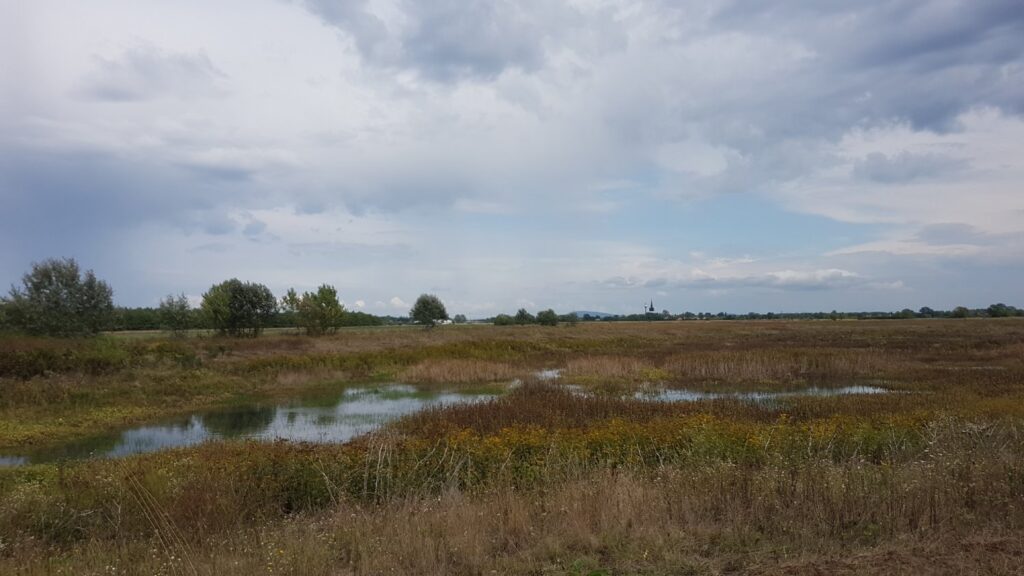
In recent years – especially after the record drought in 2022 – a paradigm shift has begun in agriculture and the country’s water management, which, instead of quickly draining water, is looking for technical solutions and, above all, suitable locations for water conservation and the utilization of water in the landscape. A good example of the latter is Water to the Landscape! program, in which farmers can offer their areas for flooding. In the absence of adequate financial incentives or compensation for farmers, the change in attitude has been very slow so far, despite the fact that temporarily flooded areas and small wetlands are no longer excluded from the area-based basic payment of the Common Agricultural Policy. Moreover, additional support can be obtained for them in agri-environmental management and agri-ecological programs.
The call for applications, which opens a long-awaited support called “Investments promoting the creation and maintenance of semi-natural and wetland habitats”, is intended to further encourage the change in landscape use, especially the willingness of farmers to retain water. In contrast to the previously published and largely unsuccessful calls for support for both creation and maintenance, the amount of support now available is spectacularly high this time. The amount of funding available for the creation of wetlands is 958 euros/hectare, and for their maintenance, 911 euros/hectare per year. The key, of course, is in the details, which are also promising. One of the objectives of the support is to create wetlands by retaining inland waters appearing in areas used for arable or grassland, and by rewetting the areas. Ecological water replenishment is permitted, but irrigation from the created wetlands is prohibited. The other activity eligible for support is the creation of grassy and shrub strips on arable land, primarily for soil protection purposes. Both priorities fill a gap in their own right. There will be three application phases in 2026, the first of which opens on February 19 with a deadline of March 21. The total amount of the support is 12.8 billion forints, which includes the funding requirements for erosion control (creation of shrubbery, grass strips) and the creation of wetlands, as well as the 5-year maintenance.
“The January snow cover is particularly fortunate, as we hope that the gradual melting will nicely outline the deeper areas prone to inland water, which can help farmers in their planning. The moisture-loving, herbaceous vegetation (sedge, reed) that occasionally appears on the fields also indicates the periodic water saturation of the soil and helps in the designation and delimitation of sites. Water does not know plot boundaries, so the evaluation system also encourages the cooperation of neighboring farmers with extra points. The best medium for water retention is soil, so in addition to filling reservoirs and canals, replenishing the soil’s water resources is also “is the most urgent task, since it is estimated that 40-200 mm of moisture is missing from the surface, depending on the region”
– said Péter Kajner, an expert in the WWF Hungary Living Rivers program.
Expert civil organizations see great prospects in the appearance of the application, and it also fits the objectives of the MERLIN Horizon project, which promotes nature-based water management solutions, and the Living Danube Partnership 2.0 program operating at the watershed level, in which WWF Hungary participates with the Upper Tisza, Bereg reservoir. The Tisza Valley Innovation and Climate Adaptation Association (TIKE) is organizing farmer forums in cooperation with WWF Hungary to explain the support opportunities and answer any questions that arise. The forums are aimed at farmers and local governments, and employees of water management directorates and national parks also participate in them. Multi-faceted participation helps to discuss agricultural, water management and nature conservation professional issues. The aim is to receive as many successful applications as possible, and after the assessment, as many new wetlands as possible can enrich our agricultural areas. This is an important component of the spread of mosaic landscape use, which has numerous advantages.
Related news

A change of perspective in forest management
🎧 Hallgasd a cikket: Lejátszás Szünet Folytatás Leállítás Nyelv: Auto…
Read more >
Water retention and ecological water replenishment: from now on, every idea will go into your pocket
🎧 Hallgasd a cikket: Lejátszás Szünet Folytatás Leállítás Nyelv: Auto…
Read more >
Milestone in domestic energy policy: new package of recommendations supports sustainable solar and wind power plant developments
🎧 Hallgasd a cikket: Lejátszás Szünet Folytatás Leállítás Nyelv: Auto…
Read more >Related news

What do we spread on our bread? Young people prefer butter, older people prefer margarine
🎧 Hallgasd a cikket: Lejátszás Szünet Folytatás Leállítás Nyelv: Auto…
Read more >
Products in the EU will receive a digital passport
🎧 Hallgasd a cikket: Lejátszás Szünet Folytatás Leállítás Nyelv: Auto…
Read more >
The Hungarian sports drink manufacturer has launched three new functional drinks
🎧 Hallgasd a cikket: Lejátszás Szünet Folytatás Leállítás Nyelv: Auto…
Read more >
