
The domestic SME sector is characterized by declining digitalization and weak efficiency

A recent, comprehensive study on the situation and problems of Hungarian small and medium-sized enterprises was conducted by management consulting firm Helix Consulting. Since this group accounts for 99% of all enterprises in Hungary and is responsible for 65% of employment, its existence is of paramount importance in every respect. The operation of the sector is well characterized by the fact that, compared to the aforementioned employment rate of almost two-thirds, only 41% of the added value is produced by SMEs, and the degree of digitalization in non-enforced areas has even decreased in recent years.
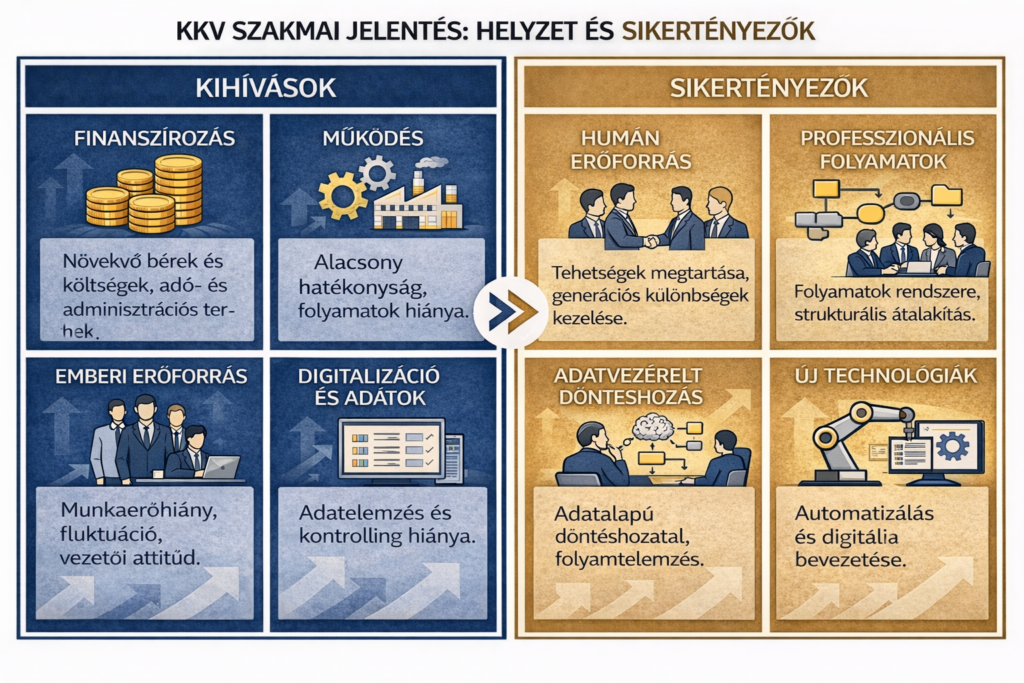
The experts defined the problems of companies along four dimensions, emphasizing that by addressing these systematically, lasting improvements can be achieved. One is finance and financing, where wages are rising disproportionately faster than productivity, and tax and administrative burdens have also increased. The second category is operational efficiency itself, where deficiencies in productivity and processes are common. The third is the issue of human resources, where labor shortages, high turnover, and managerial attitudes often cause problems. Finally, the fourth area is the idea of data and digitalization, where there are significant gaps in reporting systems, AI use, and data-based decision-making capabilities, ‒ Dóra Kovács-Vojsánszki, senior consultant at Helix Consulting, which conducted the survey, presented the findings of the report.
After analyzing the correlations revealed by the entire report, the picture only becomes more worrying, but some of the extracted data are very telling. The added value of small enterprises employing 10-49 people is proportionally higher than that of medium-sized enterprises employing 50-249 people. Of course, these are averages, but the point is that corporate growth, for example, is often difficult for the company culture and operations to keep up with, and running a much larger company with small-company tools results in a deterioration in efficiency, because in some cases the same one or a few people would have to manage 50 processes, who were already just getting by with 10.
The issue of generational change is also partly related to this. Thousands of founders from the era of regime change would like to hand over control in these years, but either there is no one to do it, or the company’s processes and structure are not suitable for this. Restructuring requires recognition, intention and time, but all three are often lacking.
Financial pressure has also been a serious factor in recent years, the expert pointed out. Fluctuating inflation, rising wage levels, energy, subcontractor and material costs, loan interest rates, as well as special taxes, official fees and logistics costs appearing in supplier fees all destroy the profit that would have a chance to finance, for example, the digital transition or the transformation of processes. The situation is only made worse by the circular debts that seem to be starting again.
Finally, the lack of controlling and the resulting lack of control pose serious challenges. In forced areas, e.g. invoicing programs connected to the National Tax Service, there is unbroken growth, which can hide in the statistics that, according to the Digiméter report, for example, in 2022 74% of companies analyzed the data generated during their operations, while in 2023 only 69% said the same.
The research focused primarily on the challenges, but of course there are also good examples – added Dóra Kovács-Vojsánszki. The consulting experience of recent years has identified four defining capabilities and characteristics as the key to the success of the SME sector. The first is data-driven decision-making, the structural and technical conditions for which obviously need to be created. The second is the construction of professional processes instead of the sole management of the founder. Third is the proper management of human resources, i.e. so that the company is able to manage generational differences and retain talents. Finally, the easiest thing is for the company to be open to new technologies, not afraid of automation and artificial intelligence. This is already widespread in production, but in corporate management and administration in Hungary it is still in its infancy.
As you can see – concluded the consultant with the lessons of the survey – the difference between success and struggle is not the macro environment that applies to everyone, but the internal operation. Those who intensively and proactively develop their companies and do not get stuck in the status quo can stand out from the crowd.
Related news

State support scheme
🎧 Hallgasd a cikket: Lejátszás Szünet Folytatás Leállítás Nyelv: Auto…
Read more >
QR code can help track food
🎧 Hallgasd a cikket: Lejátszás Szünet Folytatás Leállítás Nyelv: Auto…
Read more >
Hungarian-Serbian food industry adult training program launched
🎧 Hallgasd a cikket: Lejátszás Szünet Folytatás Leállítás Nyelv: Auto…
Read more >Related news

Spring renewal: interest in surprising products increased in spring
🎧 Hallgasd a cikket: Lejátszás Szünet Folytatás Leállítás Nyelv: Auto…
Read more >
Rossmann celebrated women’s successes as the main sponsor
🎧 Hallgasd a cikket: Lejátszás Szünet Folytatás Leállítás Nyelv: Auto…
Read more >
Hungarians order with one sentence: this is how we shop with the help of AI
🎧 Hallgasd a cikket: Lejátszás Szünet Folytatás Leállítás Nyelv: Auto…
Read more >
