
The K&H large company growth index shows a turnaround that cannot yet be called a trend

The leaders of large companies seem more optimistic compared to the strong pessimism of the previous period, according to the last quarter research data of the K&H Large Company Growth Index. Although the indicator is still in negative territory, it has improved from -13 to -7- points, which is close to the level after COVID but before the outbreak of the Russian-Ukrainian conflict. Therefore, fewer people expect a worsening economic environment in the next 12 months, and instead they are settling for stagnation. In addition, the proportion of companies that calculate with a worsening sales-to-profit ratio has also decreased by nearly 10 percentage points.
 After the strongly pessimistic mood of the third quarter of 2024, the pessimism of large company leaders decreased in the last three months of last year, which broke a continuous downward trend that had lasted for more than a year. The K&H Large Corporate Growth Index, which provides an overview of the economic and growth prospects of large companies, is currently at -7 points, up 6 points compared to the previous quarter. The corporate sub-index – which shows the microeconomic effects – returned to 0 points, and the macro sub-index also achieved a 9-point increase, which is still the fourth worst result in the history of the index.
“The current increase undoubtedly signals a turnaround after a longer, pessimistic period, but it can by no means be considered a trend
– stressed Tibor Bodor, Head of the K&H Corporate Division, in connection with the results.
“Based on the data, it can be seen that the majority of company managers are expecting stagnation. Among the possible reasons for the easing, the government’s economic stimulus measures can be mentioned, which had a positive effect on the mood of company managers. All this is supported by the fact that in the last quarter, far fewer people held the government’s economic policy as the primary cause of the economic environment. “On the top list of factors most influencing the economic outlook, this has fallen two places to third place, while according to recent data, consumers are most concerned about the narrowing of the domestic customer market and a possible spike in inflation,” the expert explained.
Related news

In February, industrial production decreased by 1.5 percent compared to the same period of the previous year and by 1.8 percent compared to the previous month
🎧 Hallgasd a cikket: Lejátszás Szünet Folytatás Leállítás Nyelv: Auto…
Read more >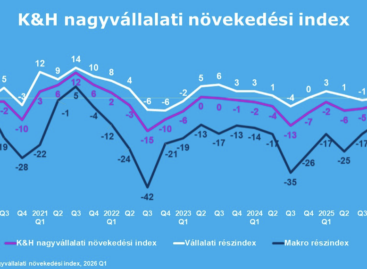
The corporate sector on a uniform basis of trust
🎧 Hallgasd a cikket: Lejátszás Szünet Folytatás Leállítás Nyelv: Auto…
Read more >
K&H: travel budget has reached its ceiling
🎧 Hallgasd a cikket: Lejátszás Szünet Folytatás Leállítás Nyelv: Auto…
Read more >Related news

Aldi, Auchan, Lidl, PENNY, SPAR, Tesco: in 2024 they paid more than 710 billion into the budget, while closing with a loss
🎧 Hallgasd a cikket: Lejátszás Szünet Folytatás Leállítás Nyelv: Auto…
Read more >
OKSZ: Household consumption cannot keep up with the growth rate of real wages
🎧 Hallgasd a cikket: Lejátszás Szünet Folytatás Leállítás Nyelv: Auto…
Read more >
KSH: retail turnover in February exceeded the same period of the previous year by 3.8 percent and the previous month by 0.4 percent
🎧 Hallgasd a cikket: Lejátszás Szünet Folytatás Leállítás Nyelv: Auto…
Read more >
