
The market continues to seek high-quality Hungarian horseradish

Despite cheap Chinese imports, there is a stable market for Hungarian horseradish. Hungarian horseradish remains a product of outstanding quality and is in demand on foreign markets. For this reason, both domestic and foreign consumers and processors insist on the usual quality of Hungarian horseradish.
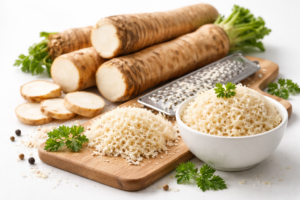
(Illustration: AI)
The horseradish harvest is over, after which the horseradish is stored in cold storage. The main roots are sold, while the side roots are used by farmers as propagation material for the next year’s production. Replanting is currently underway, which the producers start immediately after the harvest.
Although Chinese horseradish appeared on the EU market last year, its quality is far inferior to the domestic product
Although cheap Chinese imports have depressed purchase prices in the short term, they have only temporarily weakened the market position of domestic horseradish. Both domestic and foreign consumers and processors insist on the usual quality of Hungarian horseradish, so Chinese horseradish will probably not permanently endanger Hungarian production and export. Hungarian horseradish continues to be a product of outstanding quality and in demand on foreign markets. The domestic product traditionally has strong and stable export markets, with Germany, Poland and the Scandinavian countries among our most important partners. Due to the excellent quality of the crop, the processing industry also explicitly prefers Hungarian raw materials. In our country, horseradish is grown on nearly 1,470 hectares, of which 1,427 hectares, 97% of the production area is located in Hajdú-Bihar County. The size of the production area has been stable or has shown some expansion in recent years. The annual quantity harvested is around 11-12 thousand tons. This makes Hungary the largest horseradish producer in the EU, accounting for approx. gives half, but we are also considered a large horseradish producer in the world, after China and the United States.
In order to achieve higher yields and good quality, horseradish must be irrigated
This increases the production cost by about 10% in an average year, and in a drought year it accounts for about 20% of the total cost. Irrigation pays off handsomely in the case of horseradish, with proper water supply and care, the proportion of first-class goods is 80 percent. The domestic production capacity currently covers the needs of the processing industry and the fresh product market; if its production exceeds 8–10 thousand tons, the price will decrease significantly. At the same time, greater interest from the canning industry and the pharmaceutical industry can be expected in the future, which may also increase the demand for raw materials. 90-95% of the domestic production capacity is sold to the processing industry, and 5-10% to the fresh market. The largest amount of fresh horseradish is sold by producers during the Easter period.
Hajdúság horseradish has had a protected designation of origin in the European Union since October 21, 2009. The protection protects the name, which means that only those who grow horseradish in the area and in the manner specified in the product description can display it on their products. The Hajdúság horseradish growing region is a well-defined, territorially connected region, which is made up of about 13 settlements in Hajdúság.
NAK

Related news
Four more products have been approved for drone application this spring
🎧 Hallgasd a cikket: Lejátszás Szünet Folytatás Leállítás Nyelv: Auto…
Read more >
Tibor Navracsics: rural Hungary must be further strengthened
🎧 Hallgasd a cikket: Lejátszás Szünet Folytatás Leállítás Nyelv: Auto…
Read more >
EU soybean acreage may increase
🎧 Hallgasd a cikket: Lejátszás Szünet Folytatás Leállítás Nyelv: Auto…
Read more >Related news

Waste-free Easter with the advice of the Without Leftovers program
🎧 Hallgasd a cikket: Lejátszás Szünet Folytatás Leállítás Nyelv: Auto…
Read more >
Kifli.hu is preparing to deliver approximately sixty thousand orders
🎧 Hallgasd a cikket: Lejátszás Szünet Folytatás Leállítás Nyelv: Auto…
Read more >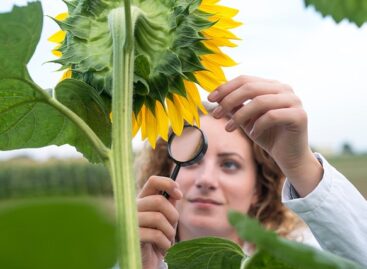
ENAG Project in the Hungarian-Serbian border region successfully concluded
🎧 Hallgasd a cikket: Lejátszás Szünet Folytatás Leállítás Nyelv: Auto…
Read more >
