
More than 5,000 students and teachers testified: the school mobile phone ban introduced a year ago had unexpected effects

The mobile phone ban introduced in September 2024 was feared by many: many students were disappointed and feared that they would not be able to reach their parents if necessary. It turned out that the opinions of students have changed a lot since then, discipline in vocational training institutions has improved significantly, while a spectacular generational divide has emerged in the teaching staff. Jójegy surveyed the opinions of more than 5,000 students and teachers on the results of the measure.
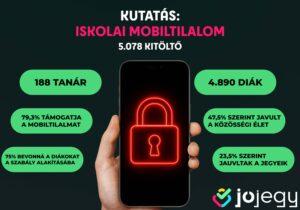 A total of 4,890 students and 188 teachers participated in the survey conducted by Jójegy in the fall of 2025, making it perhaps the largest, independent study of mobile phone use in Hungary. The distribution of responding students by type of institution reflects the diversity of school education: 30.1% study in a gymnasium, 31.3% in a technical school, 22.5% in a vocational school and 16.1% in a primary school. This sample allowed for the precise mapping of differences between institution types, such as changes in grades and attention. Most of the responding teachers (34%) came from gymnasiums. The proportion of technical school teachers was 27.1%, vocational school teachers 12.8%, primary school teachers 20.2%, and teachers from other institutions (e.g. music schools) 5.9%. Thus, the survey shows the experiences of not only students but also faculty in a balanced way, and also provides an opportunity to examine generational and pedagogical differences.
Students were on an emotional roller coaster: very few were happy about the mobile ban
Following the announcement of the mobile ban decree, 32% of students reacted negatively: 16% were sad or disappointed, 8% were angry, and 6% were anxious. Only 6% were happy with the change, but most students were neutrally affected by the news of the regulation.
“Our survey also revealed that the initial anger that many people showed was not self-inflicted. Most students experienced fear of Crete and parental contact due to their schedule,”
– said Márk Mester, co-founder of Jójegy, which conducted the research.
However, the emotional state of nearly half of the students changed during the school year: eight out of ten students moved from angry rejection to resignation or positive recognition. The students’ social awareness was outstanding: 47.5% of them talked more during breaks.
“It is a spectacular result that offline communication between students has returned during breaks”
– highlighted Márk Mester, who added that digital tools and opportunities also have their place and role, and can also be a great help in home learning.
Significant differences in academic results: a quarter of students improved
A positive effect was also evident in terms of grades, but significantly different results were achieved by type of institution. Only 15-18% of students in high school experienced an improvement, but this number is roughly double for students in technical and vocational schools. Overall, 23.5% of students, or almost a quarter, felt that the ban had a positive impact on their academic performance. In contrast, only 5.8% experienced a deterioration. The effect is less pronounced in terms of attention and activity, but still significant. A third of the students, 36.4% to be exact, paid better attention, but only 20.6% became more active verbally in class.
“Taking away the phone will not bring magical results: attention increases, but motivation must be supported by the teacher. So passivity can also be traced back to other reasons”
– added the co-founder of Jójegy.
It is not social media platforms that students miss the most
More than half of the students (54%) would allow mobile phones back in schools, but the answers were not motivated by a desire for social media platforms or games. The most common reasons were 17% for the “safety chain” (e.g. parents’ availability), 15% for the “digital Swiss Army knife” (e.g. Chalk, timetable, bus timetable), and 8% for listening to music during breaks.
“Some people said: »I don’t want to hang out, I just want to know that I’m available if there’s a problem«”
– emphasized Márk Mester.
Three-quarters of teachers would involve students in developing the rules
Educators also expressed their opinion on the mobile phone ban. Of these, 79.3% considered the restriction on phone use to be justified, indicating a strong professional consensus in favor of the regulation. 47.9% of teachers said that taking away phones led to stronger attention in class.
Related news
Related news

How will we pay for coffee in 2030, and will Europe finally get its own financial infrastructure?
🎧 Hallgasd a cikket: Lejátszás Szünet Folytatás Leállítás Nyelv: Auto…
Read more >
The government supported food industry developments with more than one thousand billion forints
🎧 Hallgasd a cikket: Lejátszás Szünet Folytatás Leállítás Nyelv: Auto…
Read more >
While the world changes, the shared experience is eternal: Unicum’s new commercial debuts with a journey across universes
🎧 Hallgasd a cikket: Lejátszás Szünet Folytatás Leállítás Nyelv: Auto…
Read more >
