
The leasing market was able to grow last year in a stable environment

Last year – partly thanks to the stable interest rate environment – the amount financed and the number of contracts on the Hungarian leasing market increased, but the picture is mixed when broken down by sector. The growth is spectacular for passenger cars and light commercial vehicles, while this trend is less visible for production equipment. According to the Secretary General of the Hungarian Leasing Association, László Kőszegi, financing was able to grow significantly in the corporate sector, and this is mainly due to large companies. Uncertainty and low investment appetite also affect small and medium-sized companies, but less so large ones. Meanwhile, subsidized financing played a decisive role last year as well.
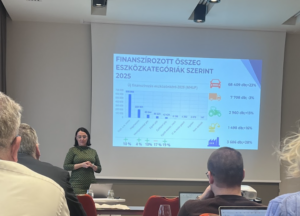 Last year, the volume of new financing reached HUF 1,037 billion, which represents a 7 percent increase compared to 2024. The number of new contracts was 85,166, which was 1 percent higher than the previous year’s 84,262. The total portfolio value increased by 5.6 percent to HUF 2,508 billion, while the number of contracts in the portfolio decreased by 1 percent to 315,656.
Nearly 90 percent of new financing was related to enterprises. Within corporate clients, 70 percent are small and medium-sized enterprises and 30 percent are large enterprises, while in 2025 the growth engine was primarily large enterprise financing. The share of the population based on the amount financed was only 8 percent and stagnated overall, while the number of contracts decreased.
“According to market participants, uncertainty remains significant in the corporate sector and investment appetite is subdued, especially among small and medium-sized enterprises. Large companies, on the other hand, remained more active,” said László Kőszegi.
54 percent of financing was closed-end financial leasing, 31 percent was open-end financial leasing, 11 percent was operational leasing, and 4 percent was a loan. 82 percent of the financed assets were new and 18 percent were used.
Stable interest rate environment
The interest rate environment was relatively stable in 2025. The BUBOR level, which is the benchmark for variable-rate financing, fluctuated around 6.5 percent during the year, while the BIRS indicators, which are the benchmark for fixed-rate constructions, also indicated stability, with the five-year BIRS decreasing to around 6 percent by the end of December.
Subsidized schemes remain strong
Subsidized financing played a decisive role in 2025 as well. They accounted for 20.9 percent of the total leasing market in terms of financed amount and 14.4 percent in terms of number of contracts. If we exclude passenger car financing – for which no subsidized scheme was available in recent years – from the data, the proportion of subsidized financing for production assets is already 39 percent, while in terms of number it is slightly higher: 39.6 percent in the Exim or Széchenyi Card program. The latter represents an increase.
In 2025, 161 billion forints of new financing was implemented within the framework of the Széchenyi Card Program, which is 29 percent higher than the previous year’s volume. The number of contracts amounted to 10,708, which also represents an increase of 29 percent. Leasing transactions related to Exim achieved even more dynamic growth: 55.9 billion forints of new financing was implemented with 1,497 contracts. This represents a 70 percent increase in the amount financed and a 66 percent increase in the number of contracts compared to the previous year.
The weight of subsidized schemes is particularly significant in the financing of production assets. Széchenyi Card products account for 62 percent of forint-based financing in this area and have a 54 percent share in the number of contracts
The Széchenyi Card Program plays a prominent role in practically every asset category – with the exception of passenger cars, where it is currently not available, except for electric cars. Foreign currency-based schemes dominate the leasing products of the Exim Demján Program, especially in the financing of heavy commercial vehicles and industrial machinery. For these assets, the proportion of euro-based financing in the amount financed was 89 percent and in the number of contracts was 95 percent.
Car financing was dominant last year
The passenger car, light commercial vehicle and motorcycle segment remained the largest area: with 607 billion forints of new placements, it accounted for 58 percent of the total market, which is a 10 percent increase compared to 2024. The number of new contracts was 68,409, which at the same time practically stagnated.
Related news

Stable growth with fewer contracts: the leasing market’s adaptability has reached a new level in 2025
🎧 Hallgasd a cikket: Lejátszás Szünet Folytatás Leállítás Nyelv: Auto…
Read more >
Companies are waiting, calculating and delivering – new room for manoeuvre on the fleet market
🎧 Hallgasd a cikket: Lejátszás Szünet Folytatás Leállítás Nyelv: Auto…
Read more >
Slight growth in the leasing market
🎧 Hallgasd a cikket: Lejátszás Szünet Folytatás Leállítás Nyelv: Auto…
Read more >Related news
Hungarian consumers are saving on ham, label reading is becoming more important
🎧 Hallgasd a cikket: Lejátszás Szünet Folytatás Leállítás Nyelv: Auto…
Read more >
International food prices have risen due to the impact of the Middle East conflict on energy prices
🎧 Hallgasd a cikket: Lejátszás Szünet Folytatás Leállítás Nyelv: Auto…
Read more >
It doesn’t matter how big the egg is on the shelves: genetics, age, and the chains’ tender logic decide
🎧 Hallgasd a cikket: Lejátszás Szünet Folytatás Leállítás Nyelv: Auto…
Read more >
