
Tomb, museum and liquor factory shortlisted for the title of the world’s most beautiful brick building

The shortlist for the 2026 BRICK AWARD has been announced. The biennial architectural competition is a competition where the most beautiful and innovative brick buildings from around the world compete. This year, a record 849 entries were received, and the winners will be chosen from 50 projects from 21 countries in the final.
 Wienerberger has been awarding the most outstanding brick architecture projects from around the world every two years since 2004. The company created the international Brick Award competition to encourage both architects and non-professional enthusiasts to explore new building forms and share design concepts. Entries will be awarded in five categories – single-family homes, urban residential developments, commercial and industrial buildings, public buildings and innovative, disruptive buildings.
This year’s shortlist for the prestigious international event features 50 projects from 21 countries on five continents, selected by the pre-jury from a total of 849 submissions. The 26 winners of the BRICK AWARD will be selected in the final by an international panel of renowned architects and designers at the awards gala in Vienna on June 11, 2026.
Excerpt from the 50 best entries:
The projects from the Middle East include the Shafagh Tomb in the small town of Ardakan, Iran, whose inverted domes and free-flowing ribbing on its surface give it a unique appearance. The building thus becomes a “canvas” celebrating freedom of expression. Serving as the gate to the cemetery, the structure reinterprets an essentially private space as a monument open to all – where the sacred and the mundane meet.
In Asia, the shortlisted projects include the Aga Khan Academy in Dhaka, Bangladesh, a four-storey brick-clad building adjacent to a busy highway. Green courtyards provide a sense of calm in the densely built-up environment and outdoor spaces for play and learning.
In Chennai, India, the Metallic Bellows factory office is a single-storey brick building inspired by local brickworks and clay soil. Concrete has been minimised to reduce CO2 emissions, and the traditional jack arch system gives the locally made brick architecture a light, almost floating appearance.
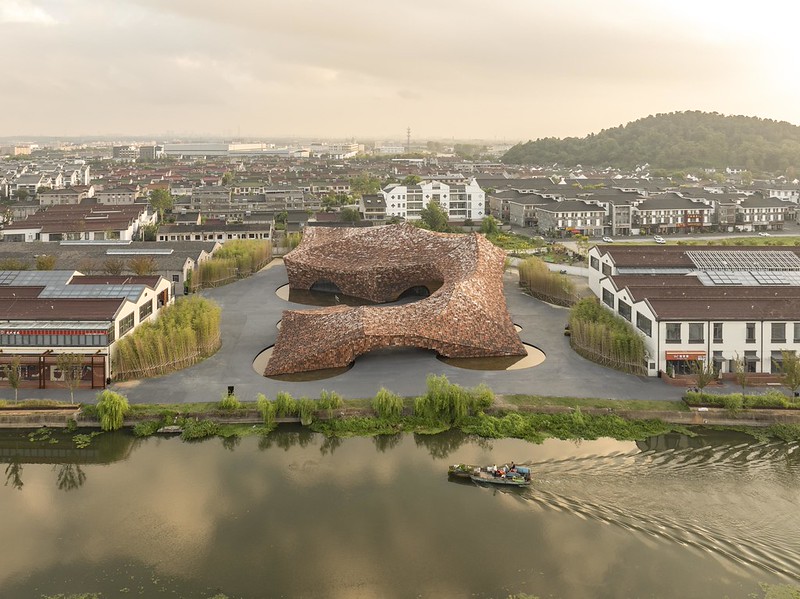
In China, a prominent example is the UCCA Clay Museum in Yixing, designed by Kengo Kuma and Associates. The distinctive roof is defined by a rhythm of peaks that reference the nearby Mount Shushan. The “inverted shell structure formed by virtual spheres” is covered with 3,600 handmade dark and light brown glazed ceramic tiles.
Closer to Beijing, in the city of Tianjin, the three-story Zhongshuge bookstore building offers a unique, immersive spatial experience with its unique, undulating brick pattern and hardware.
In Europe, Dutch Studio RAP designed a “wave-like” facade made of 3D-printed ceramic tiles for Amsterdam’s historic Hooftstraat shopping street.
On a much larger scale, in Germany, the Leipzig combined heat and power plant’s production buildings were made of fine, irregular vertical glazed clay panels.
And in Slovenia, an industrial hall in Ljubljana was transformed into a temporary theater, using recycled and reusable materials, with the visible ceramic masonry elements painted silver.
In Australia, the Melbourne Holocaust Museum used around 25,000 bricks for its façade – a combination of Ceniza clay bricks and Poesia glass bricks. The elegant, “hit and miss” pattern balances transparency and security, creating a powerful architectural symbol of remembrance and resilience that creates a visual and physical connection to the community and natural light.
In Mexico, a tequila factory made the list: the warehouses and offices of Clase Azul La Hacienda Jalisco use local ceramics and quarried stone during construction, blending into the volcanic landscape.
In Brazil, the White Bricks House was built using artisanal techniques from solid bricks painted white. The varying arrangement of bricks creates varying degrees of openness and intimacy in the spaces, while the carefully designed brick patterns give the building a timeless, artisanal character.
The shortlisted project for the United States is 64 University Place, an 11-story residential building in Greenwich Village, New York, with a hand-laid brick façade, arched windows and a lattice structure formed by pilasters. The design combines historical references to the area with contemporary details, and the brick architecture highlights craftsmanship.
Mountain House, located on the slopes of Steenberg Ridge near Cape Town, South Africa, blends into its semi-rural setting with a restrained material palette, with earthy textures and materials that age gracefully over time. The building evokes an ancient sense of refuge, creating a timeless spatial experience through simple, no-frills use of materials.
Related news
Related news
Lidl sold nearly 100 million liters of Hungarian milk
🎧 Hallgasd a cikket: Lejátszás Szünet Folytatás Leállítás Nyelv: Auto…
Read more >
Tetra Pak wins major award
🎧 Hallgasd a cikket: Lejátszás Szünet Folytatás Leállítás Nyelv: Auto…
Read more >
AI: Help or Addiction? Recent Research
🎧 Hallgasd a cikket: Lejátszás Szünet Folytatás Leállítás Nyelv: Auto…
Read more >
