
Deteriorating foreign trade balance: causes and prospects

According to the latest data from the Central Statistical Office, in February 2026, the volume of domestic exports decreased by 2.3%, while imports increased by 6.7% compared to the same period of the previous year. Examining the contribution of the main product groups, it can be stated that the development of turnover was almost entirely determined by the dominance of machinery and transport equipment: the main group of machinery and transport equipment contributed 8.3 percentage points to the increase in imports, while it mitigated the decrease in exports by 1.5 percentage points. This was primarily fueled by the large-scale machinery investments in the currently ongoing manufacturing investments – especially in the automotive and battery industries. The decline in exports was mainly due to the weak performance of processed products, which dragged down exports by 3.2 percentage points.
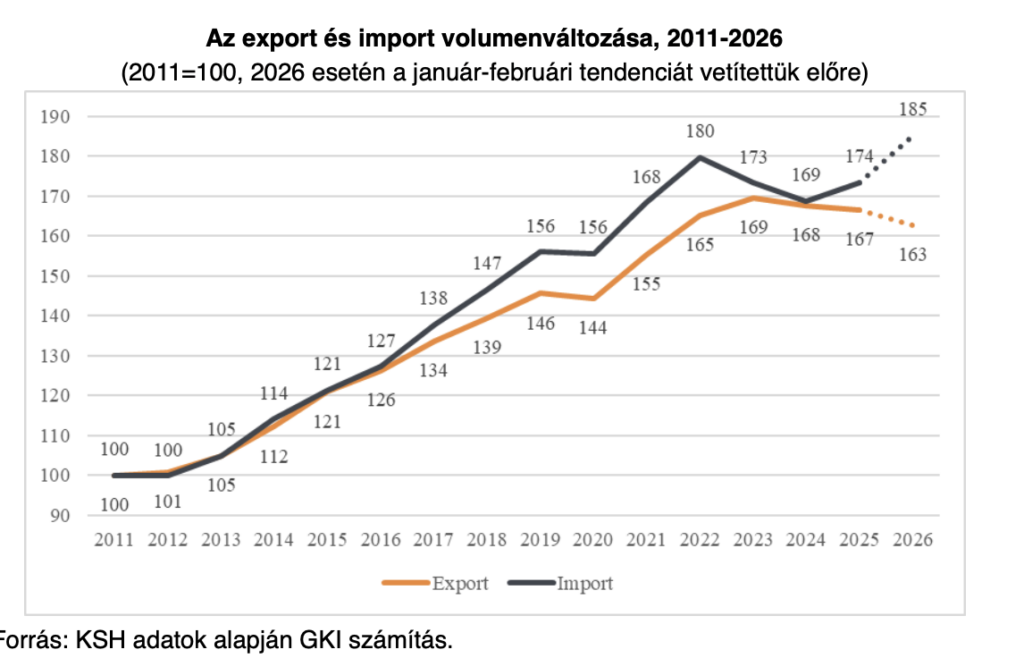
Starting in 2018-19, the growth rate of import volumes consistently exceeded that of exports. Although in 2024, due to a sharp decline in imports, the values of the two indicators compared to the 2011 base temporarily almost completely equalized, after which the gap opened again. Based on the current 2026 data, this separation may deepen further in the future, which will significantly worsen the foreign trade balance.
Change in export and import volume, 2011-2026
(2011=100, in the case of 2026, we projected the January-February trend)
Cumulative turnover of energy imports In the first two months of 2026, imports decreased by 466 million euros, while exports decreased by 202 million euros compared to the same period of the previous year. Although net imports of energy resources have decreased overall, due to the increase in energy market prices resulting from the Iranian conflict and the low level of imports so far, storage facilities are expected to be filled at increased prices, which will worsen the foreign trade balance in the near future.
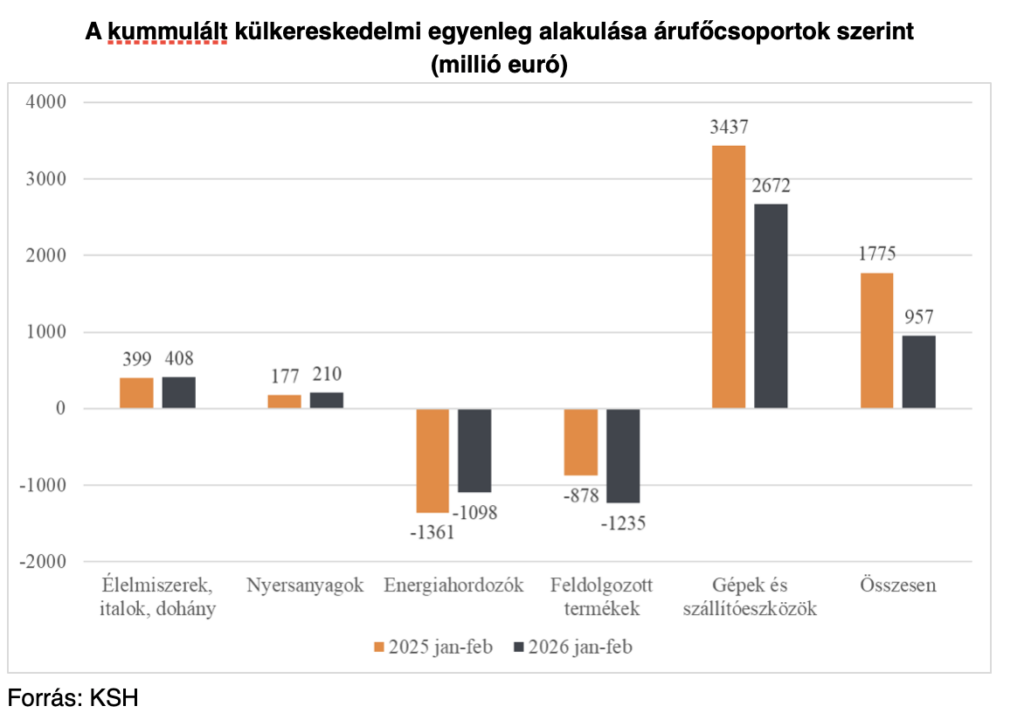
Based on the data for the first two months of this year, a drastic difference can be seen in the balance: the cumulative net export surplus of 1,775 million euros at the beginning of last year fell to 957 million euros this year (almost half, 53%).
Development of the cumulative foreign trade balance by main commodity groups
(million euro)
In the period between February 2025 and February 2026, the effect of the 6.1% strengthening of the forint against the euro can be seen in the 6.9% decrease in the price level of imports. This effect contributes to keeping domestic prices low by reducing imported inflation and increasing market price competition.
Overall, it can be stated that although the stronger forint since the previous year provides a more favorable terms of trade and lower imported inflation, an improvement in domestic competitiveness is inevitable for the future strengthening of exports. The increase in the price of energy carriers and the lack of strengthening of export market demand predict a deterioration in the foreign trade balance in the rest of the year. This could change if the new automotive and battery capacities entering the country significantly boost exports, but this will only be a realistic possibility at the end of 2026.
Related news

The beer industry continues to search for high-quality Hungarian horseradish
🎧 Hallgasd a cikket: Lejátszás Szünet Folytatás Leállítás Nyelv: Auto…
Read more >
KSH: in February the foreign trade surplus for goods was 665 million euros, the volume of exports was 2.3 percent lower, and that of imports was 6.7 percent higher than in the same period of the previous year
🎧 Hallgasd a cikket: Lejátszás Szünet Folytatás Leállítás Nyelv: Auto…
Read more >
GKI: High base rate, low inflation?
🎧 Hallgasd a cikket: Lejátszás Szünet Folytatás Leállítás Nyelv: Auto…
Read more >Related news

KPMG: Easter boom: the season is exploding for families, retail and the chocolate industry
🎧 Hallgasd a cikket: Lejátszás Szünet Folytatás Leállítás Nyelv: Auto…
Read more >
Every fourth package now arrives from abroad
🎧 Hallgasd a cikket: Lejátszás Szünet Folytatás Leállítás Nyelv: Auto…
Read more >
HELL turns 20: Michele Morrone, an exclusive awards ceremony and a spectacular safe await fans at the anniversary event
🎧 Hallgasd a cikket: Lejátszás Szünet Folytatás Leállítás Nyelv: Auto…
Read more >

