
How will we pay for coffee in 2030, and will Europe finally get its own financial infrastructure?

Europe has digitized payments, accelerated settlements, and put security at the heart of the financial system. But the next step is not just about speed. The digital euro and tokenization raise a much bigger question: who controls the infrastructure of money in the digital age, and how will value move in a 24/7 economy?
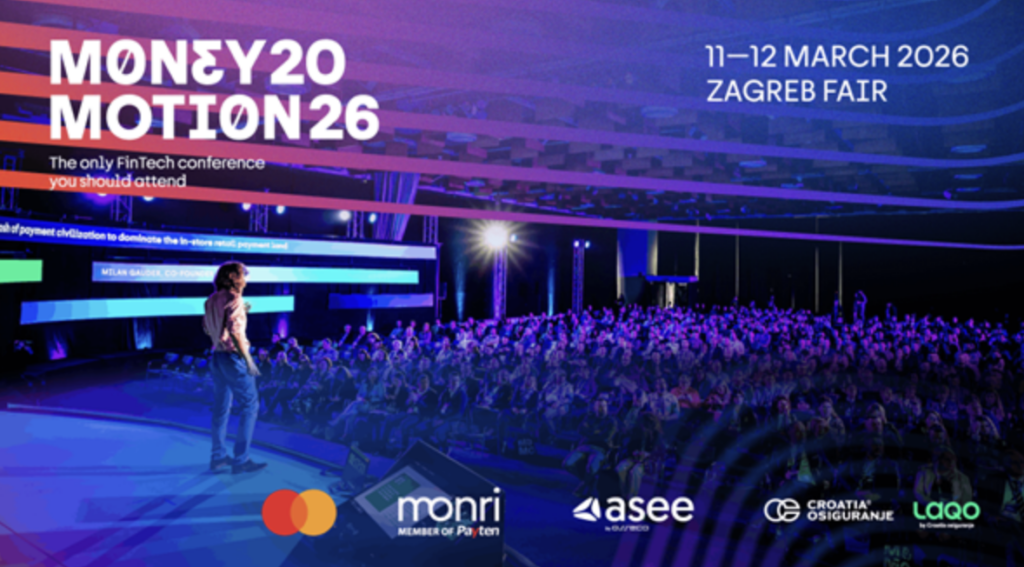 These are the questions industry leaders will seek answers to at the largest FinTech conference in Central and Eastern Europe. The fourth Money Motion will take place on March 11-12 at the Zagreb Fair, supported by leading industry brands such as Mastercard, Monri, ASEE, Croatia osiguranje, A1 Hrvatska, Electrocoin, Nexi, HPB, Bankart, Smartis and many more.
The digital euro and asset tokenization in Europe and beyond are important topics of this year’s program. Discussions on the future of financial infrastructure will be heard on the main stage as well as on the FinTech2030 stage. Before the conference, we spoke to three experts and representatives of various financial market players about the most important issues.
Digital tools as a complement, not a threat
From the perspective of a global payments network, new forms of digital currencies do not represent the collapse of the existing system, but rather its expansion. “The technologies behind new forms of digital currencies represent a new opportunity for payments and our network. We have been working with partners in this area for years, and there are already a number of Mastercard programs in the market that allow users to buy and use digital assets,” says Hendrik Bourgeois, Senior Vice President, Public Relations and Government Affairs, Mastercard Europe. He pointed out that Mastercard sees the development of digital currencies as a natural part of the ecosystem. He adds that digital tools are not competition, but an additional layer. “We see digital assets as an addition to the payments ecosystem and as another currency that we support within our network. Ultimately, it’s about enabling people to pay in the way that works best for them – by expanding the payments ecosystem through interoperability, relevant services, global reach and trust.”
This formulation also captures a key European dilemma: how to maintain interoperability and trust while at the same time supporting a private, public-funded they are developing infrastructure that is being built.
Europe is lagging behind, but it cannot stay out of the coastline
The 2025 data clearly shows what is at stake. Nikola Škorić, co-founder of Electrocoin and Money Motion, warns that the private sector is already in serious trouble.
“Europe is quite lagging behind the leading private stablecoin issuers, as the US USDC and USDT stablecoins together processed over $30 trillion worth of transactions in 2025, a huge global turnover that far exceeds most nominal
Related news
Contactless payment will soon be available on all metros
🎧 Hallgasd a cikket: Lejátszás Szünet Folytatás Leállítás Nyelv: Auto…
Read more >
K&H: style, comfort, speed – this is how women pay today
🎧 Hallgasd a cikket: Lejátszás Szünet Folytatás Leállítás Nyelv: Auto…
Read more >
Retail accounts: banks are already warming up for summer fee increases
🎧 Hallgasd a cikket: Lejátszás Szünet Folytatás Leállítás Nyelv: Auto…
Read more >Related news
The government supported food industry developments with more than one thousand billion forints
🎧 Hallgasd a cikket: Lejátszás Szünet Folytatás Leállítás Nyelv: Auto…
Read more >
While the world changes, the shared experience is eternal: Unicum’s new commercial debuts with a journey across universes
🎧 Hallgasd a cikket: Lejátszás Szünet Folytatás Leállítás Nyelv: Auto…
Read more >
Fans have more friends: Heineken launches new campaign
🎧 Hallgasd a cikket: Lejátszás Szünet Folytatás Leállítás Nyelv: Auto…
Read more >
