
Aldi Süd’s German flagship store: A closer look at the discounter’s largest format

With its two-thousand-square-meter flagship, Aldi Süd extends the discount template to a new scale. The concept remains streamlined yet reinforces the retailer’s quality cues across all fresh departments.

Sebastian Rennack
international retail analyst
Aletos Retail
Aldi Süd is testing the limits of scaling its discount concept. With a total sales area of around two thousand square meters, the flagship store near the company’s head office was, at the time of its reopening in autumn 2020, the largest store within Aldi Süd’s estate globally. The branch is a redevelopment of an existing location that was closed, remodeled and expanded by roughly three hundred square meters of sales area.
At first glance, the enlarged branch feels even more like a classic hard discounter. The additional space creates wide sightlines, simplified and more intuitive shelf layouts, low gondolas and generous product facings that support efficiency in both merchandising and customer navigation.
A closer look, however, reveals a more strategic recalibration. Across all fresh departments, Aldi Süd connects its price leadership to a continuous quality narrative that spans regional sourcing, organic ranges and advanced animal-welfare standards. This aligns with the company’s ambition to become Germany’s market leader in the organic segment and to set new benchmarks for animal welfare, expanding the traditional limits of discount retailing.
This quality-led positioning is a key component of Aldi’s broader ‘supermarketization’ strategy. It responds to Edeka’s and Rewe’s strong differentiation through serviced counters and regional sourcing and acts as a counterweight to Lidl, which has intensified its challenge to Aldi’s long-held price leadership. Naturland-certified private labels exceed the organic tiers offered by other discounters or mainstream supermarkets. Freshness, regionality and ethics are embedded across fruit and vegetables, meat, dairy and bakery, building a consistent message from the start to the end of the shopper journey.
The result is a concept that appears simple on the surface but introduces a layered repositioning. It subtly reframes Aldi Süd as the most quality-oriented discounter in the German market while holding on to the operational clarity and price credibility that define the banner’s core identity.

The enlarged flagship format, expanded to 2,000 square meters in 2020, marks a new scale for the discounter. The visited branch is a redevelopment of an existing site that became the banner’s largest store at that time.
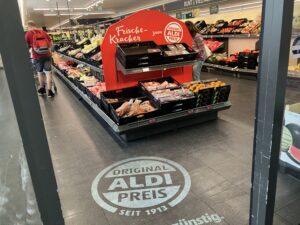
The store reinforces its price-leader positioning right at the entrance with a floor projection stating Original Aldi Preis seit 1913 (Original Aldi Price since 1913). The fruit and vegetable department opens the customer journey and stretches along roughly one third of the sales floor.
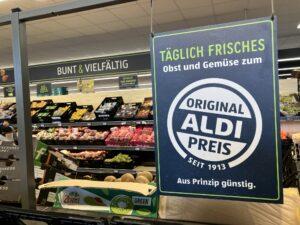
Inside this section, the discounter links its freshness message closely with its long-standing value claim.
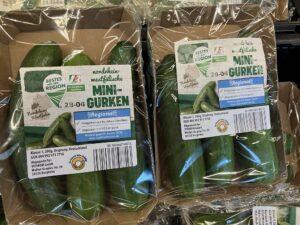
Regional sourcing is highlighted through the Bestes aus der Region (Best from the region) label, here applied to mini cucumbers from North Rhine-Westphalia, the federal state where the store is located.
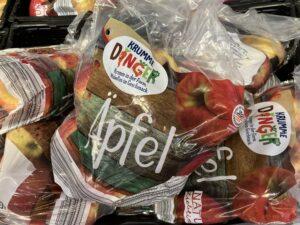
Under the Krumme Dinger (Wonky Produce) range, the discounter sells cosmetically imperfect fruit and vegetables that are flawless in taste, supporting its food-waste reduction strategy.
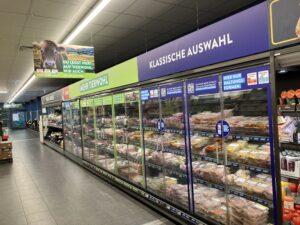
The chilled meat and poultry aisle is structured according to the Haltungsform animal-husbandry system. Green-colored sections present higher levels 3 to 5 (outdoor-climate, free-range or pasture access, and certified organic), followed by blue sections for basic levels 1 and 2 (legal-minimum indoor housing and modestly improved standards).
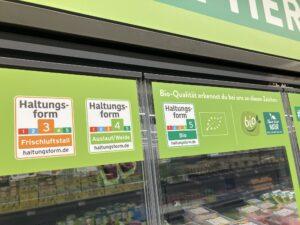
To clarify quality tiers and ease navigation, the store explains Haltungsform levels 3 and 4 directly on the chiller doors and highlights level 5 together with its EU and Aldi organic certifications.
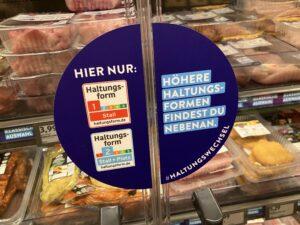
Basic Haltungsform levels 1 and 2 are marked hier nur (here only) on the chiller doors, guiding shoppers toward the adjacent higher-tier options and underlining a quality-driven positioning.

A compact convenience zone sits directly beside the meat aisle, offering ready-to-eat and ready-to-heat options complemented by chilled beverages.
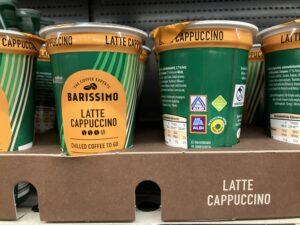
Chilled coffee drinks are presented under the joint Aldi Süd and Aldi Nord Barissimo brand.
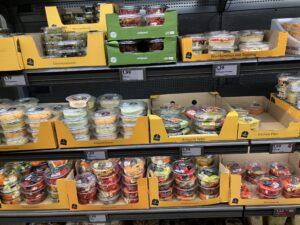
The chilled delicatessen range uses yellow shelf-ready trays printed with product names, making navigation straightforward in front of the shelf.
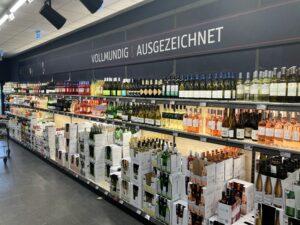
The wine department occupies the back wall under dedicated lighting. Price-entry wines below three euros are displayed in transport cartons on the lower podium shelves.
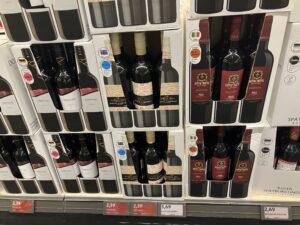
The transport cartons include essential product information directly on the packaging, such as origin, taste profiles and bottle visuals
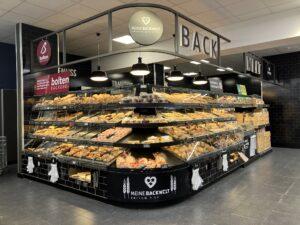
The bake-off area merges several modules, including a regional baker offer, seasonal specialties and an organic selection
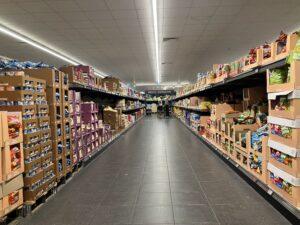
Wide aisles and clearly structured shelves contribute to easy in-store navigation
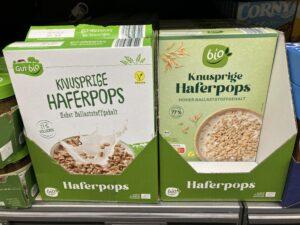
The discounter is phasing out its Gut Bio label in favour of the unified bio brand shared across both Aldi Süd and Aldi Nord

The Nur Nur Natur range represents the banner’s top organic tier, certified to Naturland standards that exceed both German and EU organic requirements. Introduced in 2021, it strengthens the retailer’s premium organic credentials
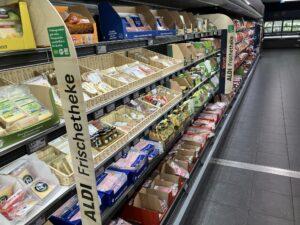
Under the Aldi Frischetheke (Aldi’s fresh serviced counter) branding, the self-service cheese and deli assortment is presented in wicker baskets for a more premium look and is supported by animal-welfare and organic cues

In this extra-large format, the non-food area takes up nearly one third of the sales space, arranged in a classical valley layout with low promotional tables at the centre and standard food shelving around the perimeter
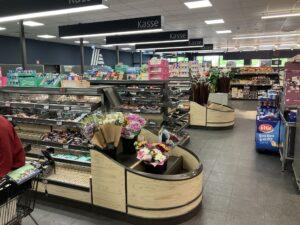
The checkout zone features curved wood-look modules and wire-basket shelving for last-minute snacks and small accessories, with fresh flowers positioned prominently to trigger impulse purchases
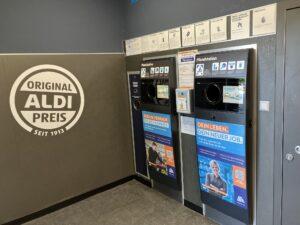
The reverse-vending station is located directly at the entrance, framed by clear rule signage and employer-branding messages. The combination of deposit returns and recruitment posters reflects the discounter’s pragmatic and efficiency-oriented communication style.

Related news

Germans reluctant to trust AI with their purchases
🎧 Hallgasd a cikket: Lejátszás Szünet Folytatás Leállítás Nyelv: Auto…
Read more >
When organic becomes mainstream: A glimpse of what awaits food retail in Central & Southeast Europe
🎧 Hallgasd a cikket: Lejátszás Szünet Folytatás Leállítás Nyelv: Auto…
Read more >
dm Tests QR-Code Checkout Technology in Selected German Stores
🎧 Hallgasd a cikket: Lejátszás Szünet Folytatás Leállítás Nyelv: Auto…
Read more >Related news
Good Friday is in a week: the Easter shopping season has begun
🎧 Hallgasd a cikket: Lejátszás Szünet Folytatás Leállítás Nyelv: Auto…
Read more >
Seed sampling in focus: VSZT and Nébih held a training day
🎧 Hallgasd a cikket: Lejátszás Szünet Folytatás Leállítás Nyelv: Auto…
Read more >
This is how the construction industry will change in 2026
🎧 Hallgasd a cikket: Lejátszás Szünet Folytatás Leállítás Nyelv: Auto…
Read more >
