
Cutting-Edge Plant-Based Plastic Bag Dissolves In Seawater Leaving No Microplastics

A team of researchers has demonstrated a cutting-edge plant-based plastic bag that can dissolve in water without producing microplastics.
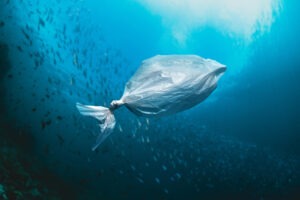
The “plastic” bag is made with cellulose, which is the most abundant organic polymer on the planet. It safely dissolves in seawater after just a few hours, Plant Based News reports. The researchers also described the material as “closed loop recyclable,” because the dissolved fragments can be gathered and recombined to create a new bag.
The research team described the search for plastic alternatives made from renewable biomass as a “promising” potential solution to the problem of petroleum-based plastic and pollution. They created a tough and brittle “cellulose-based supramolecular plastic” (CMCSP) that can be modified with choline chloride to be tough and flexible or soft and elastic, making it ideal for something like a plastic shopping bag.
“We demonstrated that plasticized CMCSPChCl could be processed into a flexible plastic bag, which was mechanically tough but perfectly dissociable in seawater and closed-loop recyclable with electrolytes. Hence, CMCSPChCl never generates microplastics,” wrote the researchers.
They published a study cataloguing their work in ACS publications towards the end of last year titled “Supramolecular Ionic Polymerization: Cellulose-Based Supramolecular Plastics with Broadly Tunable Mechanical Properties.”
The team was led by Takuzo Aida of Japan’s RIKEN Center for Emergent Matter Science (CEMS), which focuses on green energy and “emergent materials” and aims to help build a sustainable society coexisting “in harmony with the environment.”
Microplastics, pollution, and human health
Plastic pollution negatively impacts every single part of the planet’s vital ecosystems, and is expected to increase significantly over the next quarter-century. According to the International Union for Conservation of Nature, approximately 20 million tons of plastic litter already end up in the environment each year, including microplastics.
Microplastics are extremely small pieces of plastic that come from the breakdown of plastic waste, microbeads, and other products. Microplastics are now ubiquitous and have been found in the air, water, earth, and in animal and human bodies.
The researchers published their work within weeks of a separate study that found plastic particles from water bottles can kill pancreatic cells and increase diabetes risk. Some scientists claim that the average person eats roughly the equivalent of a credit card per week, increasing the risk of a range of negative health outcomes.
Related news
Carrefour and Coca-Cola are focusing on refillable glass bottles
🎧 Hallgasd a cikket: Lejátszás Szünet Folytatás Leállítás Nyelv: Auto…
Read more >
Colruyt is the first to introduce meat trays made from recycled plastic
🎧 Hallgasd a cikket: Lejátszás Szünet Folytatás Leállítás Nyelv: Auto…
Read more >
Give new life to old gadgets! – results of the 2025 “Pass it back, bro!” campaign
🎧 Hallgasd a cikket: Lejátszás Szünet Folytatás Leállítás Nyelv: Auto…
Read more >Related news

SPAR renovated three of its stores with an investment of 880 million forints
🎧 Hallgasd a cikket: Lejátszás Szünet Folytatás Leállítás Nyelv: Auto…
Read more >
The government is helping dairy farmers with another 7 billion forints
🎧 Hallgasd a cikket: Lejátszás Szünet Folytatás Leállítás Nyelv: Auto…
Read more >
Vál-Völgye Bakery won ten awards at the 22nd International Bread Competition
🎧 Hallgasd a cikket: Lejátszás Szünet Folytatás Leállítás Nyelv: Auto…
Read more >
