
MBH Analysis Center: Hungarian tourism is soaring – further growth is expected in the hotel market
Tourism is not only a driving force in the service sector, but also a stable growth pillar of the Hungarian economy: its contribution to GDP directly and indirectly reaches 13% and ensures the livelihood of more than 400 thousand people. Despite economic challenges and geopolitical uncertainties, tourism has become a defining sector of the Hungarian economy. This is clearly demonstrated by the continuously increasing number of guest nights and airport passenger traffic, which also support the recovery and long-term potential of the sector. While tourism has regained its former momentum, the country’s hotel market has once again become the center of attention. According to the latest commercial real estate market report of the Hungarian National Bank, the hotel segment became one of the best-performing sectors of the commercial real estate market in the first half of 2025.
 Domestic tourism achieved outstanding results at the national level this year: In the first ten months of 2025, 16.8 million guests arrived at domestic accommodations (7% year-on-year growth). Both domestic and foreign guests, as well as the number of nights they spent, increased. The growth was driven by foreign tourists – especially European and North American ones – but domestic demand also picked up, albeit to a lesser extent. The recovery of domestic tourism is also supported by the Szép Kártya: with its help, more and more Hungarian guests are discovering the country’s accommodation and services, which further strengthens the role of tourism in the economy.
“This process is particularly spectacular in Budapest: in the first ten months of the year, nearly 14.7 million guest nights were registered, which is about 8% more than in the same period of the previous year. Foreign tourists typically book in hotels (54% of guest nights), which indicates the strong role of the hotel segment”
– emphasizes Flóra Horti, senior industry analyst at MBH Analysis Center. Most guests came from the United Kingdom, the United States, Israel, Germany and Italy, which confirms Budapest’s international appeal. Among inbound tourists, the main motivation is leisure and entertainment travel, followed by private visits and then business trips. In parallel, investor confidence is also strengthening at the national level, especially in the hotel industry, whose performance is increasingly approaching pre-pandemic levels.
Hotel performance indicators indicate strengthening
In the first half of 2025 (the most recent comparable data), the hotel room occupancy rate of the region’s capitals ranged between 58 and 73%, with Budapest’s 68% indicator roughly matching the regional average. Among the 35 European destinations included in the report, Budapest ranks 15th in room occupancy, 24th in average room rate, and 21st in net RevPAR. In the comparison of Vienna, Prague, and Budapest, the Hungarian capital ranks only 3rd in terms of net REVPAR in all three categories examined by the study (Luxury & Upper Upscale, Upscale, Midscale & Economy). Although Budapest is still in a more favorable price category in the regional comparison, the dynamics clearly show a catch-up, based on the net average room rate of 130.2 euros and the net REVPAR of 106.4 euros.

Source: MSZÉSZ Trendriport
Budapest in the international arena – lagging behind or opportunity?
Budapest can be mentioned on the same page as regional cities such as Vienna or Prague based on its size, culture, and landmarks, but there is still room for improvement in terms of hotel capacity. While Vienna has nearly 40–42 thousand rooms, Budapest has only 23 thousand rooms, of which 3,500–4,000 are in the five-star category. The number of tourists also lags behind in comparison: Budapest has 6 million visitors, while Vienna and Prague have over 8 million. Budapest also lags behind Prague and Vienna in terms of the amount spent here, as Prague and Vienna attract more premium travelers. The proportion of luxury and upper-scale accommodations in these cities is close to 30%, compared to the Hungarian capital’s proportion of under 20%. According to a McKinsey 2024 study, Budapest has a share of only 0.37% of global tourism based on the number of visitor and guest nights and their spending, while the average for similar cities is 0.65%.

Related news

KSH: in February, the number of guests (nearly 1.1 million) exceeded the number of guest nights (2.4 million) by 4.6 percent and the number of guest nights (5.2 percent) by 5.2 percent compared to a year earlier
🎧 Hallgasd a cikket: Lejátszás Szünet Folytatás Leállítás Nyelv: Auto…
Read more >
VisitBalaton365 would also help make Lake Balaton tourism more attractive by supporting entrepreneurs.
🎧 Hallgasd a cikket: Lejátszás Szünet Folytatás Leállítás Nyelv: Auto…
Read more >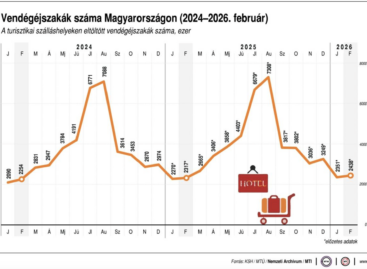
NGM: domestic tourism did not slow down in February either
🎧 Hallgasd a cikket: Lejátszás Szünet Folytatás Leállítás Nyelv: Auto…
Read more >Related news
István Nagy: the government’s goal is to further strengthen the competitiveness of Hungarian agriculture and place the future of domestic agriculture on a solid foundation
🎧 Hallgasd a cikket: Lejátszás Szünet Folytatás Leállítás Nyelv: Auto…
Read more >
Good Friday is in a week: the Easter shopping season has begun
🎧 Hallgasd a cikket: Lejátszás Szünet Folytatás Leállítás Nyelv: Auto…
Read more >
ENAG Innovation BootCamp for the Development of Women Agribusiness Entrepreneurs in Hungary Successfully Ended
🎧 Hallgasd a cikket: Lejátszás Szünet Folytatás Leállítás Nyelv: Auto…
Read more >
