
Every twentieth instant payment is now processed through the Qvik system

Four out of every hundred forints are already transferred to our accounts via some kind of qvik payment within the instant payment system – points out Péter Gergely, financial expert at BiztosDöntés.hu. At the beginning of last year – he adds – payment requests exploded, and in the fourth quarter QR code payments exploded, which proves that qvik has definitively left the experimental phase and has become a substantial part of the domestic payment system.
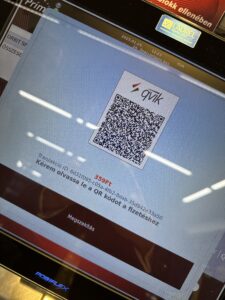 Qvik has now spectacularly exited the experimental phase: it already represents a significant weight within the instant payment system, while its growth rate remains outstanding – draws attention to Péter Gergely, financial expert at BiztosDöntés.hu.
According to data published by the Hungarian National Bank, in the fourth quarter of 2025, qvik-based transactions accounted for 4.5 percent of instant payment turnover in terms of number and reached a share of 4.3 percent in terms of value. “This means that out of every hundred forints of instant transfers, more than four forints are already made through some kind of qvik payment,” points out Péter Gergely.
A giant leap in QR code payments
Qvik’s success has so far been based on payment requests, but growth is now increasingly being escalated by QR code and deeplink payments. According to the financial expert of BiztosDöntés.hu, this is well illustrated by the fact that in the fourth quarter of 2025 the number of transactions increased nearly threefold – from 420 thousand to 1.2 million – and the value of turnover jumped three and a half times, approaching 60 billion forints. The strength of the dynamics is clearly demonstrated – he adds – by the fact that at the end of last year, the total value of QR code and deeplink payments was greater in a single month than in the entire previous quarter.
Qvik has not only reached a new level in terms of number, but also in transaction value. The average amount of QR code and deeplink payments has more than doubled in half a year and exceeded 50 thousand forints. This is no longer a micropayment category, the average value per transaction is nearly five times the average value of traditional, physical bank card payments of 10 thousand forints, but it is also much higher than the average basket value of 20 thousand forints of card payments made in online webshops – reminds Péter Gergely.
Merchant acceptance is also set to develop rapidly
However, the traffic explosion – as the financial expert of BiztosDöntés.hu points out – is not caused by the expansion of the acceptance network, but by the more thorough utilization of the existing infrastructure, primarily the advancement of QR code payments on online payment platforms. Nevertheless, the expansion is also felt here: 2025. In the fourth quarter of 2019, the number of merchants accepting Qvik increased by 3.6 percent to 33,879, which shows that the size of the Qvik acceptance network now accounts for more than 14 percent of the physical and online bank card acceptance network.
According to Péter Gergely, based on the rapid increase in transaction volume and value, it is almost natural that the expansion of the merchant side will also accelerate in the coming period – the lower cost level and the increasing customer demands both point in this direction.
The cost-saving opportunity is also attractive to the business sector
While direct payments are making spectacular progress, payment requests continue to be the backbone of Qvik’s traffic: last year’s
Related news

Despite the record number of ATMs, cash withdrawals are declining in Hungary
🎧 Hallgasd a cikket: Lejátszás Szünet Folytatás Leállítás Nyelv: Auto…
Read more >
How will we pay for coffee in 2030, and will Europe finally get its own financial infrastructure?
🎧 Hallgasd a cikket: Lejátszás Szünet Folytatás Leállítás Nyelv: Auto…
Read more >
A zero-deductible bank account is no longer available even for start-up companies
🎧 Hallgasd a cikket: Lejátszás Szünet Folytatás Leállítás Nyelv: Auto…
Read more >Related news

International food prices have risen due to the impact of the Middle East conflict on energy prices
🎧 Hallgasd a cikket: Lejátszás Szünet Folytatás Leállítás Nyelv: Auto…
Read more >
Oat-based “feta” wins the cheese innovation competition of Lidl Germany and ProVeg
🎧 Hallgasd a cikket: Lejátszás Szünet Folytatás Leállítás Nyelv: Auto…
Read more >
The horticulture of the future is being built in Szentes
🎧 Hallgasd a cikket: Lejátszás Szünet Folytatás Leállítás Nyelv: Auto…
Read more >
