
Hungarian professional leadership also shaped global economic decisions at the historic B20 summit in South Africa

The year 2025 was a milestone in the history of global business cooperation: the official business forum of the G20, Business 20 (B20), was held in Africa for the first time in its history under the South African presidency of the G20. The B20 is the official economic policy advisory body of the G20 business community, bringing together corporate actors from economies that account for about 85 percent of the world’s GDP and more than three-quarters of global trade. The forum’s task is to formulate policy and economic recommendations for the G20 leaders.
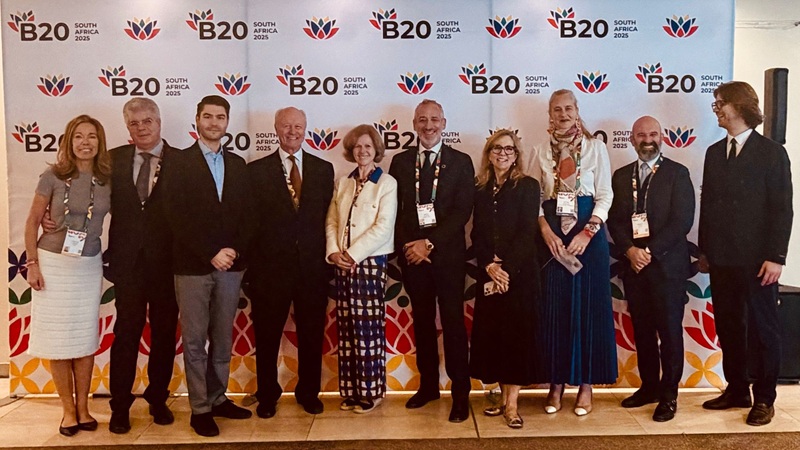
The professional work is carried out in 8 working groups, of which the Trade and Investment Working Group was given a prominent role this year, examining issues determining the future of global trade and investment, with a particular emphasis on Africa’s economic integration and new directions for investment. In addition to the top management of companies and organizations that lead and influence the global economy, a Hungarian expert was also appointed as co-chair of the working group: Dr. Patrik Kovács, who is the co-chair of the Hungarian Federation of Entrepreneurs and Employers (VOSZ) for international affairs and the chairman of the SME and Entrepreneurship Committee of Business at OECD (BIAC).
No Hungarian expert has ever held such a high-level policy leadership position in the B20 structure before, so through the mediation of VOSZ, the Hungarian business community was able to directly engage in the highest-level workshop on global economic policy for the first time.
The Investment and Trade Working Group was led by leading corporate and institutional players from around the world: David Roth, Head of International Public Policy at Amazon; José Serrador, Deputy CEO of Embraer – one of the world’s leading aircraft manufacturers; and Sultan Ahmed bin Sulayem, Chairman and CEO of DP World, whose ports handle more than 10 percent of global trade.
This year’s B20 South Africa was historic: it was the first time an African country had led the G20 business community, putting Africa’s economic integration, investment potential and the role of the continent’s businesses at the centre of international attention. This year, hundreds of international and African leaders attended the B20 Summit in Johannesburg, where discussions focused on how to strengthen the stability of global supply chains, increase investment in Africa, expand entrepreneurship opportunities for youth and women, and accelerate the green and digital transitions.
The policy recommendations from the summit emphasize restoring predictability to global trade, reducing market access barriers, and restoring the WTO dispute settlement system. Supporting Africa’s economic rise and implementing the “Investment Deal for Africa”, which aims to significantly increase FDI in Africa, were identified as important priorities by the international community. In addition, the alignment of trade and climate policy, the expansion of trade in green technologies, and the harmonization of carbon measurement systems were also included in the package of recommendations.
The Trade and Investment Working Group developed detailed policy proposals that emphasize strengthening African value chains, increasing the added value produced on the continent, and improving investment conditions that promote the economic diversification of the region. The proposals contain concrete, measurable steps in all three target areas – trade, investment, sustainability –, making them suitable for becoming part of the economic policies of the G20 countries.
Several high-level professional partner events were also held in the framework of the B20 Summit. Business at OECD – the economic advisory body of the OECD – organized its high-level forum in Johannesburg entitled “OECD Impact, B20 Drive: The Business at OECD Nexus”, which was attended by around 150 business and institutional leaders. Dr. Patrik Kovács – as Chair of the organization’s SME Committee, led one of the featured roundtable discussions, which focused on open markets, the resilience of food supply chains and the future of global trading conditions.
The B20-related professional program also included the Trade and Investment Working Group Professional Conference, supported by the ABSA Group, where Dr. Kovács presented together with Julian Kassam, Deputy Secretary-General of the International Chamber of Commerce (ICC) on strengthening the role of SMEs, women and young entrepreneurs in global trade. The event received special attention among this year’s focus areas and official events of B20.
Related news

Hungarian world first: AI calculator calculates how much a company will lose during the flu season and how much can be saved by using preventive technologies
🎧 Hallgasd a cikket: Lejátszás Szünet Folytatás Leállítás Nyelv: Auto…
Read more >
GDP growth in OECD member countries slowed to 0.3 percent in the last quarter of last year
🎧 Hallgasd a cikket: Lejátszás Szünet Folytatás Leállítás Nyelv: Auto…
Read more >
VOSZ co-chair elected to the board of directors of the organization representing 65 percent of the world economy
🎧 Hallgasd a cikket: Lejátszás Szünet Folytatás Leállítás Nyelv: Auto…
Read more >Related news
KSH: in February the foreign trade surplus for goods was 665 million euros, the volume of exports was 2.3 percent lower, and that of imports was 6.7 percent higher than in the same period of the previous year
🎧 Hallgasd a cikket: Lejátszás Szünet Folytatás Leállítás Nyelv: Auto…
Read more >
REGIO Játék: Families spend a maximum of ten thousand forints on Easter gifts
🎧 Hallgasd a cikket: Lejátszás Szünet Folytatás Leállítás Nyelv: Auto…
Read more >
Péter Szijjártó: the domestic food industry is further strengthened with the investment of SUGO FOOD Kft. in Baja
🎧 Hallgasd a cikket: Lejátszás Szünet Folytatás Leállítás Nyelv: Auto…
Read more >
