
The retail sector is in a double bind

Over the past year, 77% of retail companies increased their investments in customer experience, and half of CEOs are already seeing online revenue growth. The outlook for the next three years is far more cautious, however—only 25% expect meaningful expansion. The sector must keep pace with rapidly changing consumer expectations as well as an uncertain regulatory environment. PwC’s consumer markets industry insights, part of its CEO Survey, were prepared in cooperation with Trade magazin.
According to PwC Hungary’s 15th CEO Survey, retail leaders respond to economic and technological challenges in several ways differently from other sectors. Compared to previous years, they are moderately optimistic about the global business environment, while the outlook for the Hungarian economy continues to call for caution. Regulatory exposure is listed among the top threats by 67% of retail respondents; at the same time, they are ahead of many industries in several areas of practical AI adoption.
Retail expectations
Based on PwC Hungary’s CEO Survey, the commercial sector is most typically characterized by the following:
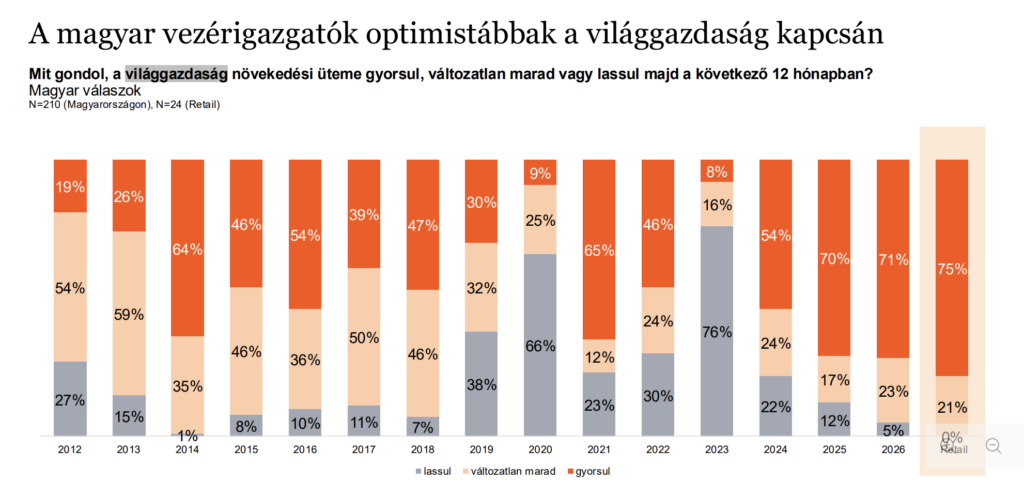
- they are the most optimistic about the global economy: 75% of retail leaders expect an acceleration—more optimistic than the Hungarian average (71%), while globally this share is only 61%
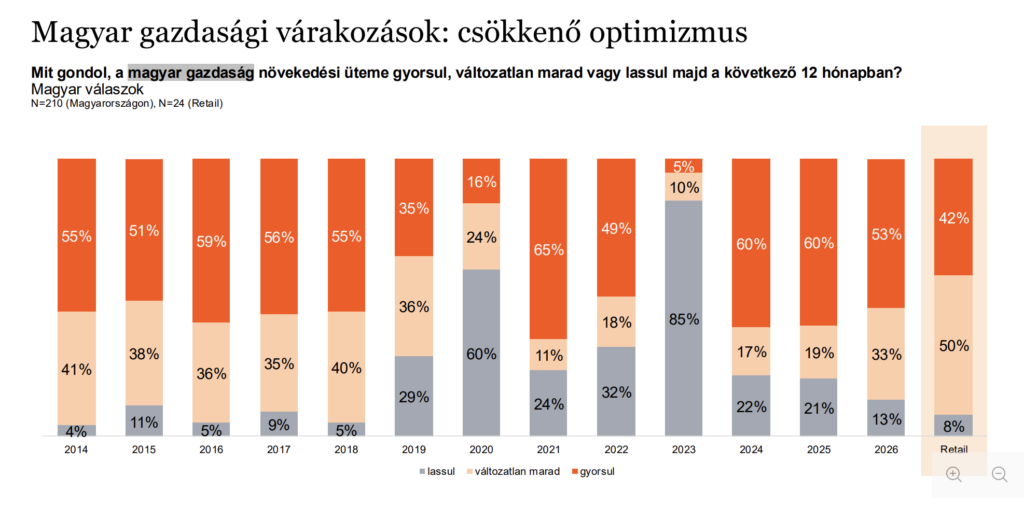
- they are far more restrained about the domestic economic environment: only 42% expect acceleration, compared to the Hungarian average of 53%
- for 12-month revenue growth, 33% are optimistic, slightly above the overall Hungarian sample (31%)
- for the next three years, optimism drops sharply: only 25% are confident about longer-term growth—showing an inverse pattern compared with domestic and international results
- 33% plan headcount growth, slightly above the domestic average (31%), but they expect more cautious workforce expansion longer term (38% compared to 45% in the overall Hungarian sample)
- domestic regulatory exposure is the biggest threat (67%) for the retail sector—one of the highest values in the entire survey
- the share concerned about inflation and macroeconomic volatility is also high (58%–58%)
- they are more active than the domestic average in AI use, especially in demand fulfillment (25%) and demand generation (33%)
- AI ROI shows similar results: the vast majority of the sector (77%) experienced neither revenue growth nor cost reduction as a result of AI implementations
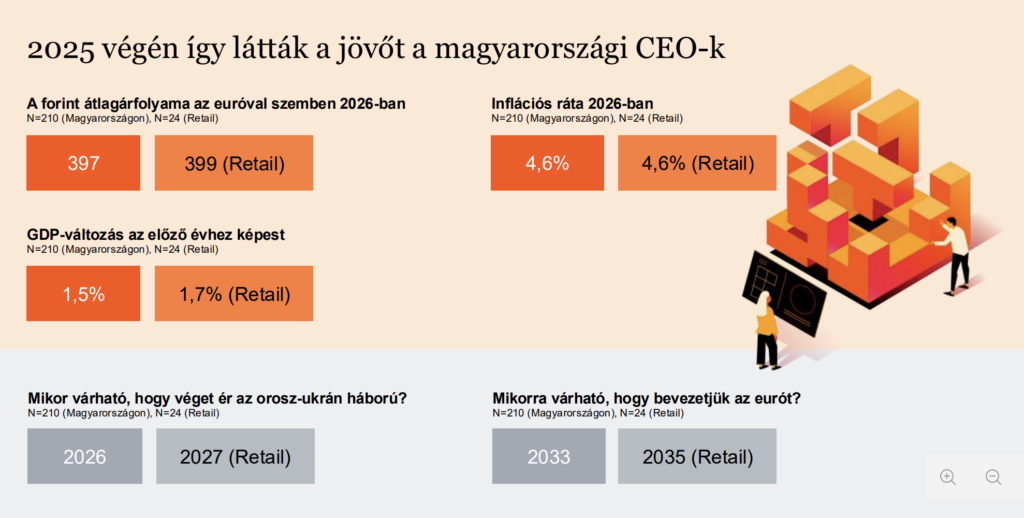
Regarding the forint–euro exchange rate, retail leaders expect a weaker forint in 2026 (HUF 399/EUR) than the overall sample (HUF 397). Sector respondents forecast the euro’s adoption for 2035.

Mekler Anita
When selecting target countries for investment, retail shows a much more balanced picture and focuses on nearby CEE markets, while the overall sample highlights Germany, the United States and Romania.
In the short term, they expect greater workforce movement, but plan more cautiously in the longer run: looking three years ahead, the share planning headcount growth is lower in retail (38% vs. 45%), reflecting more cautious long-term labor outlooks.
Over the next three years, they plan to open up primarily toward freight and logistics, business services, and the media and entertainment industry.
Among the most important strategic questions, the balance between resilience and lean operations, as well as the company’s long-term viability, come to the fore.
“In listening to and speaking with industry players, a proactive strategy is what pays off; therefore it is important that, even in an uncertain economic and regulatory environment, companies are able to maintain their investments and strengthen their operational resilience. While longer-term growth expectations have become more cautious, sector players still see stable, sustainable developments as the best chance to adapt to rapidly changing market conditions.”
– pointed out Mekler Anita, Partner, Consumer Markets, PwC Hungary.
AI adoption is ahead, but ROI is lagging
For CEOs today, the key question is whether they are transforming their businesses fast enough to keep pace with technological change, including AI. Although we are still in the early stages of the AI era, organizations are already experimenting with the technology in many areas, but full, enterprise-wide integration remains limited.
Retail, however, is among the most active AI users across multiple fields—well above the overall sample: demand generation (33% vs. 18%), product and service development (25% vs. 17%), demand fulfillment including supply chain and logistics management (25% vs. 11%), and support services (21% vs. 12%) are the areas where AI is already part of daily operations.
Similarly to Hungarian respondents overall, the return on AI investments is limited in retail as well: they reported cost reductions in the 0–22% range, while only 13% experienced revenue growth.
Among the most active in online sales
A sector-specific section of the survey addressed online sales. In retail, 17% of respondents do not sell online at all, but at the other end of the scale there were players where online sales account for 80–100%. Over the past 12 months, half of companies saw growth in online channels, and 77% of leaders increased investments in customer experience. Retail CEOs most often see online sales as the main growth engine for the next year.

Madar Norbert
Changing consumer expectations clearly put strong pressure on the omnichannel model, which is not only a technological issue but also a strategic mindset.
“Providing a consistent experience at every touchpoint is key to customer loyalty.”
– emphasized Madar Norbert, Head of PwC Hungary’s e-commerce team.
According to PwC’s latest Digital Commerce Outlook (published at the end of 2025), building a returning customer base requires an omnichannel presence and a consistent customer experience. Consumers expect a seamless transition between online and offline channels: prices, stock information and promotions should be available consistently. Retailers that can integrate digital and physical experiences can gain a significant competitive advantage.
“The retail sector operates under dual pressure: it must manage rapidly changing customer expectations and the uncertainties stemming from a tightening regulatory environment. While AI use is more advanced than in many other sectors, returns are still lagging. The winners of the next period will be those who can integrate their technology investments at an organizational level and turn them into real business value.”
– emphasized Mekler Anita.

Hermann Zsuzsanna
The sector-specific results clearly show which risks and regulatory and market uncertainties shape retailers’ strategic room for maneuver, and where they see realistic growth opportunities in light of domestic and global trends – highlights Hermann Zsuzsanna, Managing Editor-in-Chief of Trade magazin, based on the research findings.

Related news

AI is now a health advisor
🎧 Hallgasd a cikket: Lejátszás Szünet Folytatás Leállítás Nyelv: Auto…
Read more >
Dr. AI – Artificial intelligence instead of a healthcare professional?
🎧 Hallgasd a cikket: Lejátszás Szünet Folytatás Leállítás Nyelv: Auto…
Read more >
PwC Hungary CEO Survey: Hungarian leaders focus on the imperative of technological transformation
🎧 Hallgasd a cikket: Lejátszás Szünet Folytatás Leállítás Nyelv: Auto…
Read more >Related news

TUTTI turns 40 – a defining Hungarian family company with development spanning generation
🎧 Hallgasd a cikket: Lejátszás Szünet Folytatás Leállítás Nyelv: Auto…
Read more >
Opportunity for Hungarian small businesses to make a breakthrough: local foods can be placed on Auchan shelves in a national program
🎧 Hallgasd a cikket: Lejátszás Szünet Folytatás Leállítás Nyelv: Auto…
Read more >
The message of Hungarian business leaders for 2026: Consolidation instead of revolution
🎧 Hallgasd a cikket: Lejátszás Szünet Folytatás Leállítás Nyelv: Auto…
Read more >
