
Imports drove growth in sea container traffic in 2025

Hungarian intermodal containerized cargo traffic increased significantly in 2025, according to aggregated data from the Hungarian Logistics Service Centers Association (MLSZKSZ). The annual volume exceeded the 2024 level by more than 17 percent. The expansion was mainly fueled by imports, while several recurring difficulties in the transport chain, such as port congestion, railway delays and roadworks, also made predictable operations difficult. The increase in traffic thus means both an expanding volume of goods and greater pressure on the transport system. Overall, sea routes remained a competitive alternative to other solutions in 2025.
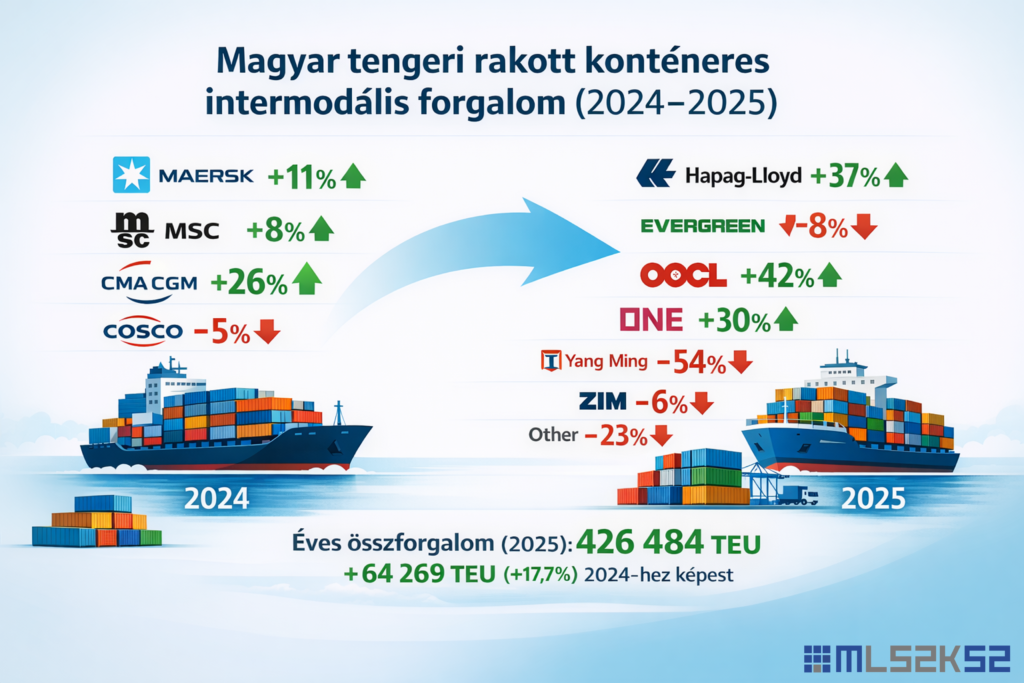
The increase in traffic was driven by deliveries related to factory construction, the gradual strengthening of consumer consumption, and the fact that sea transport remained a favorable alternative to other routes. However, the growth was not equally balanced, with exports remaining weaker, so the weight of imports continued to increase throughout the year. In 2025, every quarter was stronger than the same period in 2024, but the momentum decreased in the second half of the year. In 2025, the total annual loaded sea traffic was 426,484 TEU.
Import dominance continued to grow
Hungarian loaded sea container traffic remained fundamentally import-driven in 2025, and this continued to strengthen during the year. The average annual ratio of imports and exports was 70/30. The majority of the growth thus came from the incoming volume of goods, while exports were unable to expand at a similar pace. The traffic routes were not significantly rearranged, and the southern directions remained dominant, especially in imports. The northern directions were able to offer a stronger alternative when they were available with more favorable rates and more frequent flights. Overseas traffic showed a more balanced picture overall and is expected to grow more steadily in the longer term.
The fourth quarter’s traffic (73,486 TEU imports and 34,356 TEU exports) and the market environment were characterized by strong price competition and subdued export demand. Several players were therefore more cautious in taking on new orders and avoiding deals that did not bring adequate returns. In addition to the growth, congestion at several major ports, as well as rail delays and cancellations, caused problems throughout 2025. In addition, roadworks and track closures often slowed down transport. In the south, these problems led to a significant portion of freight being diverted to road in several cases. However, it is a positive development that the gradual commissioning of a new terminal has begun in Rijeka, but its longer-term impact largely depends on the pace at which the related railway infrastructure develops.
Growth is there, predictability is the goal
According to the analysis of the MLSZKSZ, in 2025, Hungarian loaded sea container traffic strengthened in volume, but at the same time the market remains very sensitive to operational disruptions and a permanent shift in the import-export ratio. The most important task for the next period is to strengthen a more predictable transport environment, especially by stabilizing railway performance and developing infrastructure.
“The growth in 2025 shows that Hungary’s role in international freight traffic is growing, but there is still a lot of uncertainty in everyday operations. The goal is to be able to manage the growing volume of goods in an increasingly predictable and efficient manner,”
– said Ajtony Bíró Koppány, Secretary General of the MLSZKSZ.
Related news

The Hungarian Procurement Community (HPC) and the Hungarian Logistics Association (MLE) have signed a cooperation agreement
🎧 Hallgasd a cikket: Lejátszás Szünet Folytatás Leállítás Nyelv: Auto…
Read more >
Rossmann Begins Testing Humanoid Robot in Logistics Operations
🎧 Hallgasd a cikket: Lejátszás Szünet Folytatás Leállítás Nyelv: Auto…
Read more >
New tachograph regulations – groupage could be a solution
🎧 Hallgasd a cikket: Lejátszás Szünet Folytatás Leállítás Nyelv: Auto…
Read more >Related news

EY: The EU customs system is undergoing fundamental changes: the reform will affect many companies
🎧 Hallgasd a cikket: Lejátszás Szünet Folytatás Leállítás Nyelv: Auto…
Read more >
A single courier can save up to 9 liters of fuel per day – this is how online ordering changes fuel consumption
🎧 Hallgasd a cikket: Lejátszás Szünet Folytatás Leállítás Nyelv: Auto…
Read more >
Shoppers loved chocolate bars
🎧 Hallgasd a cikket: Lejátszás Szünet Folytatás Leállítás Nyelv: Auto…
Read more >
