
How Lidl uses Poland’s new deposit system as a loyalty tool
Lidl’s implementation of Poland’s new deposit-return scheme goes beyond legal compliance. The discounter accepts plastic bottles and cans, including those not yet officially marked. In doing so, it turns a regulatory obligation into a tool for building loyalty and long-term shopper habit.
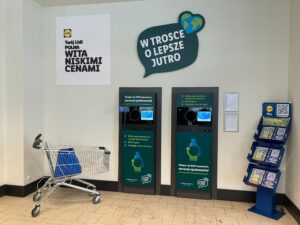
Poland’s new deposit system may look like compliance, but in Lidl’s case it is already a battle for future footfall.
Since 1 January 2025, Poland has operated a nationwide deposit-return system for selected beverage packaging: single-use PET bottles up to 3 litres and metal cans up to 1 litre carry a PLN 0.50 deposit, while reusable glass bottles up to 1.5 litres carry PLN 1.00. Retailers above 200 square metres selling in-scope beverages must accept returns and refund deposits, while smaller stores may join voluntarily. Only packaging with the official deposit marking and barcode qualifies for reimbursement, with producers responsible for registration and compliant labelling.
However, the market transition is gradual. Some producers have not yet fully switched production lines to the new marking, while retailers continue to sell legacy stock without the deposit logo. As a result, consumers currently encounter a mixed environment: some bottles generate a full PLN 0.50 refund, others are not legally eligible for deposit reimbursement.
A visit to Lidl stores in Poland shows a differentiated operational response. Reverse-vending machines accept legally covered packaging and refund the statutory deposit. At the same time, Lidl also accepts plastic bottles and cans that do not yet feature the official deposit marking, issuing a voucher of PLN 0.10 per item.
Lidl Turns Deposit Returns Into a Driver of Repeat Store Visits

Sebastian Rennack
international retail analyst
Aletos Retail
Sebastian Rennack, international retail analyst for Aletos Retail claims that Lidl systematically leverages the deposit mechanism to anchor repeat visits. In the short term, this requires higher in-store costs for additional logistics, sorting and recycling. In the longer term, however, the mechanism has the potential to translate operational expense into recurring traffic.
During the transition phase, the system in Poland remains uneven. Shoppers must distinguish between marked and unmarked packaging, creating friction at the very moment new routines are meant to form.
By accepting plastic bottles and cans beyond the statutory scope, Lidl simplifies the behavioural decision. The PLN 0.10 voucher is economically marginal. The strategic effect lies in removing uncertainty and standardising the return experience.
In Germany, where the deposit system has operated for more than two decades, store visits suggest that bottle return is embedded in everyday traffic patterns.
By positioning itself as the friction-free destination in the early phase, Lidl is not competing on deposit value but on repetition. Because deposits can only be redeemed in-store, the act of returning empties itself generates a visit. Once return is integrated into the weekly trip, the routine extends beyond recycling. The deposit machine becomes a loyalty interface.
Ireland indicates the next stage. There, Lidl integrates deposit refunds into Lidl Plus: shoppers scan a QR code, balances are credited digitally, and paper vouchers disappear. The incentive to use the loyalty app is no longer driven by price discounts but by convenience and access to stored deposit value.
Return behaviour thus becomes measurable data. Within Schwarz Group, where the waste management division PreZero generated €3.9 billion in net revenue in fiscal year 2024/2025 (to February 2025), operational cost at store level is embedded in a broader circular infrastructure. What appears as expense in-store also feeds activity within the group ecosystem.
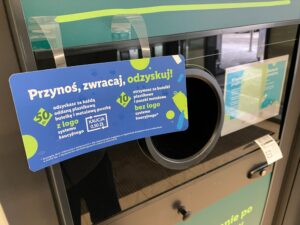
With dedicated wobblers at the reverse-vending machine, Lidl communicates both the statutory PLN 0.50 deposit for officially marked packaging and PLN 0.10 for non-marked bottles and cans, signalling a friction-reducing approach during the transition phase
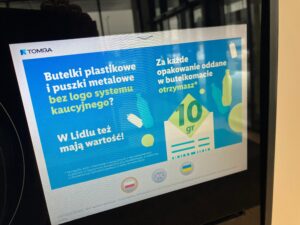
Also the on-screen communication highlights that plastic bottles and cans without the official deposit logo receive PLN 0.10 in Lidl, with the message presented in three languages to ensure clarity across shopper groups
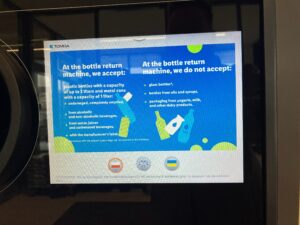
The on-screen guidance serves an educational function by clearly outlining accepted and excluded packaging types in three languages, aiming to help standardize shopper understanding during the system’s early phase
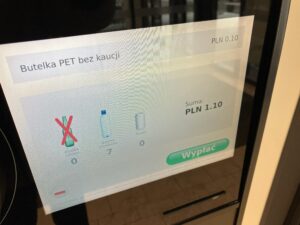
The screen transparently differentiates between deposit-eligible and non-eligible packaging, clearly showing that PET bottles without the official deposit logo are credited at PLN 0.10
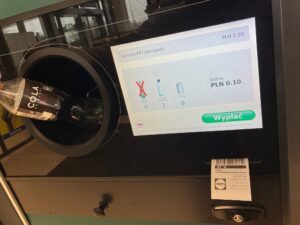
The reverse-vending machine accepts even private-label PET bottles from competitors such as Biedronka, subtly opening the door to capturing return-driven traffic beyond Lidl’s own customer base
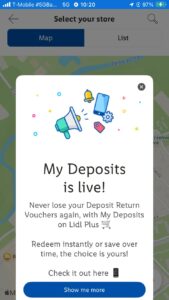
In Ireland, Lidl is piloting the full digital integration of deposit refunds into Lidl Plus, promoting the “My Deposits” feature as a paperless alternative that keeps voucher value within the app ecosystem
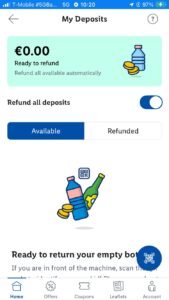
The deposit balance is transparently displayed and can be set to refund automatically at checkout when the app is scanned, embedding the return value directly into the payment process
Related news
When organic becomes mainstream: A glimpse of what awaits food retail in Central & Southeast Europe
🎧 Hallgasd a cikket: Lejátszás Szünet Folytatás Leállítás Nyelv: Auto…
Read more >
Food Retailer Biedronka Eyes Carrefour Assets In Poland
🎧 Hallgasd a cikket: Lejátszás Szünet Folytatás Leállítás Nyelv: Auto…
Read more >Lidl Expands UEFA Collaboration With Multi-Year Partnership
🎧 Hallgasd a cikket: Lejátszás Szünet Folytatás Leállítás Nyelv: Auto…
Read more >Related news
How will we pay for coffee in 2030, and will Europe finally get its own financial infrastructure?
🎧 Hallgasd a cikket: Lejátszás Szünet Folytatás Leállítás Nyelv: Auto…
Read more >
The government supported food industry developments with more than one thousand billion forints
🎧 Hallgasd a cikket: Lejátszás Szünet Folytatás Leállítás Nyelv: Auto…
Read more >
While the world changes, the shared experience is eternal: Unicum’s new commercial debuts with a journey across universes
🎧 Hallgasd a cikket: Lejátszás Szünet Folytatás Leállítás Nyelv: Auto…
Read more >
