
How does the forint exchange rate affect consumer prices?

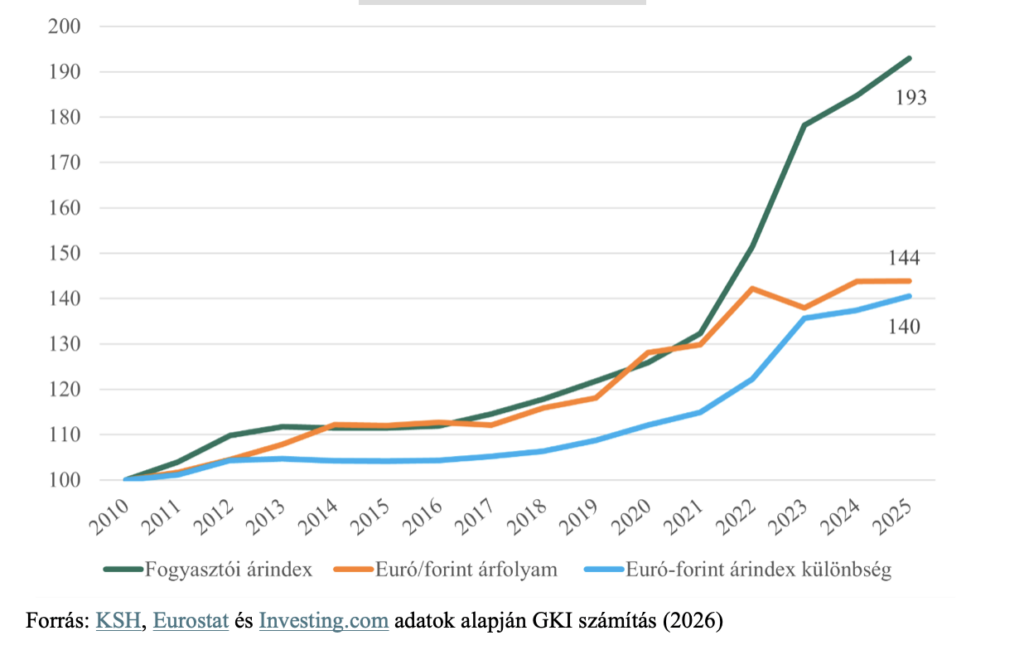
In Hungary, the consumer price index has nearly doubled since 2010, while the increase in the eurozone was only 38 percent. This in itself means that with an unchanged exchange rate, the international competitiveness of domestic companies would have deteriorated significantly, as their operating costs, measured in euros, would have increased much faster than those of their foreign competitors. However, this effect was partially offset by the gradual depreciation of the forint against the euro: the price competition position of exporting companies was thus maintained, but the prices of imported products and services increased.
The time series show that in Hungary the annual average consumer price index has consistently exceeded the central bank’s 3 percent target since 2019, and then reached extreme values in 2022 and 2023 (14.5% and 17.6%, respectively). During the same period, the gap between the domestic and eurozone price indices widened significantly, meaning that inflation in Hungary was much faster than in the eurozone countries. Meanwhile, the euro strengthened by about 45 percent against the forint: the annual average exchange rate of 275 around 2010 rose to nearly 400 in fifteen years. This permanent depreciation significantly contributed to the increase in the domestic price level.
Consumer price index, euro-forint exchange rate and the difference between the euro-forint price index
2010–2025 (2010 = 100%)
Based on the DSGE model developed for the domestic economy, the GKI examined how the change in the forint exchange rate ripples through the domestic inflation after 2010. Based on model estimates, the exchange rate effect was relatively weak in 2010. A 1 percent depreciation of the forint increased the consumer price index by approximately 0.2 percentage points with a lag of two quarters. This effect steadily weakened until 2013, reaching 0.13 percentage points, and then began to rise suddenly. The inflationary effect of exchange rate movements intensified, and the pass-through increased to around 0.5 in 2018, while the exchange rate itself also showed larger fluctuations. As a result, the weakening forint contributed significantly to the development of a high inflation environment until 2022 (the degree of pass-through also reached its peak here, 0.65 percentage points). The reason for the increasing exchange rate effect is that the weight of imported products in the consumer basket increased (partly due to price increases).
According to our estimates, the strengthening of the forint in 2025 reduced the consumer price index, but this effect is not immediate: it appears after two to three quarters and runs out within about a year. One reason for this is the turnover rate of existing stocks (as the stock of goods previously purchased at a weaker exchange rate runs out, cheaper imported products gradually appear).
The effect of a 1% forint depreciation on the increase in the consumer price index (%)*
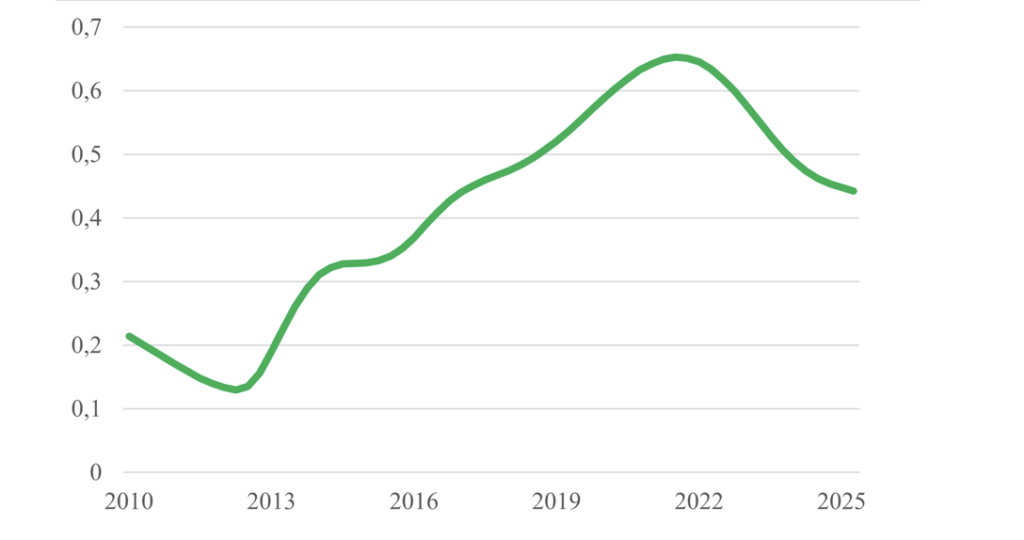
Source: GKI model estimate (2026), *In the case of forint appreciation, it shows the effect on the decline of the price index, so the strengthening forint reduces inflation by this amount.
The model allows for the decomposition of inflation into exchange rate effects and other, mostly domestic factors. It is important to emphasize that the annual results do not only show the direct effect of the exchange rate change in the given year, but also reflect the longer-term, lagged effects of the exchange rate. Exchange rate changes are not immediately and fully incorporated into prices, but have their effect over several quarters.
According to the data, the exchange rate effect was particularly high in 2020 and 2022. In 2020, the depreciation of the forint prevented the development of deflation, while in 2022, the exchange rate weakening significantly contributed to the consumer price index jumping to nearly 15 percent. Based on our estimates, without the weakening of the forint this year (all other factors held constant), inflation would have been around 8 percent.
Breakdown of the consumer price index by exchange rate effect and other factors, 2011–2025 (%)
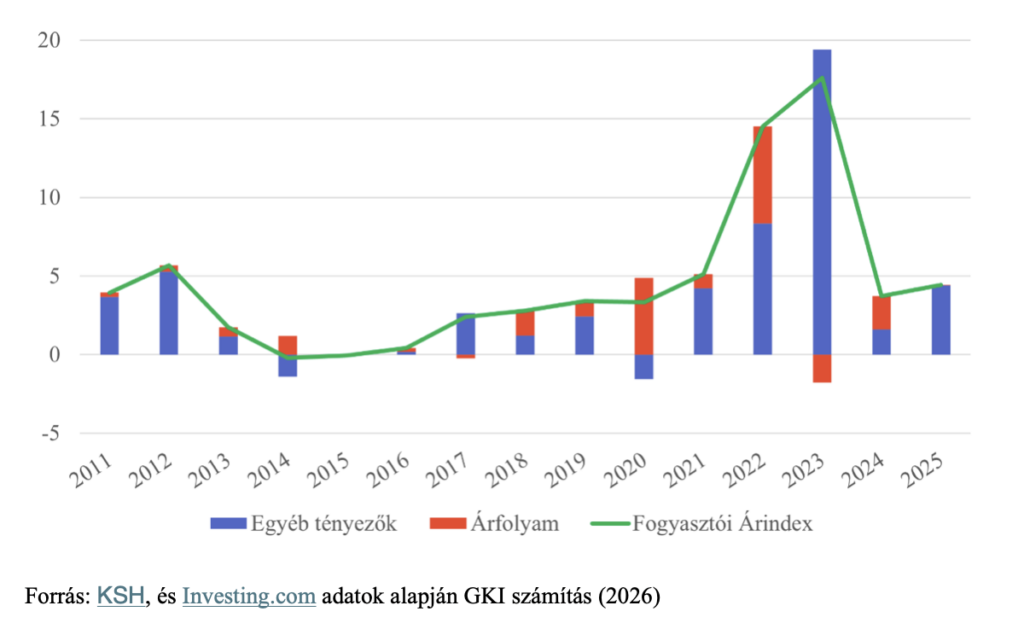
In 2023, on the other hand, the strengthening of the forint has already mitigated the high domestic inflation, by about 2 percentage pointstal, reducing the rate of price increase, which was still well above the previous year. This can be partly attributed to the fact that the lingering, inflation-increasing effect of the significant devaluation in 2022 was offset by the disinflationary effect of the appreciation in 2023, so the exchange rate had an overall inflation-reducing effect.
In 2024, 1.6 percentage points of the 3.7% increase in the consumer price index was caused by the weakening of the forint. All this clearly shows that in an open economy like Hungary, the exchange rate has a significant effect on the price level.
The Magyar Nemzeti Bank, a key player in the fight against inflation, tried to reduce price pressure by, among other things, keeping the base rate high. Higher interest rates, on the one hand, restrain domestic credit demand (and thus consumption), and on the other hand, make forint assets more attractive to foreign investors. This increases the demand for forint (“hot money” inflow), which leads to an appreciation of the exchange rate and thereby reduces imported inflation. The significant appreciation of the forint took place in the 3rd and 4th quarters, which reduces the 2026 price level by 2.3 percentage points in the first half of the year. The effect of this is already reflected in the (rather favorable) inflation figure of 2.1% in January 2026.

Related news
Products in the EU will receive a digital passport
🎧 Hallgasd a cikket: Lejátszás Szünet Folytatás Leállítás Nyelv: Auto…
Read more >
Domestic inflation was still high in 2025 compared to the EU
🎧 Hallgasd a cikket: Lejátszás Szünet Folytatás Leállítás Nyelv: Auto…
Read more >
GKI economic sentiment index begins 2026 with a small decline
🎧 Hallgasd a cikket: Lejátszás Szünet Folytatás Leállítás Nyelv: Auto…
Read more >Related news

How will we pay for coffee in 2030, and will Europe finally get its own financial infrastructure?
🎧 Hallgasd a cikket: Lejátszás Szünet Folytatás Leállítás Nyelv: Auto…
Read more >
The government supported food industry developments with more than one thousand billion forints
🎧 Hallgasd a cikket: Lejátszás Szünet Folytatás Leállítás Nyelv: Auto…
Read more >
While the world changes, the shared experience is eternal: Unicum’s new commercial debuts with a journey across universes
🎧 Hallgasd a cikket: Lejátszás Szünet Folytatás Leállítás Nyelv: Auto…
Read more >
