
How will AI continue to shape our lives? Seven areas to watch in 2026

AI will enter a new era next year: from a practical tool to a real digital assistant. According to a recent study by Microsoft, Hungary is keeping up with the changes and has the infrastructure conditions to catch up with the leading countries in Western and Northern Europe in AI use. Below, we present seven trends for the coming year that clearly demonstrate the rise of AI in all areas of life.
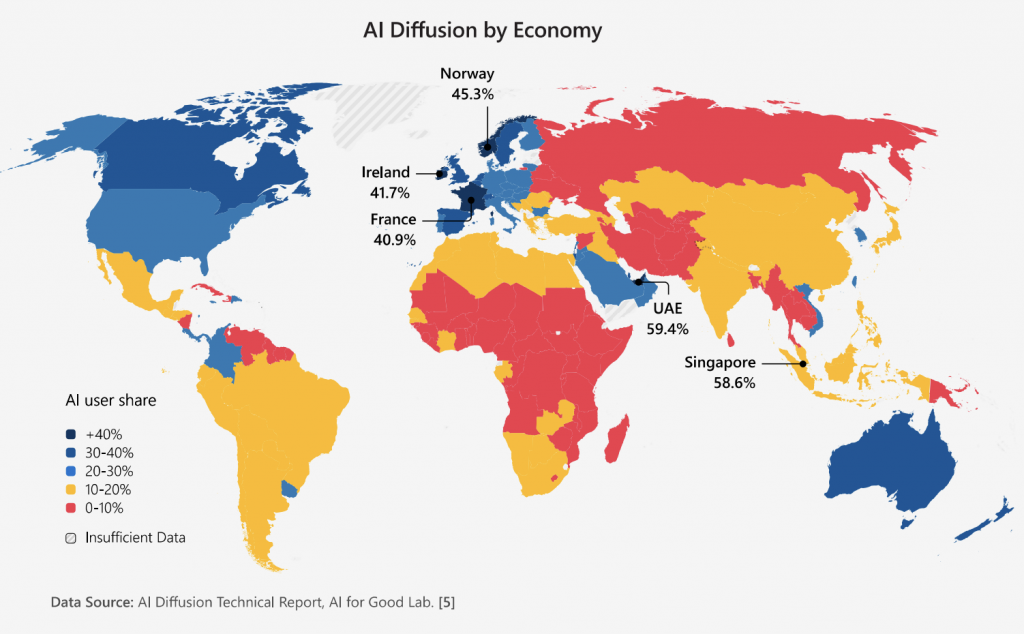
Generative artificial intelligence is spreading at a speed that surpasses all previous technological innovations: it is conquering the world faster than electricity, the Internet, personal computers or even smartphones. In developed countries, more than half of adults now use AI-based solutions on a daily basis. This means that just a few years after the technology’s emergence, more than 1.2 billion people worldwide are living with artificial intelligence, according to the recently published AI Diffusion Report. The use of AI is most widespread in countries with widespread internet access and high levels of digital literacy.
According to the report, Hungary is in the upper middle of the AI penetration spectrum with a rate of around 30%: this is in line with the regional average, but it lags behind the 40–50% level in Western and Northern Europe. Hungary has favorable infrastructural conditions, so the key to moving forward lies primarily in strengthening digital skills.
According to Microsoft’s forecast, in 2026, the developments of previous years will bring about an era change: AI will move from being a tool to a digital assistant. This development will completely transform the way we work, create, and solve problems. We will no longer use AI to answer certain questions, but also to collaborate with us and, by supplementing our knowledge, enable us to do even more.
We will feel the impact of this change in almost every aspect of our lives. In the world of scientific research, AI will become a true laboratory assistant. In the field of quantum computing, previously unimaginable scientific breakthroughs are expected thanks to new hybrid approaches.
AI agents will act like digital colleagues and perform tasks assigned by humans. This will allow organizations to strengthen their security and keep up with new threats.
Gabriella Bábel, Managing Director of Microsoft Hungary, sees a huge boost in the use of artificial intelligence in Hungary in 2025, primarily in the large enterprise sector. Overall, they measured an increase of nearly 28% in AI penetration, which is a development rate exceeding the EU average and is considered a leader in our region. He added: “AI is no longer just a privilege of large companies. The fact that this technology is becoming available to a wider range of people indicates that innovation itself is being democratized, so startups and public institutions are also strengthening their activities in this direction. AI eliminates differences, because in the future, innovation will not require its own research and development department, all that will be needed is a cloud connection and the readiness to integrate AI into the organization’s workflows.”
The following seven trends will be worth paying attention to in 2026, which shed light on what humans will be able to do in the future with the help of AI.
With AI, we can achieve even more things together
According to Aparna Chennapragada, Microsoft’s director of product development for AI experiences, the era of technology and humans’ alliance will arrive in 2026. In recent years, AI has provided answers to questions and solutions to problems, but now it will be about true collaboration, Chennapragada says.
“The future is not about replacing people,” he says, “but about empowering them to do more.”
AI agents will become digital collaborators, empowering individuals and small teams to perform tasks that we wouldn’t expect them to do today.
Related news

Although the business benefits of using AI are clearly visible, half of companies are still lagging behind
🎧 Hallgasd a cikket: Lejátszás Szünet Folytatás Leállítás Nyelv: Auto…
Read more >
Digital trends and advertising market impacts: AI and podcast in focus
🎧 Hallgasd a cikket: Lejátszás Szünet Folytatás Leállítás Nyelv: Auto…
Read more >
Three trends that will reshape the labor market due to AI
🎧 Hallgasd a cikket: Lejátszás Szünet Folytatás Leállítás Nyelv: Auto…
Read more >Related news

KPMG: Easter boom: the season is exploding for families, retail and the chocolate industry
🎧 Hallgasd a cikket: Lejátszás Szünet Folytatás Leállítás Nyelv: Auto…
Read more >
Deteriorating foreign trade balance: causes and prospects
🎧 Hallgasd a cikket: Lejátszás Szünet Folytatás Leállítás Nyelv: Auto…
Read more >
Ultrarunner Szilvia Lubics helps with Ultrabalaton
🎧 Hallgasd a cikket: Lejátszás Szünet Folytatás Leállítás Nyelv: Auto…
Read more >
