
From the shopfloor: What the Mere format reveals about retail concentration

Shopfloor observations in Lithuania highlight a format built around sell-through rather than category optimisation. An unusually diverse supplier mix points to a new route to market for small and medium producers.
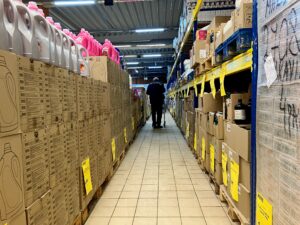
Permanent listings in mainstream grocery retail are becoming increasingly difficult for small and medium-sized suppliers as national food retail consolidates, raising the scale threshold required for enduring presence on shelves. Alternative routes to market that lower entry barriers and do not demand national scale from the outset therefore grow in relevance.
A visit to Mere hard discount stores in Lithuania reveals a format that departs visibly from classic category-management-driven grocery retail logic. The shopfloor is dominated by pallet placements, tall racks, and minimal shelving; products frequently remain in their transport packaging and price communication is limited to basic A4 sheets.
The most striking characteristic of Mere is its assortment diversity, notably the presence of many lesser-known brands. In addition to smaller domestic suppliers, there is a broad mix of producers from Poland, Ukraine, Turkey and, as a novelty, China. Established branded goods appear selectively as spot buys rather than as permanent listings with full SKU families.

Sebastian Rennack
international retail analyst
Aletos Retail
Sebastian Rennack, international retail analyst of Aletos Retail believes that for smaller suppliers, Mere’s model shifts the core challenge of market access. Rather than securing a permanent national listing and managing slow rotation or excess stock, suppliers must demonstrate sell-through. This is reflected in commercial terms: Suppliers deliver goods to the store and are typically paid weekly on volumes actually sold, transferring inventory and rotation risk from the retailer onto themselves. Slow-moving products do not tie up the retailer’s capital, and suppliers absorb the commercial risk of underperformance in exchange for physical shelf access and shopper exposure.
In this context, the format is largely populated by smaller and mid-sized suppliers rather than national category leaders. One example visible on the Mere shopfloor in the canned meat category is Wielkopolskie Zakłady Mięsne Agrico. According to analytics company BizRaport, Agrico Polska reported revenues of approximately PLN 63.6 million (around €15 million) in 2024.
As a reference point, the distance to Poland’s category leaders is striking. Krakus is a brand of Animex Foods, which reported revenues of PLN 12.3 billion (approximately €2.9 billion) in 2024. Revenue data for Sokołów Group is not publicly available; however, the company reported investments of PLN 168 million (around €40 million) for the 2024 business year alone. This single-year investment volume is almost three times higher than Agrico’s entire annual revenue, underlining the scale gap that increasingly defines access to permanent listings in mainstream retail.
A similar pattern is evident in canned fruit and vegetable lines. Another Polish supplier present in Mere’s assortment is Frutico; a related entity registered at the same address reported total company net revenues of PLN 14.6 million (€3.4 million) in 2024, well below the scale of category leaders. In mainstream retail, this segment is dominated by industrial processors such as Bonduelle and Dawtona. Bonduelle Polska’s net revenues reached approximately PLN 453 million (€105 million) in the year ending June 2025, while Dawtona Sp. z o.o.’s latest reported figures are around PLN 847 million (€196 million), underscoring the structural scale advantages held by these large processors.
Seen together, these contrasts illustrate how retail concentration increasingly favours large suppliers across categories, while smaller producers are structurally channelled toward alternative routes to market. Mere’s format exposes these suppliers precisely because it bypasses the listing logic that governs mainstream retail.
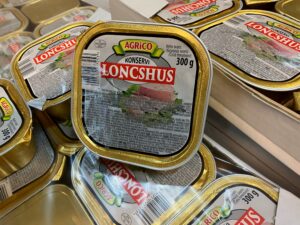
Canned meat from Polish producer Agrico carries multilingual descriptions for the Baltic states and the Czech Republic, indicating a regional export strategy
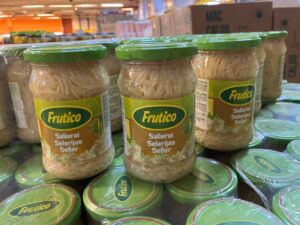
Vegetable preserves from Polish supplier Frutico are part of Mere’s assortment, while category leaders such as Bonduelle remain absent despite their dominant scale in Frutico’s home market
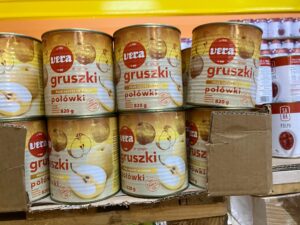
Canned pears sourced from Asia under the Vera label are marketed by Limpol Sp. z o.o., a mid-sized Polish importer largely absent from permanent listings in mainstream grocery retail
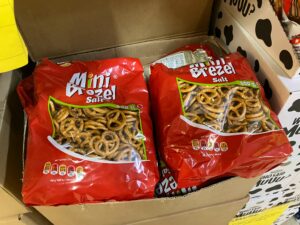
Salted pretzels from Romanian producer Dunicec illustrate Mere’s openness to smaller regional suppliers that rarely appear in national retail assortments
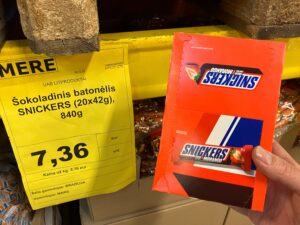
The global A-brand Mars is present via Snickers, but only as a strawberry flavour variant produced in Brazil, underscoring Mere’s selective use of non-core international brand production
Related news
Aldi tests “Compact 2.0” urban store concept at Warsaw transport hub
🎧 Hallgasd a cikket: Lejátszás Szünet Folytatás Leállítás Nyelv: Auto…
Read more >
When organic becomes mainstream: A glimpse of what awaits food retail in Central & Southeast Europe
🎧 Hallgasd a cikket: Lejátszás Szünet Folytatás Leállítás Nyelv: Auto…
Read more >
How Lidl is redefining its Polish store model
🎧 Hallgasd a cikket: Lejátszás Szünet Folytatás Leállítás Nyelv: Auto…
Read more >Related news

Using the system has a boost effect
🎧 Hallgasd a cikket: Lejátszás Szünet Folytatás Leállítás Nyelv: Auto…
Read more >
Hungarian consumers are saving on ham, label reading is becoming more important
🎧 Hallgasd a cikket: Lejátszás Szünet Folytatás Leállítás Nyelv: Auto…
Read more >
International food prices have risen due to the impact of the Middle East conflict on energy prices
🎧 Hallgasd a cikket: Lejátszás Szünet Folytatás Leállítás Nyelv: Auto…
Read more >
