
The message of Hungarian business leaders for 2026: Consolidation instead of revolution

Hungarian business leaders are not looking for new directions in 2026, but are focusing on how to operate stably and grow in a permanently uncertain economic environment. This is revealed in the study Hungary CEO Outlook 2026, which is the Hungarian chapter of the international research of the International Executive Search Federation (IESF), with the participation of Prime by JobGroup. The whitepaper is based on a structured interview with more than a hundred top executives in Hungary. It is based on interviews and discussions, and places the trends revealed by the global research in 23 countries, involving 909 CEOs, into the Hungarian context. According to the central finding of the research, uncertainty is no longer a temporary state, but a structural condition that permanently shapes managerial decision-making.
Six fundamental priorities account for the majority of the responses
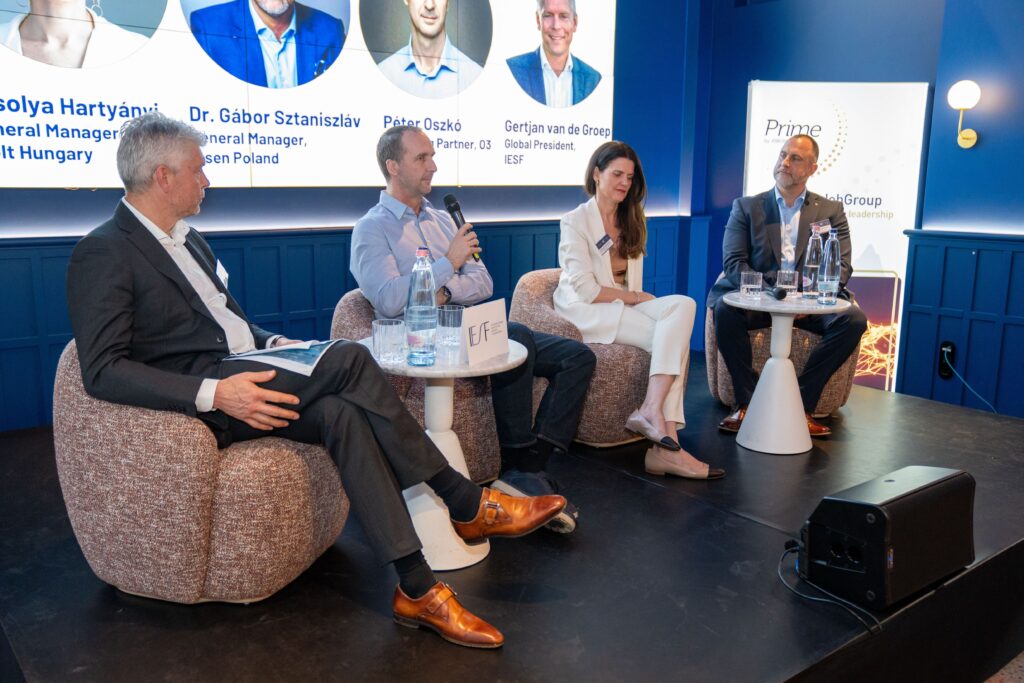 One of the most important lessons is that the ability to execute has become the key issue. Most leaders know exactly what they should do – but they also see that the organization is often not prepared enough to implement it. Therefore, in 2026, the focus will not be on rewriting strategies, but on strengthening people, structures and operations.
There is no implementation without key people
The most important topic for Hungarian CEOs is still human resources. However, the emphasis has changed: it is no longer just about the labor shortage, but about how to retain key people, build up the leadership pipeline, and strengthen the middle management layer. More and more people are saying: if there is no stable management and expert team, there is no growth, digitalization or efficient operation.
Growth – only if the organization can handle it
Growth is still a goal, but in a much more cautious form. Most CEOs will only embark on new markets or international expansion if the financial situation, organizational capacity and risks are manageable. So growth did not disappear, but became conditional.
Financial discipline – a condition for implementation
Closely related to this is the issue of costs and profits. According to the study, in 2026, cost control will no longer be a forced crisis response, but a fundamental management approach. CEOs see financial discipline as a tool that gives them room to maneuver: it creates opportunities for investments,

Related news
Related news
TUTTI turns 40 – a defining Hungarian family company with development spanning generation
🎧 Hallgasd a cikket: Lejátszás Szünet Folytatás Leállítás Nyelv: Auto…
Read more >
ALDI will be on Sziget again this year
🎧 Hallgasd a cikket: Lejátszás Szünet Folytatás Leállítás Nyelv: Auto…
Read more >
The Easter table can be complete without any problems
🎧 Hallgasd a cikket: Lejátszás Szünet Folytatás Leállítás Nyelv: Auto…
Read more >
