
Society identifies with the krőzus tax for a reason, but reality demands a more sensible implementation

Will residents of the inner districts of Buda really be targeted by the new wealth tax? According to Blochamps’ analysis, the one-billion-forty-dollar “rich threshold” no longer represents exceptional wealth, but rather reflects the inflation and property price explosion of the past decade. Moreover, the math doesn’t add up: According to Blochamps, a 1% wealth tax could generate a maximum of 170 billion forints, even with an optimistic estimate. Meanwhile, international examples indicate that collection efforts based purely on wealth tax are, due to their inefficiency, incapable of achieving their political goals, namely a more proportionate burden on the public sector through a “croesus tax” for the very wealthy.

Blochamps Capital – which has been analyzing domestic wealth concentration processes for more than two decades – indicated when the idea of a wealth tax was first raised in October 2025: a policy operating with nominal numbers could easily go astray.
“The one billion forint threshold is, at first glance, a truly shocking amount of wealth for 90% of the population. In the eyes of society, a “billionaire” is still considered a crook.” However, the economic reality is much more prosaic than this,” points out István Karagich, CEO of the market-leading private banking analysis company.
Based on the inflation rate between 2014 and 2025, the purchasing power of today’s 1 billion forints corresponds to roughly 540–560 million forints at the 2014 price level. In other words, a billion-dollar fortune is not exceptional wealth today, but rather an indicator of the inflation rate of the past decade.
Added to this is the explosion in real estate prices. In Budapest, in the inner Buda districts, the price per square meter was around 300–400 thousand forints a decade ago, and these apartments are now often advertised at a price of 2–2.2 million forints per square meter. “Can the political goal of making property owners in the inner Buda districts and entrepreneurs in the SME sector the target of the new wealth tax really be useful? In their case, we should certainly not call what is actually a krőzus tax inflationary side effect” – said István Karagich, CEO of Blochamps Capital.
The question is not whether there are billionaires – but what does a billion mean
However, the problem is deeper. In the household wealth statistics of the Hungarian National Bank (MNB), the value of entrepreneurial business shares accounts for more than a third of the financial wealth of households. However, their valuation is model-based, not transactional. In market practice, the selling price of a company depends largely on demand, the financing environment and the number of competitors – in the event of a mass supply, the value can even decrease drastically. A nominally “billion” company value is therefore not a liquid, non-realizable asset. The situation is similar with real estate. In some districts, the combined value of real estate owned by household members, perhaps supplemented by a family-owned summer house on Lake Balaton, could easily amount to a billion-dollar fortune, while family members earn their income as employees, without any significant capital income.
In other words, based on this, a significant part of the tax base is theoretical, in the tens of thousands. This would have been a risky tax approach even ten years ago, but it is clearly distorting when examined in the inflation and real estate market environment of recent years.
Revenue: hundreds of billions or much less?
It is often said that a 1% wealth tax could bring in hundreds of billions of forints in revenue. However, looking behind the numbers, a more cautious estimate is warranted. If we were to project 1% on all household financial assets (wealth), it would be in the order of 1,145 billion forints, if on all social wealth, it would be 2,800 billion forints – but this applies to the whole of society, not just those with a net worth of over one billion – emphasizes the Blochamps expert.
According to Blochamps’ 2025 half-year wealth stratum estimate, the top 1% – around 40,400 households – have a total net wealth of around 50,000 billion forints. Based on current calculations, the 1 billion forint threshold issue could affect around 25,000–30,000 households, whose combined net wealth above the threshold is around 16,500 billion forints. But it should also be noted that the network of companies and influence of this entrepreneurial elite operating through company structures and capital funds is only partially included in the household wealth statistics that record corporate ownership shares, meaning that the real size certainly exceeds the MNB data.
Nevertheless, if we apply the 1% tax to the part above 1 billion forints – as a theoretical maximum – then the annual revenue could be in the order of 160–180 billion forints. However, this is an estimate calculated with an upper band, taken at nominal value, not corrected by optimization, and not taking into account liquidity effects – in other words, it is not guaranteed, but rather an optimistic ceiling.
Related news

Who pays in the end? – the reality of wealth tax in Hungary according to the expert
🎧 Hallgasd a cikket: Lejátszás Szünet Folytatás Leállítás Nyelv: Auto…
Read more >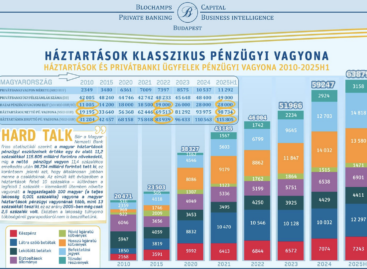
Despite the increase in average wages, saving has become the privilege of the richest
🎧 Hallgasd a cikket: Lejátszás Szünet Folytatás Leállítás Nyelv: Auto…
Read more >
An 11 percent increase in wealth sounds good, but according to Blochamps, it’s only the happiness of a narrow elite
🎧 Hallgasd a cikket: Lejátszás Szünet Folytatás Leállítás Nyelv: Auto…
Read more >Related news
István Nagy: the government’s goal is to further strengthen the competitiveness of Hungarian agriculture and place the future of domestic agriculture on a solid foundation
🎧 Hallgasd a cikket: Lejátszás Szünet Folytatás Leállítás Nyelv: Auto…
Read more >
Good Friday is in a week: the Easter shopping season has begun
🎧 Hallgasd a cikket: Lejátszás Szünet Folytatás Leállítás Nyelv: Auto…
Read more >
ENAG Innovation BootCamp for the Development of Women Agribusiness Entrepreneurs in Hungary Successfully Ended
🎧 Hallgasd a cikket: Lejátszás Szünet Folytatás Leállítás Nyelv: Auto…
Read more >
