
2026 will be the year of construction in agriculture

This year will be the year of construction in agriculture: developments and investments will be launched, which will mean jobs, a secure livelihood and a future in the Hungarian countryside – the State Secretary for Agriculture of the Ministry of Agriculture (AM) responsible for agriculture announced on Tuesday in Kecskemét.

(Photo: AM/Tibor Vermes)
Imre Hubai spoke at the Portfolio Agrárium 2026 conference that “by using the available historical resources, Hungarian agriculture and food industry will be on the podium in Europe by 2030”. He added that the developments of the past decade and a half have created a stable foundation for further growth. The productivity of Hungarian agriculture may increase by one and a half times and the added value may double in the coming years. Exports, which were around 10 billion euros at the beginning of the decade, may even double by 2030 – he explained. He recalled that in the previous year, agricultural and rural development payments exceeded all previous expectations: 1,509 billion forints reached farmers, thanks to the fact that the support system worked more efficiently and faster than ever before. Imre Hubai said: the Rural Development Program ended at the end of 2025 without any loss of funds, which moved almost 3 thousand billion forints, and about 400 thousand projects were implemented throughout the country. In the new cycle, more than 3,150 billion forints of funds are available in the second pillar supporting agricultural and rural development, more than half of which will be spent directly on economic development. “We are making good progress, as by the end of February we had published 65 calls for proposals worth more than 1,200 billion forints, and so far 104 thousand applications have received positive evaluations,” he listed.
The politician said that the largest-scale developments are being implemented in processing plants
So far, 314 large-scale investments have received support worth a total of 458 billion forints. Within the framework of smaller and medium-sized developments, the development of 627 plants can be implemented with almost 40 billion forints. The renewal of livestock farms is also of particular importance, with more than 1,000 farms nationwide receiving support, a total of 69 billion forints, to modernize their farms. Among the measures introduced to increase efficiency, he highlighted: the 25 percent advance payment required for investments has been made available without prior proof of self-funding. And those investors who only needed the final official permits could submit their final payment application even before obtaining the permits. They were given a grace period until the end of 2026 to replace the permits, he added.
A budget of 15 billion forints is available to support small agricultural enterprises
An applicant can apply for a maximum of 10 million forints, and applications can be submitted in June and July. 2 billion forints will be available for support for closed garden developments, and rural local governments can apply for a maximum of 50 million forints in July. Young farmers are still in the foreground, he said, adding that “our goal is to renew Hungarian agriculture, because the future of the sector depends on educated young people between the ages of 18 and 40.” A 79 billion forint support program has been launched for young farmers, for which 1,428 applications have been received so far with a request for support of about 80 billion forints. The first decisions are expected in March. Economic transition is a worthy end to a career for the elderly and a sure start for the young. The aim is for family farms and agricultural enterprises not to cease to exist with retirement, but to continue to operate smoothly – the state secretary said. In the case of transferors, a decision has already been made on more than 10.6 billion forints in support, while transferees have so far requested 5.2 billion forints in support. “All this shows that generational change is not just a plan, but a living process in the Hungarian countryside,” he added. Speaking about the dangers, he said: the European Commission’s latest proposal would reduce the framework for agricultural subsidies at the EU level by more than 20 percent, which in the case of Hungary would mean a nearly 25 percent reduction in resources between 2028 and 2034. “This proposal is unacceptable. Hungary has consistently said no to these plans in the past 7 months, and we will continue to protect the interests of Hungarian farmers with all means in the future,” he underlined.
He also mentioned that at the end of last year an international milk market crisis developed, the effects of which are still being felt
As he said, “Western European products that were forced out of export markets arrived in large quantities in the Central European region”, which caused a decline in prices. Several measures have been taken to alleviate the situation: since autumn, more than 32 billion forints have been provided to dairy farmers, including targeted subsidies, and at the beginning of this year, an additional 2.4 billion forints of national support were paid. The pig sector is also operating in difficult market conditions, he said, adding that the government’s goal is “to stabilize the operation of the domestic pig market and strengthen the market positions of Hungarian products”. To this end, the budget for the animal welfare program for breeding sows was increased to 8.3 billion forints, and a new support program for breeding sow farmers was launched with a budget of 4 billion forints. Speaking about irrigation development, he highlighted that the “Water in the Landscape!” program has significantly increased the level of water retention: as a result of drought management interventions, more than one billion cubic meters of surface water has been retained in the landscape. Last year, the size of the areas actually irrigated increased by about 10 percent compared to previous years. Imre Hubai added that the year 2025 has presented Hungarian agriculture with serious challenges, which is why the government has increased the sources of damage mitigation. He said that instead of 28.4 billion, 46.5 billion forints are available, so all approved applications will be paid, and the Hungarian State Treasury will transfer the subsidies to farmers by the end of March. AM/MTI
Related news
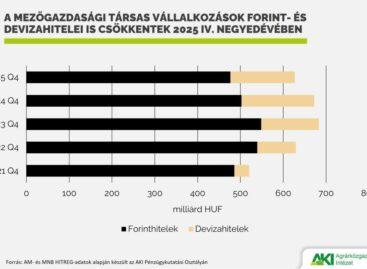
Agricultural loan portfolio decreased in 2025
🎧 Hallgasd a cikket: Lejátszás Szünet Folytatás Leállítás Nyelv: Auto…
Read more >
At the initiative of Hungary, another EU source will help farmers affected by last year’s drought
🎧 Hallgasd a cikket: Lejátszás Szünet Folytatás Leállítás Nyelv: Auto…
Read more >
Strengthening the pig sector continues with support for breeding sow farmers
🎧 Hallgasd a cikket: Lejátszás Szünet Folytatás Leállítás Nyelv: Auto…
Read more >Related news

Oat-based “feta” wins the cheese innovation competition of Lidl Germany and ProVeg
🎧 Hallgasd a cikket: Lejátszás Szünet Folytatás Leállítás Nyelv: Auto…
Read more >
Finger Food Experience
🎧 Hallgasd a cikket: Lejátszás Szünet Folytatás Leállítás Nyelv: Auto…
Read more >
KPMG: Easter boom: the season is exploding for families, retail and the chocolate industry
🎧 Hallgasd a cikket: Lejátszás Szünet Folytatás Leállítás Nyelv: Auto…
Read more >

