
2026 – the year when currency risk will determine the margins of Hungarian SMEs

Hungarian small and medium-sized enterprises (SMEs) are entering the new year with particularly volatile EUR/HUF and USD/HUF exchange rates. In 2025, the forint strengthened by around 7% against the euro, while by more than 17% against the dollar, which clearly showed that uncovered contracts can lose value in HUF even with relatively small exchange rate fluctuations. In practice, differences of 10–20 forints in the EUR/HUF pair can significantly reduce profit margins in the case of large export volumes, so in 2026, active currency risk management is no longer a choice but an obligation. Entrepreneurs are increasingly seeing that the lack of currency strategies poses a real threat to margins, while regional dependencies are also becoming more significant.
 2026 will be a test of financial resilience for Hungarian SMEs. Although the economy maintains moderate growth, companies will enter an environment characterized by increasing exchange rate volatility, cost pressures and international trade uncertainty. In this context, currency risk management decisions will become crucial.
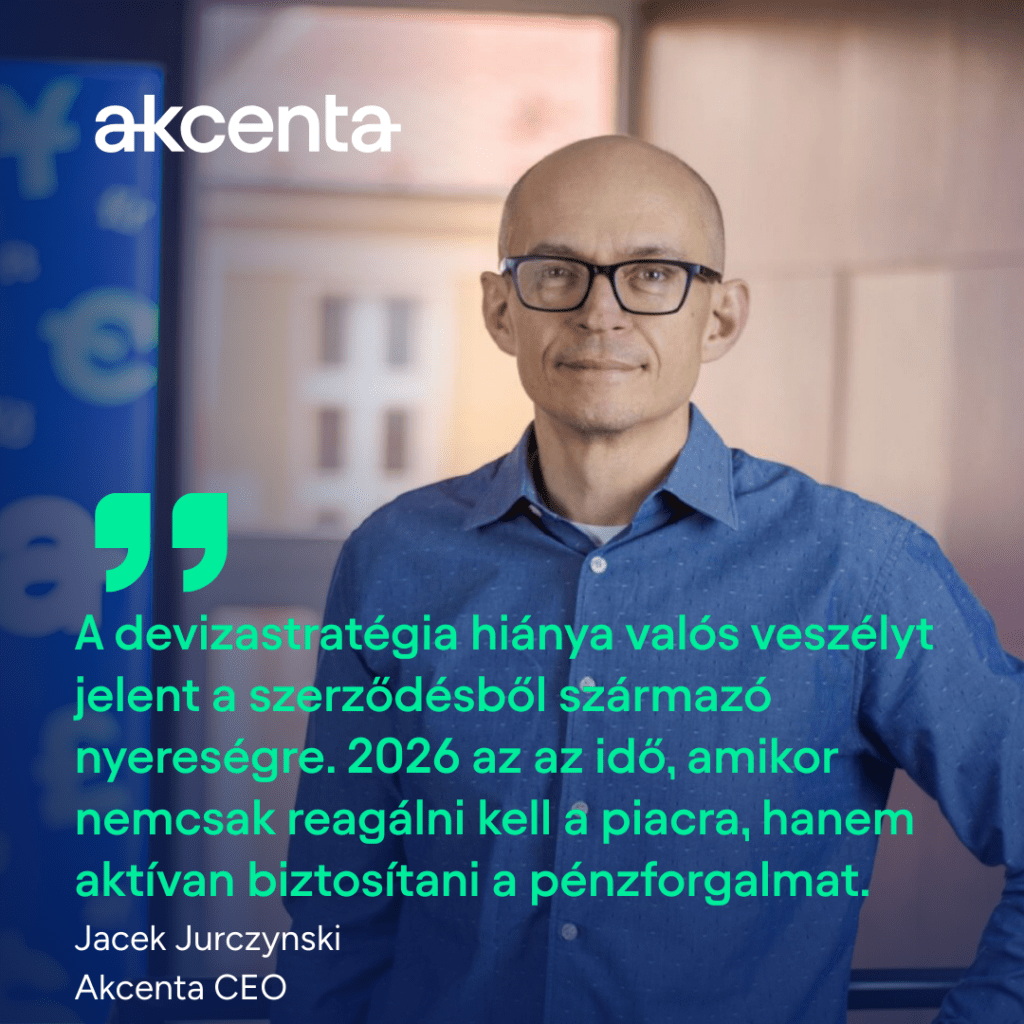
– In 2026, the question for Hungarian companies will not be whether the economy is growing, but whether they can protect their margins in the face of fluctuating exchange rates and costs. With the forint reacting to global and local factors, it no longer makes sense to plan for a single “safe” exchange rate. Companies are increasingly seeing that the exchange rate can even take away the profit from the entire contract. Therefore, in 2026, not only the market reaction will be important, but also the advance securing of cash flows through forward transactions, payment deadlines planning and conscious selection of the payment currency”
– said Jacek Jurczyński, CEO of Akcenta CZ.
Forward, payment scheduling and margin control – the key to the stability of Hungarian companies in 2026
The experience of 2025 clearly showed how quickly exchange rate fluctuations can affect companies’ results. An exporter who planned a contract worth 1 million euros at the beginning of the year at an exchange rate of 380 HUF/EUR, after the forint strengthened by 7%, received approximately 353 million HUF instead of 380 million HUF, i.e. more than 26 million HUF less, while sales and costs have not changed. Such fluctuations show that leaving the exchange rate to ourselves poses a real operational risk. For the USD/HUF pair, these differences could have been even greater, reaching 17%.
The key to avoiding such situations in 2026 is the use of hedging instruments, such as forward transactions, payment deadline planning and conscious choice of payment currency. By combining these with financial analysis, margin control already at the bidding stage and flexible payment schedules, companies can minimize the risk that exchange rate changes will take away the profits of the entire contract.
Export and import in 2026 – what to watch out for?
The Hungarian economy remains closely linked to foreign markets, with key trading partners remaining Germany, Romania, Poland, Italy and Slovakia. In relations with these countries, companies most often calculate in euros , thus they are directly exposed to EUR/HUF exchange rate fluctuations.
– Settlement in other currencies will also play an increasingly important role, primarily in the Polish zloty, Romanian leu and US dollar, which is associated with the diversification of markets and the expansion of import-export directions. Hungarian companies are increasingly operating in several markets at the same time, which means more foreign exchange exposure. With the expansion of foreign operations, it will be increasingly important to consciously manage the company’s entire foreign exchange portfolio, not just the euro exposure– adds Jacek Jurczyński, CEO of Akcenta CZ.
Increasing labor and financing costs further increase the weight of FX decisions
In 2026, Hungarian companies will continue to face higher wage and financing costs than in 2022 before. For this reason, uncovered exchange rates, inappropriate settlement currencies or unfavorable timing will have an even more sensitive impact on margins, as these factors add up to increasing operating costs. That is why more and more companies are combining investment decisions with currency planning and securing payments for, for example, machinery, technology or imported components before the contract is executed.
Although Hungary’s economic outlook for 2026 is moderately positive, the success of the SME sector will increasingly depend on the quality of financial decisions. Companies that are able to use scenario-based planning, actively manage currency risk and protect their margins in 2026 will have a real chance
Related news

AI Start 500: Hungarian SMEs receive free access to AI agents
🎧 Hallgasd a cikket: Lejátszás Szünet Folytatás Leállítás Nyelv: Auto…
Read more >
Széchenyi Card Programme: a lasting driving force for the domestic economy
🎧 Hallgasd a cikket: Lejátszás Szünet Folytatás Leállítás Nyelv: Auto…
Read more >
Strategic momentum for SMEs: 5 practical tips for 2026
🎧 Hallgasd a cikket: Lejátszás Szünet Folytatás Leállítás Nyelv: Auto…
Read more >Related news

Oat-based “feta” wins the cheese innovation competition of Lidl Germany and ProVeg
🎧 Hallgasd a cikket: Lejátszás Szünet Folytatás Leállítás Nyelv: Auto…
Read more >
Finger Food Experience
🎧 Hallgasd a cikket: Lejátszás Szünet Folytatás Leállítás Nyelv: Auto…
Read more >
KPMG: Easter boom: the season is exploding for families, retail and the chocolate industry
🎧 Hallgasd a cikket: Lejátszás Szünet Folytatás Leállítás Nyelv: Auto…
Read more >
